

Queens Brain Injury Attorney
After a Queens accident, our attorneys use advanced imaging and medical-legal expertise to build strong TBI cases. Call us for a free case review.




Based on 300+ reviews
Why Hire Our Queens Brain Injury Lawyer?

Nearly $1 Billion Won
We’ve recovered almost $1 billion for injured clients across documented cases

Largest MVA Recovery
We recovered $69.25M, the largest single motor vehicle accident settlement

Media Recognition
We’ve been featured in national and local outlets including the New York Post, Daily Mail, and CBS New York

No Fee Unless We Win
A brain injury after a Queens car crash, construction fall, or pedestrian knockdown can disrupt everything within minutes. Medical bills accumulate. The insurance adjuster calls early, pushes a fast settlement, and cites a clean ER scan as proof there’s nothing serious to pay for. Meanwhile, your headaches worsen, your memory slips, and your concentration and ability to work continue to fall apart.
Founding partner Arkady Frekhtman established Frekhtman & Associates in Brooklyn in 2000. Today, the firm represents Queens brain injury clients with cases built around medical evidence. Our Queens brain injury attorneys bring neurologists, neuroradiologists, and neuropsychologists to every case to document the injuries that standard hospital scans miss. We take every case on contingency. No fee unless we recover.
Our track record:
- $900M+ recovered for injured clients across documented cases
- 25+ years fighting for New York injury victims
- $69.25M largest single recovery in a motor vehicle accident case
- 300+ five star Google reviews from real clients
- Fluent in English and Russian
- 9.8 Avvo rating and National Top 100 Trial Lawyers
- Featured in NY Post, Daily Mail, and CBS New York
Visit us at 100-09 Metropolitan Ave, Forest Hills, NY 11375. We charge no fee unless we recover. Available 24/7.
Past results do not guarantee future outcomes.
Posted on Google
 mikhail roman
Trustindex verifies that the original source of the review is Google.
I was hurt in a car accident. I contacted Frekhtman & Associates for help. They handled my case professionally and obtained compensation for my serious injuries. Very experience and knowledgeable attorneys. Highly reccomended!!!Posted on Google Rafael MI was pleased with the work that Frekhtman & Associates did. They worked really hard on your case and do everything in their power to get you the right settlement.Posted on Google
 Jeremy BrunnsmanI was in a car accident when some guy changed lanes and sideswiped my car. Having never experienced anything like this or ever needed a personal injury lawyer, I didn't know what to do. I found these guys online, and man was it a good choice. They sent an investigator to the scene who met with me, took photos, and got my police report. Answered all my questions, kept in touch with me every step of the way, and got my bills paid. I highly recommend!Posted on Google
 Shaun GoodloeFell off a scaffold at a construction site in Jackson and suffered a serious spinal cord injury. I did the physcial therapy and got better faster then expected.....so they was gonna pay me close to NOTHING. I hired F&A and they fought and got me what i was owed. Least i can do is write this review.... If ur injured in a construction accident case, here is where u go.Posted on Google
 Marrion JohnsonI can gladly say that i am satisfied with the hard work and efforts of Frekhyman & his associates. After all the medical treatment and the consistency of the firm i recently received a settlement for my personal injury claim. Frekhtman's associates never gave me a reason to look elsewhere for legal representation. In fact, one of the paralegals at the firm by the name of Yahaira Suriel, helped me avoid making a regretful discussion when i tried to take out an unnecessary loan. I would like to take this time to thank God for his blessing and also for uniting me with such an awesome firm.Posted on Google
 Brenda GrahamExcellent work on my son's ceiling collapse case. This firm followed up with us on a consistent basis. They knew the law and explained everything to us. Mr. Frekhtman was very pleasant and treated us like his own family. During the negotiations, they were aggressive and kept fighting for the best possible outcome. All in all, I highly recommend them if you have a serious injury case and need a good trial lawyer.Posted on Google
 Tais TThe bottom line is the results we got !!!Posted on Google
 Anton HopkinsVery satisfied with the service I received from this office. They kept me informed about the progress of my case, were very friendly, and did an excellent job in recovering a settlement. I would recommend these lawyers to someone who needs a good car accident lawyers.Posted on Google
 Naeem khanMy car was rear-ended in Brooklyn. I was seriously injured and was treating for a long time. Arkady and the rest of the lawyers helped me through this hard time. I am already recommending my friends to them. Thank youPosted on Google
 Yankee BougoumaTreated me like family,Very professional and know what they doing, Sent me to the best doctors. I’m very happy that I chose this firm to represent me. I will always send my family and friends to them. Thanks a lot.Verified by TrustindexTrustindex verified badge is the Universal Symbol of Trust. Only the greatest companies can get the verified badge who has a review score above 4.5, based on customer reviews over the past 12 months. Read more

What Is a Traumatic Brain Injury?
A traumatic brain injury occurs when an external force disrupts the brain’s normal function. That force does not have to be catastrophic to cause lasting damage. Mild TBI involves loss of consciousness for under 30 minutes or no loss of consciousness. Moderate-to-severe TBI involves loss of consciousness exceeding 30 minutes, post-traumatic amnesia lasting more than 24 hours, and coma in the most serious cases. Acquired brain injuries, including anoxic and hypoxic injuries, result from oxygen deprivation rather than direct physical force. They carry the same legal weight as traumatic brain injuries in a personal injury claim.
Types of Brain Injuries That Lead to Legal Claims
The type of brain injury you sustained determines which specialists, which imaging, and which legal theories apply to your case.
- Concussion: The most common and frequently underdiagnosed TBI. CT and standard MRI scans frequently come back normal despite real neurological disruption. When symptoms persist beyond three months, the condition is classified as post-concussion syndrome and may support a stronger long-term damage claim.
- Contusion: A bruise at the direct impact point on brain tissue. It may appear on standard imaging or be missed, requiring advanced MRI to document.
- Diffuse Axonal Injury: Tearing of axon fiber tracts throughout the brain. DTI detects these injuries but is rarely ordered in standard ER settings, leaving them vulnerable to insurer denial.
- Coup-Contrecoup Injury: Damage at both the impact site and the rebound site on the opposite side of the skull, common in Queens Boulevard rear-end crashes and pedestrian knockdowns.
- Brain Bleed (Intracranial Hemorrhage): Three subtypes each carry different urgency levels and surgical risk. An epidural hematoma is bleeding between the skull and the brain. A subdural hematoma involves bleeding between the brain and its protective covering. A subarachnoid hemorrhage is bleeding into the space surrounding the brain. All require immediate evaluation.
- Penetrating Injury: Occurs in construction accidents involving falling objects, rebar, and tool strikes. Even without full skull penetration, the force causes focal brain damage.
- Anoxic and Hypoxic Brain Injury: Anoxic brain injury results from complete oxygen deprivation. Hypoxic brain injury results from partial oxygen deprivation. Common causes include cardiac arrest, near-drowning, and carbon monoxide poisoning.
I cannot say enough good things about Frekhtman & Associates.
My child had traumatic brain injury. Originally I wasn't interested in a lawsuit. But it became clear that my son's brain damage was permanent. I got scared for his future. My friend recommended Frekhtman & Associates to represent me. I went from being scared, lost and confused to having a professional, empathetic, kind, brilliant team. Their communication skills and response time for call backs is amazing. I am forever grateful that I found them.
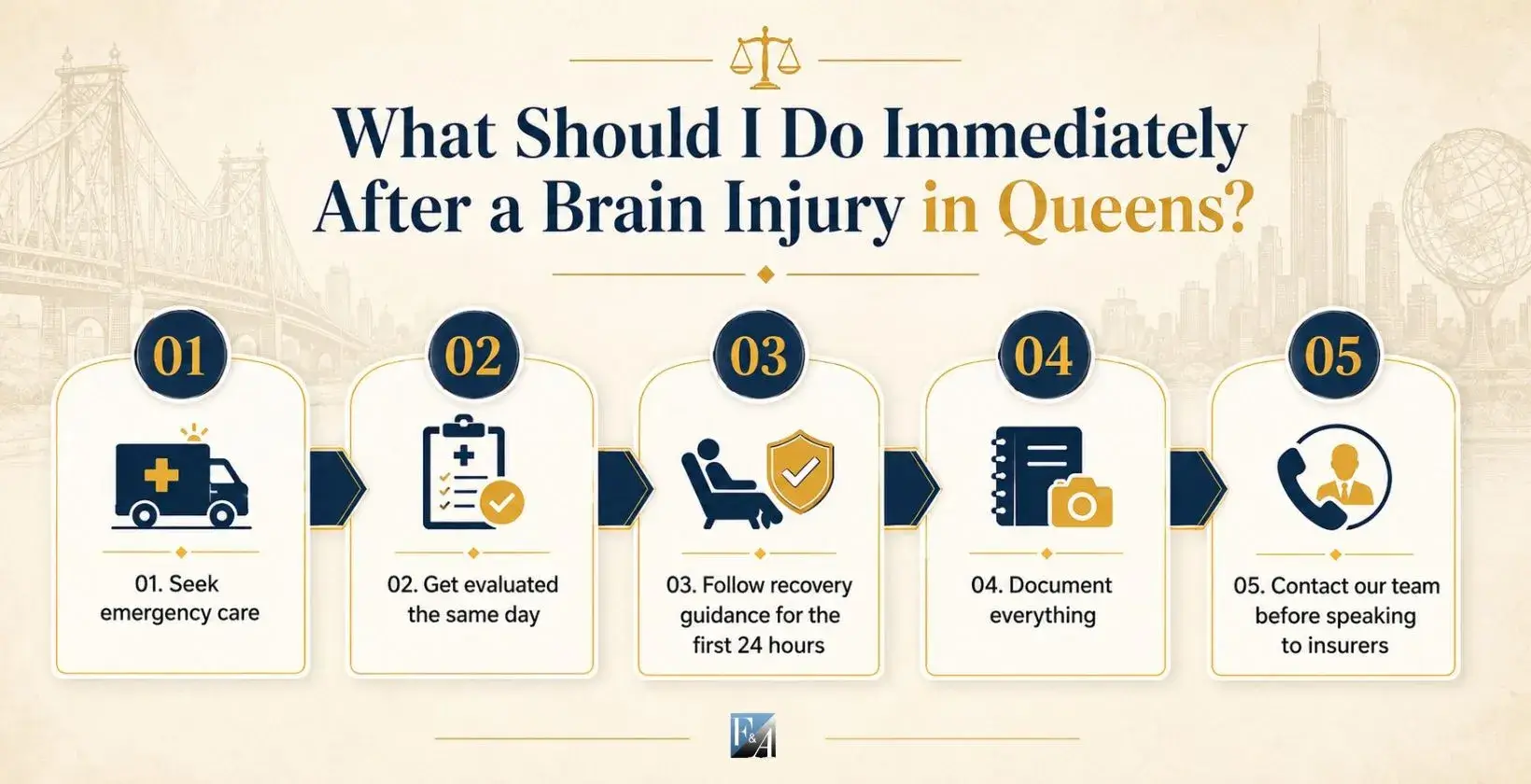
What Should I Do Immediately After a Brain Injury in Queens?
The steps you take in the first hours after a head injury affect both your health and your legal claim.
-
Seek emergency care
Call 911 if you experience loss of consciousness, seizure, vomiting, or confusion. Do not drive yourself; get to an emergency room by ambulance or have someone take you.
-
Get evaluated the same day
All suspected TBIs require evaluation by a healthcare provider, even when symptoms seem mild. A normal ER scan does not rule out a brain injury.
-
Follow recovery guidance for the first 24 hours
Rest but limit screen time, loud environments, and mentally demanding tasks. Have a family member or friend monitor you for new or worsening symptoms.
-
Document everything
Photograph the accident scene and your injuries. Start a daily symptom journal. Secure all medical records from your ER visit. This documentation becomes evidence in your legal claim.
-
Contact our team before speaking to insurers
Insurers reach out quickly and use early statements to limit your claim. Do not give a recorded statement before speaking with our Queens brain injury attorneys.
How Brain Injuries Happen in Queens
Brain injuries in Queens result from a range of accidents, each carrying its own liability framework and legal deadlines.
- Falls: Falls account for 49.1 percent of all TBI-related hospitalizations in the United States (CDC). In Queens, falls occur on icy sidewalks, unsafe staircases, uneven pavement, and wet floors in commercial properties. When a property owner knew or should have known about a dangerous condition and failed to correct it, liability may follow.
- Motor Vehicle Accidents: High-incident corridors include Queens Boulevard, Northern Boulevard, Jamaica Avenue, and roads near JFK International Airport and LaGuardia Airport. Even without a visible impact injury, the force of a collision causes diffuse axonal injury, concussion, or intracranial hemorrhage.
- Construction Accidents: Construction workers face TBI risk from scaffold falls, falling objects, and tool strikes on active sites. New York Labor Law 240 imposes strict liability on property owners and general contractors for gravity-related head injuries. Comparative negligence is not a defense for the defendant under that statute.
- Medical Malpractice: Brain injuries result from surgical errors, anesthesia mistakes, delayed stroke diagnosis, and oxygen deprivation during medical procedures. Expert testimony is required to prove a departure from the accepted standard of care.
- MTA and Transit Accidents: Subway platform falls and bus crashes involving the MTA or NYCTA are governed by the 90-day Notice of Claim requirement in NY General Municipal Law Section 50-e. A missed deadline permanently bars the claim against the city or transit authority.
- Assaults and Violent Crime: Assaults account for 10 percent of all TBI causes in the United States (CDC). Head trauma suffered in bars, parking lots, or apartment buildings may support a premises liability claim against property owners who failed to provide adequate security.
- Nursing Home Neglect: Nursing home residents sustain brain injuries from preventable falls caused by understaffing, inadequate supervision, and failure to implement fall prevention measures.
In need of a great injury lawyer?
F&A is definitely the best place to go. With strong dedication and excellent expertise, my daughter's case was handled extremely well. I worked with Anthony Robinson, her lawyer — he was very dependable and resolute. My daughter and I are incredibly grateful and lucky that her case was handled with such utmost importance and care.
Recognizing the Signs, Including Symptoms That Appear Days Later
Brain injuries do not always announce themselves at the scene. Secondary damage, including swelling and changes to the blood-brain barrier, develops over hours to days after impact. Symptoms are frequently overlooked by the injured person, their family, and even their treating physician.
- Immediate: Loss of consciousness, confusion, slurred speech, unequal pupils, vomiting, and seizure.
- Hours to days later: Worsening headache, light and sound sensitivity, sleep disruption, balance problems, and blurred vision.
- Weeks later: Memory gaps, slowed processing, depression, anxiety, and personality changes that family members notice before the injured person does.
Every day between the accident and the first TBI evaluation is a day an insurer will cite to dispute causation. If you are experiencing any of these symptoms after a Queens accident, contact us at (718) 331 3330.
Why Standard Hospital Scans Miss Brain Injuries
CT scans are the first-response imaging tool in emergency settings. They rule out life-threatening bleeds and skull fractures. They are not designed to detect axonal damage, microbleeds, or white matter disruption, which are the injuries that produce lasting cognitive impairment after a mild-to-moderate TBI.
Only about 10 percent of CT scans and 30 percent of standard MRI scans reveal abnormalities in mild TBI cases. Conventional imaging has proven insensitive to diffuse axonal injury, the most common injury in mild TBI. The imaging progression we use for Queens TBI clients starts where ER imaging stops:
- 3T MRI: Greater field strength detects smaller lesions missed on standard 1.5T scanners.
Susceptibility Weighted Imaging (SWI): Detects microbleeds and diffuse axonal injury patterns invisible on conventional sequences. - Diffusion Tensor Imaging (DTI): Maps white matter fiber tracts and quantifies axonal disruption. Not ordered in acute ER settings, it is used in follow-up clinical evaluation and paired with neuropsychological testing to build the damage narrative for cognitive impairment claims.
- Videonystagmography (VNG): Tests the vestibular system and documents dizziness and balance deficits that insurers often attribute to pre-existing conditions.
- PET Scan: Three-dimensional metabolic imaging sensitive to mild TBI patterns invisible on conventional MRI.
SPECT Scan: Confirms areas of reduced brain activity. Most useful when structural imaging is normal but cognitive impairment is documented. - Neuropsychological Testing: Quantifies cognitive, memory, and functional impairment in terms that translate directly into economic damages, lost earnings, and life care plan costs.
Arterial spin labeling measures cerebral blood flow as a follow-up when DTI shows disruption. The Glasgow Coma Scale and Rancho Los Amigos Scale provide clinical staging that forms the contemporaneous injury severity record. Our neuroradiologists and neuropsychologists conduct this testing to counter insurer denials. A clean ER CT is not the end of the TBI story. It is often the beginning of the documentation battle.
How the Glasgow Coma Scale Affects Your Traumatic Brain Injury Case
Who Is Legally Responsible After a Brain Injury?
In Queens TBI cases, more than one party is often liable. Identifying every defendant and applying the correct legal theory to each determines the full value of your case.
- Negligent Drivers: Negligent drivers face direct liability for crash-related TBIs. When the at-fault driver is underinsured, New York’s Supplemental Uninsured/Underinsured Motorist coverage allows recovery against your own policy up to your SUM limits.
- Property Owners and Landlords: Property owners face liability when a dangerous condition persists on commercial or residential property despite actual or constructive notice of the hazard.
- Construction Contractors: Property owners and general contractors face strict liability for gravity-related TBIs, including scaffold falls, object strikes, and crane collapses. Comparative negligence is not a defense on a Labor Law 240 claim. Labor Law 241 covers Industrial Code violations and requires proof that the violation was a proximate cause of the injury.
- Employers: In Queens construction and warehouse accidents, an injured worker can pursue both a workers’ compensation claim and a separate third-party personal injury lawsuit against the general contractor or site owner.
- City Agencies, MTA, NYCTA, and NYCHA: These entities require a Notice of Claim filed within 90 days of the accident. The lawsuit must be filed within one year and 90 days. That deadline is a hard cutoff.
- Product Manufacturers: Manufacturers of defective vehicle components, helmets, or safety equipment face parallel liability when their product contributed to the TBI.
- Comparative Negligence: New York follows comparative negligence under CPLR Article 14-A. Your recovery is reduced proportionally by your assigned fault percentage, but is not barred even if you are found partially at fault.
What Compensation Can a Brain Injury Victim Recover?
Brain injury victims can seek compensation across three damage categories, and understanding the full scope before accepting any settlement offer is critical.
Economic Damages
- Past and future medical costs: emergency care, hospitalization, surgery, specialist treatment, and rehabilitation
- Future care is projected in a life care plan
- Cognitive, occupational, and speech therapy
- Lost wages from the accident date through recovery
- Reduced earning capacity when cognitive impairment limits your ability to work
- Home modifications
- Transportation costs for ongoing treatment
- Caregiver costs when daily assistance is required
Non-Economic Damages
- Pain and suffering
- Emotional distress, including depression, anxiety, and PTSD
- Loss of memory and cognitive function
- Loss of enjoyment of life
- Loss of consortium for spouses and family members
Note: New York does not cap non-economic damages in personal injury cases. Queens County juries have historically returned substantial TBI verdicts, which is one reason venue matters in complex cases.
Wrongful Death
When a Queens TBI causes death, surviving family members can bring a wrongful death claim under EPTL Section 5-4.1 within two years of the date of death for funeral expenses and lost financial support. A separate survival action under EPTL Section 11-3.2 covers conscious pain and suffering the deceased experienced between the injury and death.
Punitive Damages
New York allows punitive damages when a defendant’s conduct was intentional or showed reckless disregard for others’ safety. These apply in cases involving intentional assault or extreme recklessness, not in every TBI claim.
Mr Arkady and his Staff is extremely knowledgeable about personal injury.
Was able to advise me and guide me. He constantly make YouTube video as well explaining different situation. I highly recommend him, he’s not only an attorney but a proven Trial attorney!! One you would want representing you in court!
Filing Deadlines for Brain Injury Claims in New York
Missing a New York TBI deadline permanently bars the claim. Three tracks apply depending on who caused the injury:
- Private party (driver, property owner, contractor): Three years from the accident date under CPLR Section 214.
- City agency, MTA, NYCTA, NYCHA: Notice of Claim within 90 days of the accident under NY General Municipal Law Section 50-e. Lawsuit filed within one year and 90 days.
- Workers’ compensation: Report the injury to your employer within 30 days. File with the Workers’ Compensation Board within two years.
Two evidence windows close regardless of legal deadlines. Camera footage at Queens intersections, transit stations, and commercial properties is typically overwritten within 30 to 90 days. DTI imaging at six weeks documents axonal changes that may no longer be detectable at six months. Acting early protects your legal claim and the medical evidence you need to win it.
How We Build Your Brain Injury Case
Every TBI case we take follows the same four-phase process, built from day one to withstand insurer challenges and hold up at trial.
- Liability Identification: We identify every responsible party from day one. Each defendant requires a separate liability theory and a separate preservation strategy.
- Specialist Referral and Advanced Imaging: Post-injury brain changes captured by DTI and 3T MRI diminish over time. We connect clients with specialists immediately on retention, preserving the imaging window.
- Evidence Preservation: Surveillance footage from Queens intersections, MTA stations, and commercial properties overwrites on a 30-to-90-day cycle. We send preservation demands for EDR data from vehicles, footage from NYC DOT cameras along Queens Boulevard and the Van Wyck Expressway, DOB inspection logs for construction sites, MTA incident records, and NYPD reports obtained through FOIL. Witness statements go stale. We get them early.
- Damages Documentation: We build the full damages picture before any settlement discussion begins, coordinating life care planners, vocational experts, and economic analysts so insurers cannot undervalue the claim.
Why Injury Victims Choose Frekhtman & Associates for TBI Claims
Choosing the right Queens brain injury lawyer is the main decision that determines what your case is worth. At Frekhtman & Associates, founding attorney Arkady Frekhtman has spent over 25 years building TBI cases that hold up in court and at the negotiating table. When insurance companies move fast to deny your claim, our team moves faster.

- Proven Experience: Our attorneys have secured record-setting brain injury verdicts across New York, going to trial when insurers refuse fair compensation. We do not settle cases short; we build them to win.
- Advanced Diagnostic Testing: We coordinate DTI, SWI, 3T MRI, vestibular testing, and neuropsychological evaluation, the testing that documents injuries insurance companies try to call invisible.
- Multi-Expert Trial Team: Our team assembles neurologists, neuropsychologists, neuroradiologists, life care planners, vocational experts, and accident reconstructionists who quantify your full lifetime damages.
- Queens Court Experience: Our attorneys know the judges, defense strategies, and local procedures in Queens County courts, giving your case a structural advantage from the start.
- No Upfront Costs: You pay nothing unless we recover compensation for you. We advance all litigation costs regardless of how long your case takes.
- Multilingual: Our lawyers serve Queens clients in English and Russian, covering one of the borough’s largest language communities.
When Should You Get an SWI Test After a Brain Injury?
Watch: Attorney Arkady Frekhtman explains when susceptibility weighted imaging should be ordered after a traumatic brain injury, why timing matters, and how this advanced test documents brain damage that standard scans miss entirely.
Areas We Serve Across Queens and New York
Frekhtman & Associates represents brain injury victims across every borough in New York City and throughout the metropolitan area. Our attorneys understand the specific requirements of filing claims in each jurisdiction.
Queens Neighborhoods We Serve:
Astoria, Bayside, Bellerose, Corona, East Elmhurst, Elmhurst, Far Rockaway, Flushing, Forest Hills, Fresh Meadows, Howard Beach, Jackson Heights, Jamaica, Kew Gardens, Long Island City, Maspeth, Middle Village, Ozone Park, Queens Village, Rego Park, Richmond Hill, Ridgewood, Rockaway Beach, South Ozone Park, Springfield Gardens, Sunnyside, Whitestone, Woodhaven, Woodside
We also represent clients in Manhattan (New York County), Brooklyn (Kings County), The Bronx (Bronx County), Staten Island (Richmond County), Nassau and Suffolk Counties, and across Long Island.
FAQs About Brain Injury Claims
Is a Concussion Considered a Traumatic Brain Injury Under New York Law?
Yes. A concussion is a mild traumatic brain injury under New York law. A negative CT or MRI scan does not disqualify the claim; advanced imaging can document axonal disruption that standard scans miss.
Can I File a Claim If I Did Not Lose Consciousness?
What Happens If the Insurer Claims My Brain Injury Is Pre-Existing?
A pre-existing condition does not bar recovery under New York’s eggshell plaintiff doctrine. If the accident aggravated, accelerated, or exacerbated a prior condition, the defendant is liable for that aggravation. Baseline testing establishes what changed after the accident.
What Is the Serious Injury Threshold and Does a TBI Qualify?
Can I Still File a Claim If I Delayed Medical Treatment?
Yes, but delay weakens the claim. Insurers argue that delayed treatment means the injury was not serious or was caused by something unrelated to the accident. The stronger your documentation connecting symptoms to the accident, the better your position despite the gap.
How Long Does a Queens Brain Injury Case Take?
Most Queens TBI cases take two to four years to resolve. The timeline depends on when you reach maximum medical improvement, the complexity of your injuries, and whether the case settles or goes to trial. Cases involving disputed liability or severe injury typically take longer.
Get a Free Case Review Before Evidence Is Gone
Every day after a Queens brain injury, the evidentiary record shrinks. Cameras overwrite. Witnesses’ memories fade. The imaging window for axonal documentation narrows. At Frekhtman & Associates, we move on retention: we send preservation demands, secure records, and schedule specialist imaging before those windows close.
We are available 24/7 and visit clients at home or in the hospital when travel is not possible. Our Forest Hills office is located at 100-09 Metropolitan Ave, Forest Hills, NY 11375.
Past results do not guarantee future outcomes.
The Right Representation Near You
While it’s possible to handle a personal injury case on your own, having an experienced attorney by your side significantly increases the likelihood of a favorable outcome. We have our office located all over New York City, so you don’t have to worry about office visits. You can find and visit one of our offices near you.