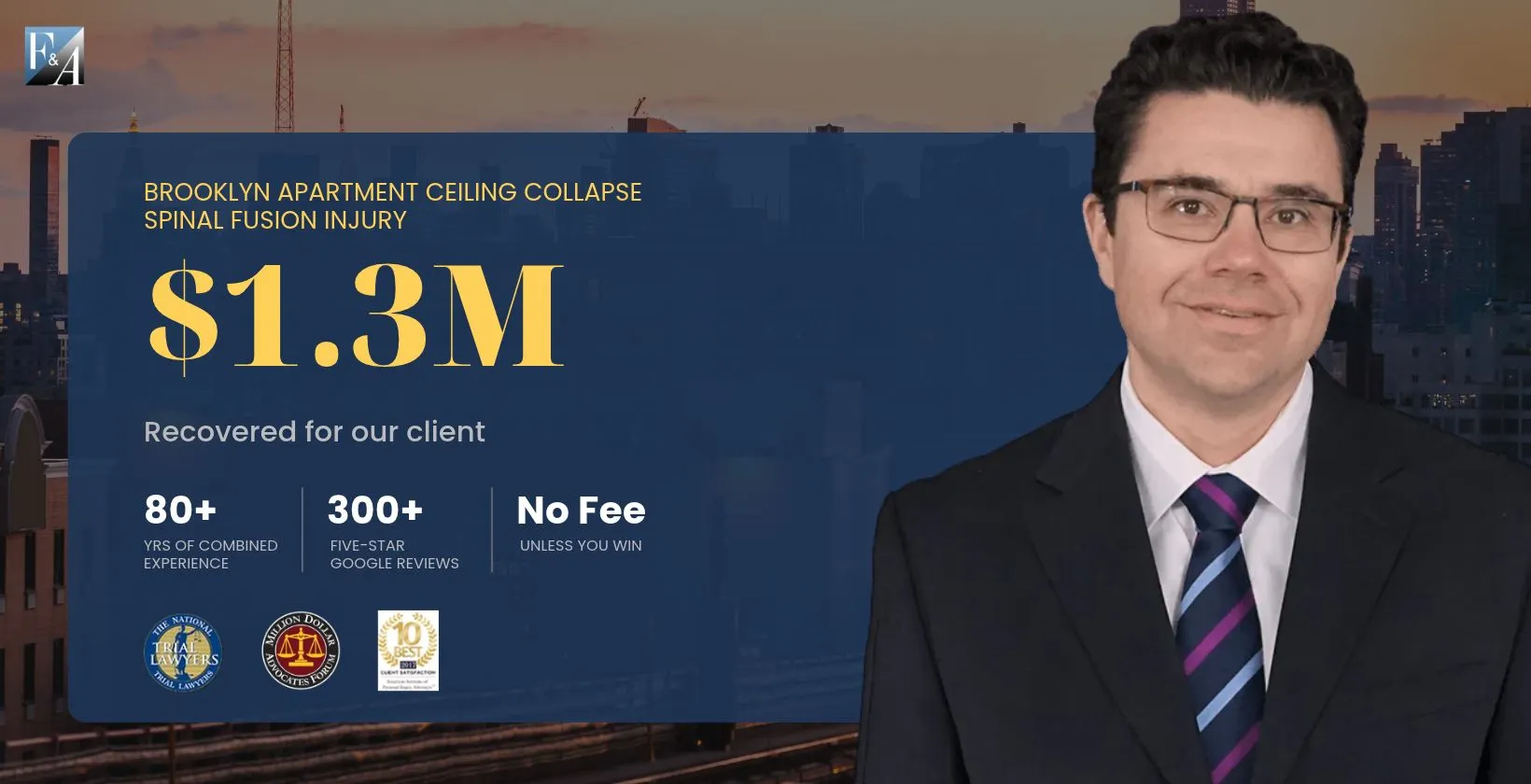
A 59 year old Brooklyn man suffered serious neck and knee injuries after his apartment bathroom ceiling collapsed, striking him and knocking him to the floor. Despite repeated complaints about water leaks and deteriorating ceiling conditions, the corporate landlord allegedly failed to make adequate repairs. Following two major surgeries and years of litigation, Frekhtman & Associates secured a $1,300,000 settlement.
Months of Water Leaks and Complaints Before the Ceiling Collapsed
For months, a 59 year old Brooklyn tenant had been dealing with a deteriorating bathroom ceiling inside his rented apartment.
Water from the bathroom of the apartment above had allegedly been leaking into the ceiling, gradually damaging the drywall and wooden materials.
According to the plaintiff, the ceiling continued to deteriorate while his complaints went unresolved.
He maintained that he repeatedly notified the building superintendent about the problem.
His complaints were made in person, over the phone, through text messages, and by voicemail.
Despite these warnings, the plaintiff alleged that the landlord failed to adequately address the dangerous condition.
The ceiling eventually became broken, sagging, and visibly deteriorated, with portions of the material missing.
The plaintiff also alleged that the landlord performed patchwork repairs in May 2020, months before the accident.
Those repairs would later become an important issue in the litigation, particularly concerning whether the landlord knew about the condition and whether its repair work contributed to the eventual collapse.
On September 16, 2020, the dangerous condition allegedly resulted in a serious accident inside the tenant’s own bathroom.
A Bathroom Ceiling Collapses on a Brooklyn Tenant
At approximately 10:00 p.m. on September 16, 2020, the plaintiff was inside his apartment bathroom when part of the ceiling suddenly collapsed.
Drywall, wood, and other debris fell onto him.
The falling material struck his head and neck, causing him to fall onto the bathroom floor.
His son in law discovered him shortly afterward.
He found the injured man dazed and barely responsive, with bloody scratches on his head.
The plaintiff complained of significant pain in his neck, right knee, and back.
He was unable to lift himself from the bathroom floor into a chair.
Emergency medical personnel responded to the apartment.
Paramedics documented complaints of pain, dizziness, and injuries involving his right knee, neck, and back.
He was transported to the hospital for emergency evaluation.
Doctors performed CT scans of his head and cervical spine, along with X rays of his right leg and knee.
He was discharged wearing a cervical collar and experiencing difficulty walking.
Although the initial emergency treatment was completed that night, the injuries were far more serious than they initially appeared.
Over the following months, he would require major surgical procedures involving both his knee and cervical spine.
Serious Neck and Knee Injuries Revealed Through Medical Imaging
Within days of the ceiling collapse, the plaintiff began receiving treatment for persistent pain and physical limitations.
His initial care included physical therapy, chiropractic treatment, and acupuncture.
As his symptoms continued, additional imaging revealed significant injuries.
An evaluation of his right knee identified an interstitial tear of the anterior cruciate ligament, commonly known as the ACL.
Imaging also showed a prominent horizontal tear of the lateral meniscus and a substantial contusion involving the kneecap and patellar tendon.
His cervical spine imaging revealed additional problems.
Doctors identified moderate to large disc herniations at C4 C5 and C5 C6, accompanied by significant spinal stenosis and nerve impingement.
Smaller disc herniations were also identified at C3 C4 and C6 C7.
The plaintiff continued experiencing neck pain and eventually developed symptoms radiating into both arms and fingers.
His condition included pain, numbness, and increasing difficulty with everyday physical activities.
The combination of knee damage and cervical spine injuries ultimately required surgical intervention.
Two Major Surgeries Within Six Weeks
The plaintiff’s first major procedure addressed his right knee.
On January 21, 2021, an orthopedic surgeon performed an arthroscopic knee operation, including a partial meniscectomy.
The surgery was intended to address the meniscus damage and associated knee symptoms.
Meanwhile, his cervical spine condition continued causing significant pain.
Pain management injections provided only temporary relief.
He developed worsening pain and numbness extending down both arms into his fingers.
As his neurological symptoms progressed, he returned to the emergency room and was admitted to the hospital.
On March 3, 2021, a spinal surgeon performed a two level anterior cervical discectomy and fusion from C4 through C6.
The procedure involved removing damaged cervical discs and stabilizing the affected levels using implanted spacers, a plate, and screws.
The two surgeries were performed approximately six weeks apart.
Despite extensive medical treatment, the plaintiff continued experiencing pain and functional limitations.
His treating providers maintained that his injuries were permanent.
A Life Changed by Chronic Pain and Physical Limitations
Before the ceiling collapse, the plaintiff was able to manage ordinary household responsibilities and participate in his usual daily activities.
Following the accident, routine tasks became increasingly difficult.
More than two years after the collapse, he continued experiencing significant physical limitations.
He reported that he could no longer perform household chores such as laundry or washing dishes.
Sitting at a desk for extended periods became difficult because of pain.
His symptoms also interfered with sleep, leaving him struggling to rest comfortably through the night.
He described episodes of weakness and instances in which he unexpectedly dropped objects.
These difficulties were consistent with his ongoing complaints of pain, numbness, and physical limitations.
He had not returned to most of the activities he enjoyed before the accident.
Medical providers continued documenting limitations affecting his ability to perform household duties.
The plaintiff’s case emphasized that the effects of the accident extended well beyond the initial emergency room visit and two major surgical procedures.
The injuries affected his independence, comfort, sleep, and ability to manage everyday responsibilities inside his home.
Establishing the Landlord’s Responsibility for the Dangerous Ceiling
The plaintiff brought a premises liability claim against the corporate landlord responsible for the apartment building.
A central issue was whether the landlord knew or should have known about the deteriorating bathroom ceiling and failed to take reasonable steps to correct the condition.
The plaintiff’s case focused on several important circumstances.
The ceiling had experienced ongoing water damage.
The plaintiff maintained that leaking water from the apartment above had damaged the drywall and wooden materials over an extended period.
The tenant repeatedly complained about the condition.
He reported notifying the superintendent through in person conversations, phone calls, text messages, and voicemail.
The ceiling showed signs of deterioration before the accident.
According to the plaintiff, the ceiling was broken, sagging, and dilapidated, with portions of the material missing.
The landlord had allegedly performed earlier repairs.
The plaintiff pointed to patchwork repairs conducted in May 2020 as evidence that the landlord was aware of the condition.
The landlord reportedly knew of an earlier partial ceiling collapse.
The plaintiff argued that the landlord’s account of an earlier collapse supported his position that the dangerous condition was recurring and known.
The plaintiff also maintained that the landlord’s own attempted repair work may have contributed to the eventual ceiling failure.
His legal argument therefore involved more than a claim that the landlord failed to discover an unknown defect.
He asserted that the landlord received repeated warnings, performed inadequate repairs, and allowed the dangerous condition to remain until the ceiling collapsed.
These allegations became central to the dispute over the landlord’s responsibility for the accident.
Overcoming the Defense’s Arguments About Notice and Preexisting Conditions
The landlord disputed responsibility for the ceiling collapse.
The defense argued that the plaintiff’s own conduct caused or contributed to the accident and contended that any dangerous condition was open and obvious.
The building superintendent testified that no one had informed him about problems involving the ceilings.
This testimony directly conflicted with the plaintiff’s account of repeated complaints.
The defense also questioned whether photographs offered by the plaintiff actually depicted the condition of the bathroom on the accident date.
These disputes created significant questions about the landlord’s prior knowledge, the condition of the ceiling, and the reliability of the evidence.
On damages, the defense challenged the severity and cause of the plaintiff’s injuries.
An orthopedic physician retained by the defense concluded that the plaintiff had sustained, at most, minor soft tissue strains that should have resolved within several weeks.
The defense also emphasized hospital imaging that showed severe preexisting arthritis in the plaintiff’s right knee.
It argued that neither the knee surgery nor the cervical spinal fusion was medically necessary because of the ceiling collapse.
The plaintiff disputed those conclusions.
His position was that any preexisting degenerative conditions had been asymptomatic or dormant before the accident and were aggravated by the trauma.
His treating surgeons connected his injuries and subsequent surgical treatment to the ceiling collapse.
The case therefore involved substantial disagreements concerning both the landlord’s knowledge of the hazard and the medical consequences of the accident.
$1,300,000 Settlement After Years of Litigation
Despite significant disputes over liability, prior notice, medical causation, and damages, Frekhtman & Associates successfully resolved the case for $1,300,000.
The settlement provided substantial compensation to a Brooklyn tenant who underwent arthroscopic knee surgery and a two level cervical spinal fusion following the ceiling collapse.
The plaintiff continued experiencing pain and physical limitations more than two years after the accident.
The resolution followed litigation in which the landlord disputed receiving notice of the ceiling condition and challenged whether the accident caused injuries requiring surgery.
The case illustrates how longstanding water damage and deteriorating building conditions can result in serious injuries when allegedly left unaddressed.
It also demonstrates the importance of documenting complaints to landlords, preserving photographs of dangerous conditions, and obtaining thorough medical evidence when the cause and severity of injuries are disputed.
Why This Case Matters for New York Apartment Accident Victims
This case highlights several important considerations in premises liability claims involving unsafe apartment conditions.
Landlords may face responsibility for dangerous conditions inside rental apartments.
Water damage, deteriorating ceilings, and inadequate repairs can create serious hazards for tenants and other occupants.
Repeated complaints can become important evidence of notice.
In this case, the plaintiff relied on alleged conversations, telephone calls, text messages, and voicemail communications to establish that the landlord had been warned about the ceiling.
Previous repairs may be relevant to a landlord’s knowledge of a hazard.
Evidence that maintenance personnel previously attempted to repair a deteriorating ceiling can become significant when determining whether the property owner knew about the condition.
Preexisting medical conditions do not automatically prevent an injured tenant from recovering compensation.
A serious accident may aggravate an existing condition, and medical evidence can help establish whether the incident caused new injuries or worsened prior problems.
Ceiling collapses can cause injuries requiring extensive surgical treatment.
Falling debris and the resulting impact can produce serious head, neck, back, and extremity injuries, with consequences that extend far beyond the initial accident.
For this Brooklyn tenant, a bathroom ceiling collapse resulted in knee surgery, cervical spinal fusion, and continuing physical limitations.
The case ultimately resolved for $1.3 million.
Injured in an Apartment Building Accident in New York?
Dangerous apartment conditions involving ceiling collapses, persistent water leaks, structural deterioration, and inadequate repairs can cause serious injuries.
The attorneys at Frekhtman & Associates represent individuals and families throughout New York City in serious premises liability cases, landlord negligence claims, and apartment building accidents.
If you or a loved one suffered injuries because of unsafe conditions in a rental apartment or residential building, contact our firm for a No Obligation Case Review.
No fee unless we win.
Attorney Advertising. Prior results do not guarantee a similar outcome. Each case depends on its own facts and circumstances. The settlement represents a negotiated resolution, not a judicial finding of liability.