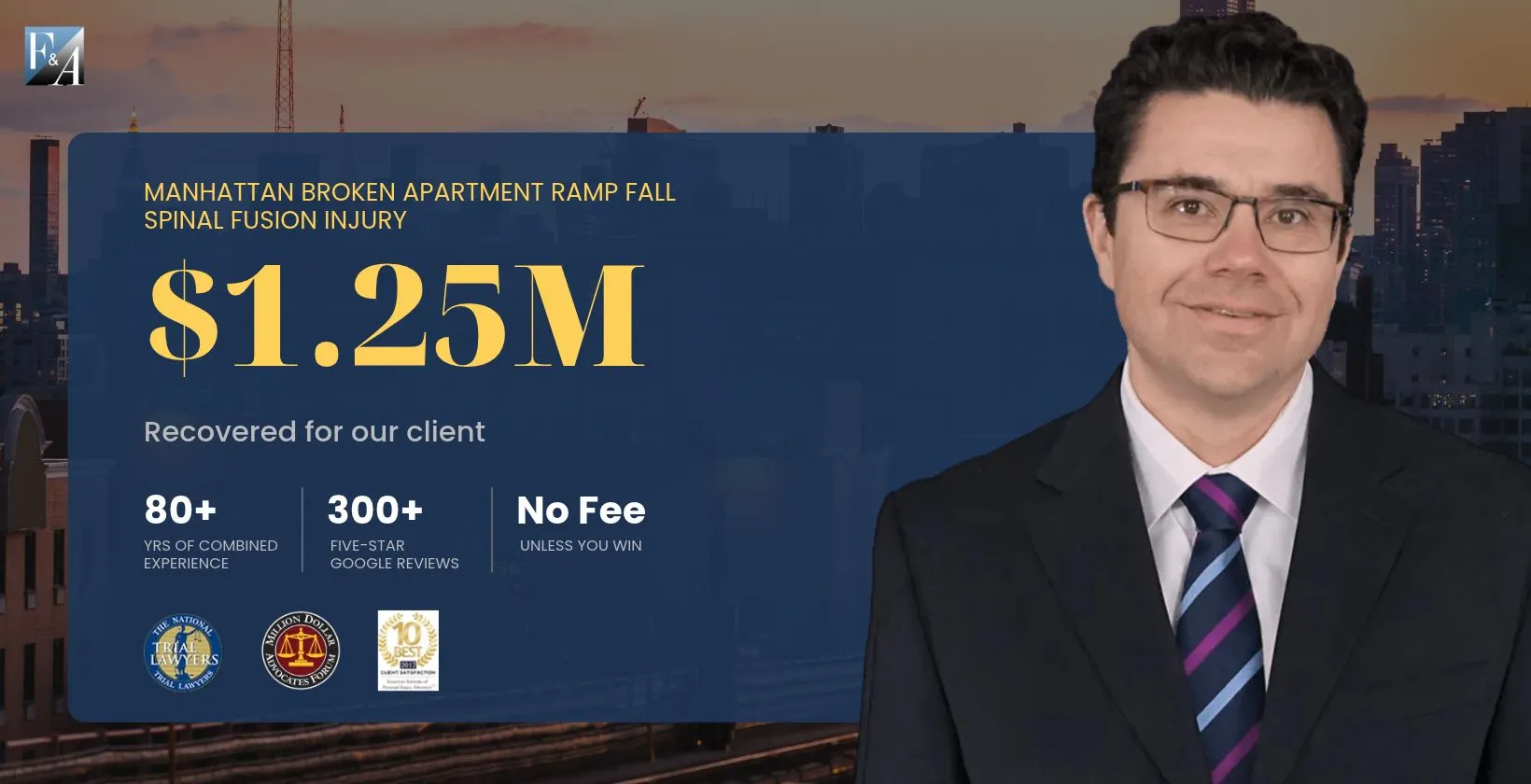
A 67 year old Manhattan grandmother suffered serious shoulder, knee, and spinal injuries after tripping on a broken concrete ramp at her apartment building while pushing her grandson’s stroller. Despite disputes over whether the ramp was defective, whether the landlord knew about its condition, and whether the plaintiff contributed to her fall, Frekhtman & Associates secured a $1,250,000 settlement.
A Morning Walk With Her Grandson Ends in a Serious Fall
On a clear, dry January morning in 2019, a 67 year old grandmother was leaving her Manhattan apartment building with her young grandson.
Shortly after 7:00 a.m., she had gone downstairs to collect him and was returning through the building’s side basement entrance.
The main entrance required climbing stairs, making it difficult to navigate with a stroller.
Instead, she used the basement entrance, which provided access through a concrete ramp without steps.
She had used this route regularly when traveling with her grandson.
As she pushed the stroller through the open basement doorway, she encountered a damaged section of the concrete ramp.
The walking surface was uneven, broken, and chipped.
According to her testimony, the defect caused her to lose her balance.
She struck the wall with her left shoulder before falling forward onto her knees and hands.
The plaintiff maintained that the stroller was functioning normally and that the damaged concrete surface, rather than any problem with the stroller, caused the accident.
What began as an ordinary morning helping care for her grandson would lead to multiple surgeries, months of confinement, and significant long term physical limitations.
Severe Shoulder, Knee, and Lower Back Injuries
The fall caused injuries affecting several parts of the plaintiff’s body.
Her left shoulder sustained significant rotator cuff damage.
She also suffered a fracture of her left kneecap, known medically as the patella.
Her lower back injuries would ultimately require lumbar spinal fusion surgery.
The combined injuries substantially affected her mobility and ability to perform everyday activities.
The plaintiff began an extended course of medical treatment that included several major surgical procedures.
Her first operation addressed the damage to her left shoulder.
In April 2019, approximately three months after the accident, she underwent arthroscopic rotator cuff repair.
However, her shoulder problems did not fully resolve.
She later experienced another rotator cuff tear that required additional surgical treatment.
At the same time, her lumbar spine symptoms continued interfering with her ability to walk and function independently.
The injuries eventually required substantial surgical intervention involving her lower back.
Multiple Surgeries Including Lumbar Spinal Fusion and Hardware Removal
The plaintiff underwent four surgical procedures associated with the injuries and complications described in her case.
In April 2019, she received her first arthroscopic left shoulder rotator cuff repair.
In November 2019, she underwent lumbar spinal surgery involving the placement of screws from L4 through S1 and fusion at L5 S1.
The spinal operation was intended to address her continuing lower back condition.
Her shoulder also required further treatment.
In May 2021, she underwent a second arthroscopic procedure for a large, full thickness rotator cuff tear.
That operation included another repair and partial removal of hardware from her earlier shoulder surgery.
Her spinal treatment continued as well.
In September 2023, she required an additional procedure to remove screws following a mechanical complication involving the spinal fixation.
The sequence of operations extended across more than four years.
Her medical treatment involved the shoulder, knee, and lumbar spine injuries that had substantially disrupted her daily activities.
The plaintiff’s claimed medical expenses included approximately $175,000 in physician services and $75,000 in hospital charges.
These amounts reflected the expenses particularized in the litigation rather than necessarily representing the complete cost of her care.
From an Independent Grandmother to Years of Pain and Limited Mobility
Before the accident, the plaintiff was retired and regularly helped care for her grandson.
Taking him to and from the building was part of her everyday routine.
Following the fall, her injuries significantly restricted her independence.
She was confined to bed for approximately three months.
For about six months, she was largely confined to her home.
Her lower back pain continued interfering with her ability to walk.
Medical providers documented ongoing physical limitations, and she began using a cane to assist with mobility.
Sleep also became difficult because of pain.
Medication and therapy provided limited relief.
The plaintiff maintained that the injuries left her intermittently totally disabled following the accident and that she would continue experiencing partial disability in the future.
For someone who had previously been able to help care for her grandson and manage daily responsibilities, the loss of mobility represented a significant change.
Her case emphasized that the harm extended beyond the surgical procedures themselves.
It affected her independence, comfort, ability to move around her home, and capacity to participate in family activities.
Establishing the Landlord’s Responsibility for the Defective Concrete Ramp
The plaintiff brought a premises liability claim against the corporate owner of her six story residential apartment building.
A central issue was whether the concrete ramp contained a dangerous defect and whether the landlord knew or should have known about it before the accident.
Frekhtman & Associates retained a professional engineer to inspect and measure the ramp.
The engineering investigation identified several important conditions.
The concrete surface contained two damaged areas.
The engineer documented broken sections at the V shaped seam where the steep upper portion of the ramp connected with the lower portion.
The walking surface had a measurable height difference.
The plaintiff’s expert measured differences of approximately 1 to 1.5 inches across the defective seam.
The defects created a potential tripping hazard.
The engineer described the uneven concrete as a “toe trap,” a condition in which a pedestrian’s foot can catch on an abrupt change in walking surface elevation.
The ramp was allegedly too steep.
The plaintiff’s engineer concluded that its slope exceeded applicable building code limitations.
The landlord’s superintendent had previously observed the condition.
The superintendent testified that he conducted daily building inspections, used the basement entrance more than 15 times per day, and had noticed the uneven area before the accident.
The superintendent also acknowledged that tenants used the basement entrance and that residents had not been instructed to avoid it.
The plaintiff argued that this evidence demonstrated both the existence of a dangerous condition and the landlord’s knowledge of the defective ramp.
Her case emphasized that the accident involved a measurable structural defect rather than an isolated or temporary obstacle.
Overcoming a Defense That Disputed the Ramp’s Condition
The landlord contested whether the ramp was dangerous.
Its engineering expert inspected the area and reached conclusions that differed substantially from those of the plaintiff’s expert.
The defense engineer measured the cracked section at approximately half an inch.
He concluded that the ramp complied with applicable building code requirements and did not present an unsafe condition.
The landlord also argued that it had purchased the building in 2016 and had not performed construction or repair work on the ramp.
According to the defense, this meant the owner had not created the alleged defect.
The company further maintained that it had received no complaints about the ramp for approximately 20 years.
The plaintiff challenged those arguments.
Her engineering expert documented more substantial changes in elevation and an excessive slope.
The plaintiff also relied on the superintendent’s testimony that he had seen the uneven concrete before the accident.
The litigation therefore involved conflicting expert measurements, different interpretations of building code requirements, and disputes over the landlord’s prior notice.
A Defense That Blamed the Plaintiff’s Stroller and Medical History
The defendants also argued that the plaintiff had caused or contributed to her own fall.
They maintained that the ramp’s condition was open and obvious.
The landlord further argued that she was not authorized to use the basement entrance.
However, the plaintiff pointed to testimony that tenants regularly used the entrance and had never been told to avoid it.
The defense also emphasized that the plaintiff had previously used the same ramp once or twice each week for at least two and a half years without incident.
It questioned why she had not noticed the defect before the accident.
Additionally, the defense argued that a preexisting vertigo condition, rather than the concrete surface, caused her to lose her balance.
Its engineering expert suggested that pushing the stroller contributed to the fall.
The plaintiff disputed those conclusions.
She testified that the stroller functioned normally and that the uneven concrete was responsible for the accident.
She also explained that she typically looked straight ahead while entering with the stroller in front of her and had not previously noticed the damaged section.
The defendants sought summary judgment dismissing the case.
The plaintiff opposed the motion, arguing that the conflicting engineering findings and disputed testimony concerning the ramp, notice, and cause of the fall presented factual questions requiring resolution.
These disputes became central issues in the litigation leading to settlement.
$1,250,000 Settlement Despite Disputed Liability
After litigation involving the ramp’s condition, engineering evidence, the landlord’s knowledge, and the plaintiff’s medical history, Frekhtman & Associates secured a $1,250,000 settlement.
The resolution provided substantial compensation in a case involving two shoulder surgeries, lumbar spinal fusion, later removal of spinal hardware, a fractured kneecap, and persistent physical limitations.
The settlement followed disputes over whether the ramp was defective, whether the landlord had sufficient notice, and whether the plaintiff’s own conduct or medical history contributed to the accident.
The case demonstrates how a damaged section of a residential walkway can result in significant injuries, even when the height difference appears relatively small.
It also illustrates the importance of careful engineering measurements, examination of building maintenance practices, and testimony from property personnel when determining responsibility for a premises accident.
Why This Case Matters for New York Apartment Building Fall Victims
This case highlights several important considerations in serious accidents involving defective ramps and residential walkways.
Small changes in walking surface elevation can create dangerous conditions.
Broken concrete, uneven seams, and abrupt height differences may cause pedestrians to trip, particularly when navigating entrances with strollers or other items.
Engineering measurements can become critical evidence.
In this case, the plaintiff’s and defendant’s experts disagreed about the size of the defect and whether the ramp complied with applicable safety requirements.
A landlord’s knowledge may be established through building personnel.
Testimony from a superintendent who regularly inspects and uses an entrance can be relevant to whether the property owner had notice of a dangerous condition.
Previous use of a walkway does not automatically eliminate a property owner’s potential liability.
The fact that someone has used a ramp many times without falling does not necessarily resolve whether a defect was dangerous or contributed to a later accident.
A serious fall can lead to multiple surgeries and lasting limitations.
Shoulder tears, knee fractures, and spinal injuries may require extensive treatment and affect mobility, independence, and everyday family activities.
For this Manhattan grandmother, an ordinary trip through her apartment building’s basement entrance resulted in years of treatment, major surgeries, and lasting physical limitations.
The case ultimately resolved for $1.25 million.
Injured in a Trip and Fall Accident at a New York Apartment Building?
Broken ramps, uneven concrete, damaged walkways, and unsafe building entrances can cause serious injuries to tenants, visitors, and their families.
The attorneys at Frekhtman & Associates represent individuals and families throughout New York City in serious premises liability cases, apartment building accidents, defective walkway claims, and catastrophic spinal injury litigation.
If you or a loved one suffered injuries because of unsafe conditions at an apartment building or another property, contact our firm for a No Obligation Case Review.
No fee unless we win.
Attorney Advertising. Prior results do not guarantee a similar outcome. Each case depends on its own facts and circumstances. The settlement represents a negotiated resolution, not a judicial finding of liability.