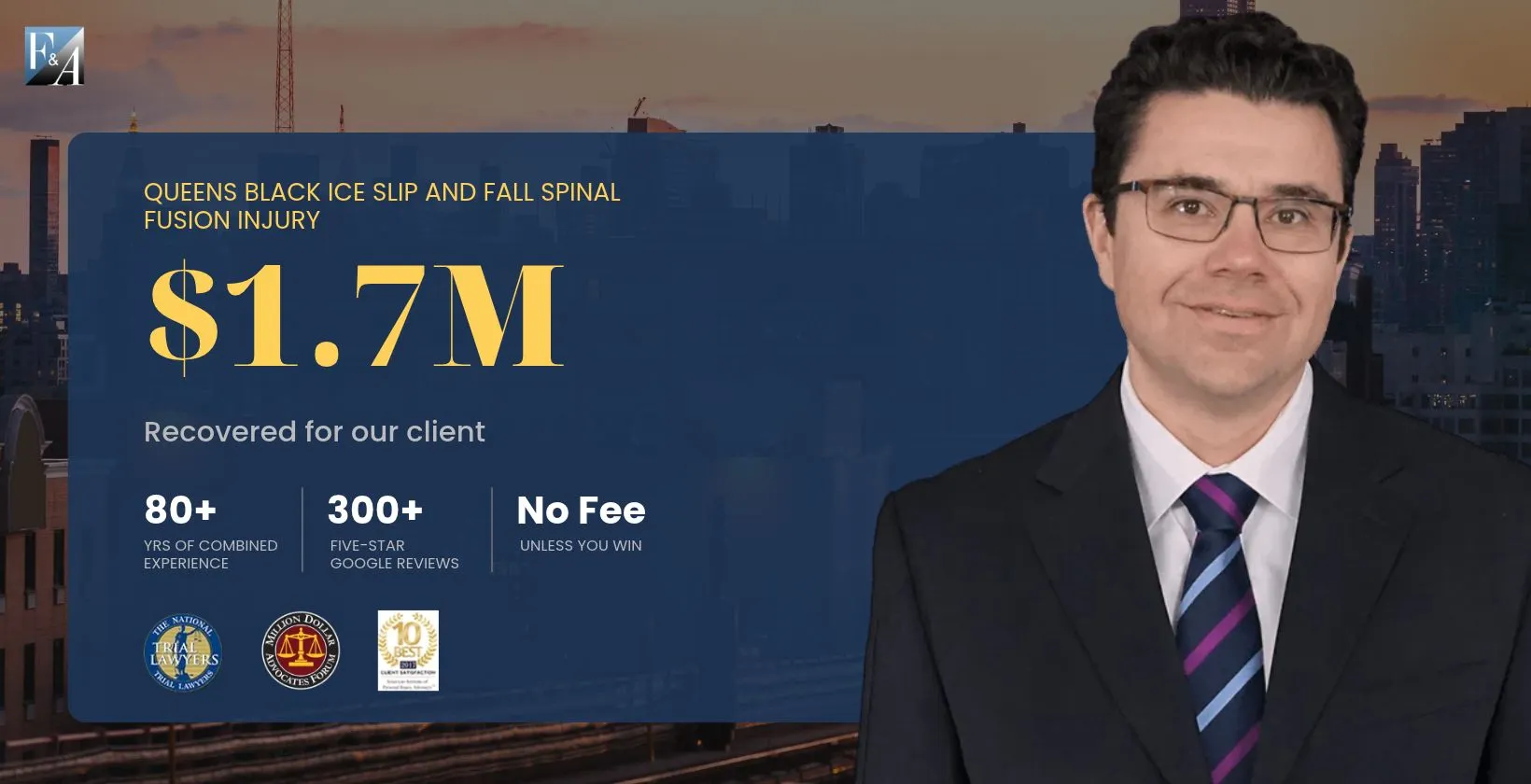
A Queens grandfather and longtime home renovation business owner suffered a serious lower back injury after slipping on black ice while walking his grandson to the school bus stop. The ice allegedly formed when snow piled beside an apartment walkway melted and refroze overnight. Despite the property owner’s attempts to dispute responsibility and attribute his condition to preexisting spinal degeneration, the case settled for $1,700,000.
A Valentine’s Day Morning Turns Into a Serious Slip and Fall Accident
At approximately 6:30 a.m. on Valentine’s Day, a grandfather living in a large Queens apartment complex was walking his grandson along a pedestrian pathway toward the school bus stop.
It was still dark outside.
As he walked, he stepped onto a patch of black ice that was virtually impossible to see in the early morning darkness.
His feet slipped out from beneath him, and he fell.The dangerous condition was not the result of snowfall that morning.
In fact, it had not snowed for six days.
Following the previous snowstorm, the apartment complex’s maintenance staff had shoveled accumulated snow into a large pile beside the pedestrian walkway.
As temperatures changed, the snow began melting.
Meltwater flowed toward a small nearby drain, spreading across the pathway before refreezing overnight.
The repeated freezing created a sheet of black ice directly in an area residents used to reach the street and the school bus stop.
According to the plaintiff’s case, the walkway had not been properly salted or cleared before the accident.
What should have been an ordinary morning walk with his grandson became the beginning of years of severe back pain, spinal surgeries, and permanent changes to his ability to work and live independently.
A Successful Craftsman Whose Work Defined His Life
Before the accident, the plaintiff had spent decades building a successful career through hard work and craftsmanship.
He grew up in Bedford Stuyvesant, Brooklyn, as one of ten children in a family with limited financial resources.
At just 16 years old, he began working as a carpenter and assisting his stepfather with handyman projects.
Over time, he developed expertise in home renovations, including plumbing, sheetrock installation, painting, and electrical work.
He eventually established a successful home renovation business.
His clients included police sergeants, court officers, attorneys, and judges who trusted him to work on their homes.
For him, the business represented far more than a source of income.
It reflected years of dedication, independence, and pride in his abilities.
Outside work, he maintained an active lifestyle.
He enjoyed exercising and had helped train his younger son in preparation for the Marine Corps.
He was also a devoted husband, father, and grandfather who valued spending time with his family.
The injuries sustained in the fall would threaten nearly every aspect of the life he had worked to build.
A Serious Lower Back Injury That Required Multiple Spinal Surgeries
Following the accident, the plaintiff experienced persistent lower back pain.
Medical evaluations identified a herniated lumbar disc compressing nearby nerve roots.
He initially pursued conservative treatment, including physical therapy, but his symptoms did not improve.
Additional diagnostic testing revealed more extensive spinal damage.
A discography examination identified annular tears involving the L4 L5 and L5 S1 discs in his lower back.
The plaintiff subsequently underwent an initial spinal procedure intended to address the damaged disc.
Unfortunately, the operation did not provide meaningful relief.
His pain continued, and further surgical intervention became necessary.
Approximately two years after the fall, he underwent a major lumbar spine operation.
The procedure included a laminectomy extending from L4 through S1, removal of the damaged discs at L4 L5 and L5 S1, and fusion at L4 L5 using an implanted spinal device and bone graft material.
The surgery represented a significant attempt to address his persistent symptoms and structural spinal injuries.
However, the plaintiff continued experiencing severe pain afterward.
He described his postoperative pain as a 12 on a scale of 1 to 10.
Despite extensive treatment, his spinal condition continued to interfere with his physical capabilities and everyday life.
From Independent Business Owner to a Man Struggling With Daily Activities
The consequences of the accident extended far beyond medical treatment.
Before the fall, the plaintiff had been actively involved in the physical work and daily operations of his home renovation business.
Afterward, his back injuries and persistent pain prevented him from maintaining the same level of involvement.
He was forced to turn much of the business over to assistants.
However, longtime customers began complaining that the quality of work was no longer the same without his personal involvement.
His loss of physical independence affected the business he had spent decades building.
Financial pressure also affected his family.
His wife took a retail job to help pay household expenses.
The plaintiff was no longer able to exercise as he once had or participate in physical activities with his grandchildren.
He could not take them to the park to play the way he had before the accident.
Even his religious practices changed.
Although he continued attending church every week, he could no longer kneel to pray because of his back condition.
Instead, he had to remain standing.
The limitation was especially personal to a man who had once gotten down on one knee to propose to his wife of 30 years.
His greatest fear was losing even more independence as he aged, eventually becoming dependent on a walker and unable to care for his grandchildren.
The plaintiff’s case emphasized that the consequences of the accident involved much more than medical expenses.
They included the loss of physical independence, disruption to his livelihood, financial strain on his family, and the inability to participate fully in activities that had once given his life meaning.
Establishing the Property Owner’s Responsibility for the Black Ice
The plaintiff brought claims against both the owner of the apartment complex and the company responsible for managing the property.
A central issue was whether the defendants had created the dangerous condition through the way their maintenance staff handled snow removal.
The plaintiff’s case focused on several important circumstances.
The snow had been piled beside a pedestrian walkway.
Following the previous storm, building maintenance personnel allegedly deposited a substantial amount of snow next to the path regularly used by residents.
Melting snow created runoff across the walking surface.
As the snow pile melted, water traveled toward a small drain and spread across the pedestrian route.
The water refroze into black ice.
When temperatures dropped overnight, the accumulated moisture froze, creating a dangerous and difficult to detect walking surface.
Six days had passed since the last snowfall.
The plaintiff argued that the property owner and management company had ample opportunity to identify and address the condition before the accident.
The walkway had not been adequately treated.
According to the plaintiff, the defendants failed to clear the ice or apply salt to make the pedestrian path safer.
The plaintiff’s central argument was that this was not simply an unexpected patch of ice resulting from a new storm.
Instead, the dangerous condition had allegedly been created by the defendants’ own snow removal practices.
By placing a large pile of snow beside a walkway and allowing meltwater to refreeze across it, the plaintiff argued, the property owner and management company created a foreseeable hazard for residents.
The plaintiff maintained that basic maintenance measures, including removing the accumulated ice and applying salt, could have prevented the accident.
Overcoming a Defense That Disputed Notice and Blamed Spinal Degeneration
The apartment complex owner and property management company contested liability.
The defense argued that it did not have sufficient notice of the icy condition.
It maintained that black ice can develop rapidly, sometimes without warning, and challenged whether the defendants had a reasonable opportunity to discover and correct the hazard before the plaintiff fell.
The plaintiff’s position was that the ice developed from an ongoing condition created by the property’s own snow removal activities.
He argued that the six days between the last snowfall and the accident provided sufficient time for the defendants to identify and address the risk.
The defense also disputed the cause of the plaintiff’s lower back injuries.
It argued that his spinal problems resulted from degenerative changes rather than the Valentine’s Day fall.
This created a significant dispute over whether the accident caused the injuries requiring surgical treatment.
The plaintiff relied on his medical history, diagnostic findings, surgical treatment, and the substantial changes in his ability to work and perform everyday activities to support his claim.
His case emphasized the difference between age related spinal degeneration and the disabling symptoms and treatment needs he attributed to the fall.
The litigation therefore involved challenges concerning both the origin of the dangerous icy condition and the cause and extent of the plaintiff’s spinal injuries.
$1,700,000 Settlement for Serious Spinal Injuries
The case ultimately resolved for $1,700,000.
The settlement provided substantial compensation in a dispute involving serious lumbar spine injuries, multiple surgical procedures, persistent pain, diminished physical independence, and significant disruption to the plaintiff’s professional and family life.
The resolution followed litigation in which the defendants disputed notice of the black ice and challenged whether the plaintiff’s spinal condition resulted from the accident.
The case illustrates how an apparently ordinary slip and fall on an apartment walkway can result in major spinal surgery, long term physical limitations, and significant financial and personal consequences.
It also demonstrates the importance of investigating how icy conditions develop, particularly when snow removal practices may have contributed to the danger.
Why This Case Matters for New York Slip and Fall Victims
This case highlights several important considerations in serious snow and ice accident claims.
Property owners may face liability when their snow removal practices create dangerous conditions.
A hazard does not necessarily have to result from freshly fallen snow. Snow piled near pedestrian areas can melt, drain across walking surfaces, and refreeze into dangerous ice.
Black ice can be especially dangerous because it is difficult to detect.
In this case, the accident occurred before sunrise, when the plaintiff argued that the icy surface was not visible to someone walking along the pathway.
The time between a storm and an accident can become important evidence.
The plaintiff emphasized that six days had passed since the most recent snowfall, supporting his argument that the defendants had an opportunity to address the condition.
Preexisting spinal degeneration does not automatically defeat a personal injury claim.
When an accident causes new injuries or aggravates existing conditions, medical evidence can be important in determining the cause and extent of the resulting limitations.
A serious back injury can affect every aspect of a person’s life.
The consequences may include major spinal surgery, chronic pain, lost earning capacity, reduced independence, and the inability to participate in meaningful family and recreational activities.
For this Queens grandfather, a morning walk to the school bus stop led to extensive medical treatment, disruption of his business, and lasting physical limitations.
The case ultimately resolved for $1.7 million.
Injured in a Slip and Fall Accident in Queens or New York City?
Dangerous conditions involving black ice, improperly cleared snow, and neglected pedestrian walkways can cause serious injuries.

The attorneys at Frekhtman & Associates represent individuals and families throughout New York City in serious premises liability cases, apartment complex accidents, snow and ice falls, and catastrophic spinal injury claims.
If you or a loved one suffered an injury because of unsafe conditions at an apartment complex or another property, contact our firm for a No Obligation Case Review.
No fee unless we win.
Attorney Advertising. Prior results do not guarantee a similar outcome. Each case depends on its own facts and circumstances. The settlement represents a negotiated resolution, not a judicial finding of liability.