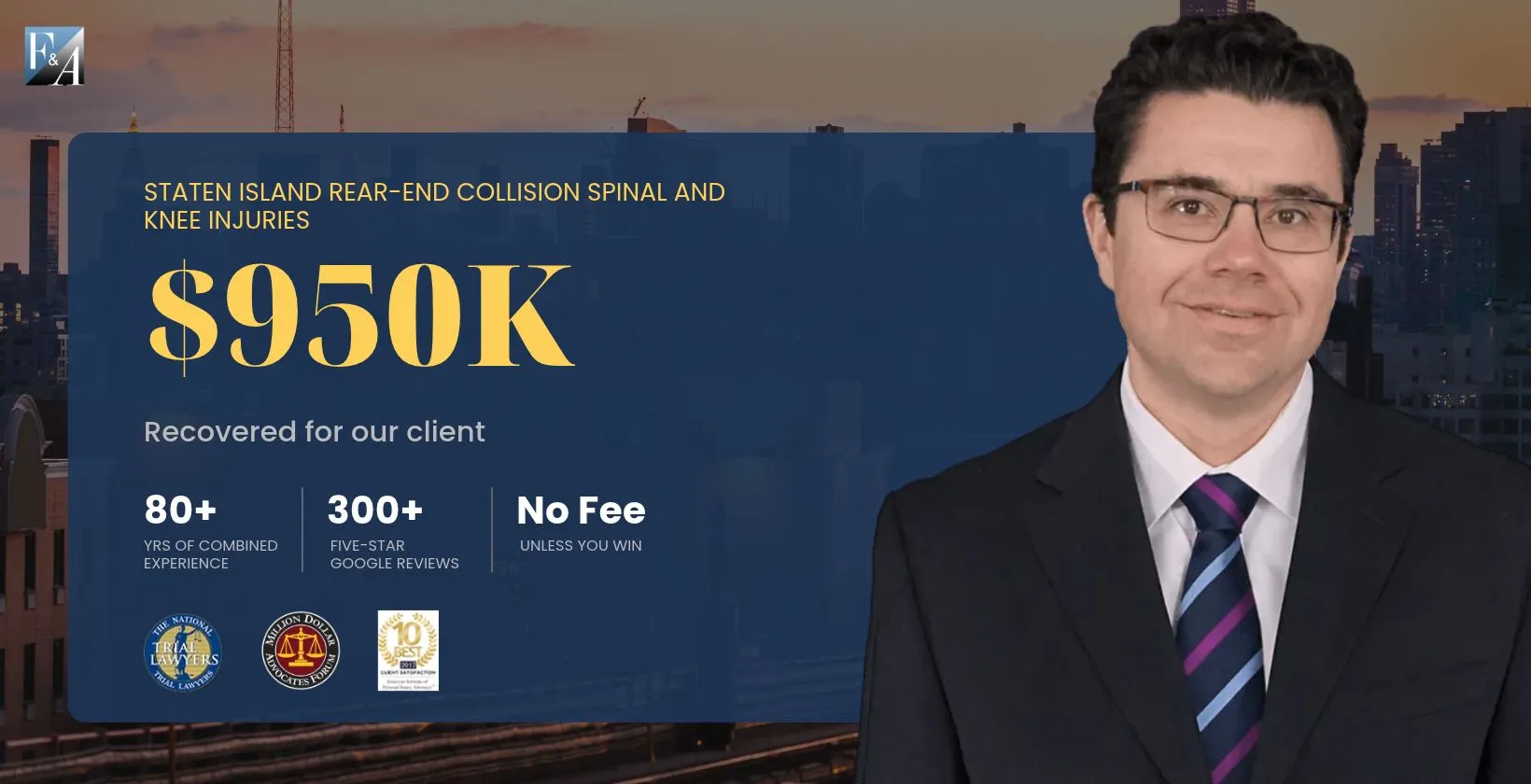
A 58 year old Staten Island flooring installer suffered serious neck, back, and knee injuries after another driver struck his stopped vehicle from behind, pushing it into a police vehicle. The accident led to multiple spinal procedures, knee surgery, a total knee replacement, and the loss of his ability to perform the physically demanding trade he had worked in for 35 years. Despite the defense arguing that his injuries were related to age and preexisting conditions, the case settled for $950,000.
A Staten Island Driver Is Struck From Behind While Stopped in Traffic
On an October afternoon, a 58 year old man was sitting in his vehicle, stopped in traffic on Staten Island.
A police vehicle was stopped directly in front of him.
Without warning, another driver struck the rear of his car.
The impact was forceful enough to push his vehicle forward into the police vehicle ahead.
Photographs taken after the collision showed substantial damage, including the rear driver’s front bumper being torn off.
The plaintiff maintained that he had been completely stopped when the collision occurred.
The case therefore centered primarily on the extent of the injuries caused by the accident rather than a complicated dispute over how the vehicles collided.
What initially appeared to be a rear end collision would lead to years of medical treatment, several surgeries, and permanent changes to the plaintiff’s ability to earn a living.
Serious Cervical Spine Injuries Requiring Surgery
Following the accident, the plaintiff underwent medical evaluations for persistent neck pain and related neurological symptoms.
MRI imaging identified cervical disc herniations involving levels C3 through C6.
Additional nerve testing confirmed cervical radiculopathy affecting the C6 nerve root.
This condition involves irritation or compression of a spinal nerve and may cause pain, numbness, weakness, or other symptoms extending into the arm.
The plaintiff initially attempted nonsurgical treatment.
His medical care included epidural steroid injections intended to relieve inflammation and pain.
However, the injections did not provide sufficient relief.
His continuing symptoms ultimately required cervical spine surgery.
He underwent a cervical discectomy at C5 C6 to address the affected disc.
Despite undergoing treatment, his physicians continued monitoring his spinal condition.
Further fusion surgery was discussed as a potential option if his symptoms continued.
Lower Back Injuries and Additional Spinal Surgery
The accident also resulted in significant complaints involving the plaintiff’s lumbar spine.
MRI imaging revealed herniated discs at L3 L4, L4 L5, and L5 S1.
The herniations were associated with pressure on nearby nerve roots.
His symptoms ultimately required a second spinal operation.
The plaintiff underwent lumbar decompression surgery intended to address the affected discs and relieve pressure on the nerves.
The combination of cervical and lumbar injuries substantially affected his ability to perform heavy physical work.
His doctors also discussed the possibility of additional spinal fusion surgery if his pain persisted.
The plaintiff’s case emphasized that the consequences of the collision involved multiple areas of his spine and the potential need for further medical intervention.
A Torn Meniscus Leads to Arthroscopic Surgery and Total Knee Replacement
In addition to his spinal injuries, the plaintiff suffered significant damage to his left knee.
Medical evaluations identified a torn meniscus.
He initially underwent arthroscopic knee surgery to address the injury.
However, the operation did not resolve his knee problems.
His condition eventually required a total knee replacement.
The procedure represented another major surgical intervention following the accident.
The knee injury, combined with his cervical and lumbar spine conditions, further reduced his ability to stand, walk, kneel, bend, and perform physically demanding tasks.
These limitations were especially significant because of the nature of his career.
Floor installation frequently requires prolonged kneeling, lifting heavy materials, bending, and working in physically strenuous positions.
The combined injuries made returning to that type of work increasingly difficult.
A 35 Year Flooring Career Cut Short by the Accident
Before the collision, the plaintiff had spent decades building a career through physical labor.
He grew up in Flatbush, Brooklyn, and left high school to begin working as a deli delivery boy.
Over the years, he worked in plumbing, painting, and union sign hanging.
He eventually established a long career in flooring installation.
For approximately 35 years, he installed vinyl flooring, ceramic tile, carpeting, and hardwood floors.
His work took him throughout New York, Florida, St. Louis, and Canada.
He took pride in being a skilled tradesman.
He considered himself a laborer rather than someone suited to office work.
Before the accident, he had planned to continue installing floors until approximately age 70.
Following the collision, his injuries prevented him from performing the physical demands of the trade.
He could no longer spend his days kneeling, lifting, bending, and installing flooring materials.
Instead, he transitioned to desk work preparing plans for flooring projects.
Although he remained involved in the industry, his ability to earn income was significantly reduced.
He reported earning approximately $8,000 less per month than before the accident.
The loss represented a substantial financial consequence for someone who had expected to continue working in his chosen profession for another decade or more.
From Active Family Member to a Life of Physical Limitations
The injuries also changed the plaintiff’s life outside work.
He had been married to his wife for 27 years.
They originally met when she visited a grocery store next to the carpet business where he worked.
Before the accident, he enjoyed spending time with his family, participating in activities, and attending events involving his children and grandchildren.
Afterward, the physical limitations caused by his spinal and knee injuries affected nearly every aspect of his routine.
His wife assumed responsibility for grocery shopping, deliveries, cleaning, and laundry.
Activities that once required little effort became difficult.
At his niece’s baby shower, he needed to use a cane.
He began declining invitations from his son to attend baseball and football games.
Family gatherings also became more challenging.
He could no longer comfortably play cornhole at barbecues or remain standing for extended periods while watching his three grandsons participate in sports.
As his ability to move around and remain active declined, he began spending much more time at home.
The plaintiff’s case emphasized that his injuries affected not only his earning capacity but also his independence, family relationships, and ability to enjoy ordinary activities.
Establishing Responsibility for the Rear End Collision
The plaintiff pursued a negligence claim against the driver who struck his vehicle from behind.
The circumstances of the accident formed an important part of the liability case.
The plaintiff was stopped in traffic.
He maintained that his vehicle was stationary immediately before the collision.
The defendant struck the rear of his vehicle.
The impact occurred from behind while the plaintiff was waiting in traffic.
The collision pushed the plaintiff’s car into another vehicle.
The force was sufficient to propel his vehicle forward into a stopped police vehicle.
Photographs documented substantial vehicle damage.
Images taken following the accident showed the striking vehicle’s front bumper had been torn off.
The plaintiff maintained that the defendant failed to stop in time and caused the collision.
In New York, a rear end collision involving a stopped vehicle can support an inference of negligence by the following driver, subject to any legally sufficient explanation for the collision.
The plaintiff’s case focused on the fact that he had been stopped when another vehicle struck him from behind.
The more significant litigation dispute involved the nature, extent, and cause of his injuries.
Overcoming a Defense That Attributed His Injuries to Age and Preexisting Conditions
The defendant disputed the extent to which the collision caused the plaintiff’s medical problems.
The defense argued that many of his symptoms and spinal conditions were related to age and preexisting degeneration rather than the accident.
This became a central issue because the plaintiff was 58 years old at the time of the crash.
The defense sought to limit damages by attributing his neck, lower back, and knee problems to conditions that existed before the collision.
The plaintiff challenged that position.
His case emphasized the medical treatment required after the crash, including cervical surgery, lumbar decompression surgery, arthroscopic knee surgery, and eventual total knee replacement.
He also relied on the substantial changes to his ability to work and perform everyday activities.
Before the accident, he had continued installing floors despite the physical demands of the occupation.
Following the collision, he could no longer perform that work and experienced a significant reduction in monthly income.
The plaintiff maintained that the accident caused new injuries or aggravated existing conditions, leaving him with substantial physical limitations.
His legal position also relied on the principle that a defendant may be responsible for aggravating a person’s preexisting condition, even when that person was more vulnerable to injury than someone without the same medical history.
The litigation therefore focused heavily on medical causation and the extent of the losses attributable to the collision.
$950,000 Settlement for Serious Spinal and Knee Injuries
After litigation involving the plaintiff’s spinal conditions, knee injuries, surgical treatment, and reduced earning capacity, the case resolved for $950,000.
The settlement provided substantial compensation in a case involving cervical and lumbar spine surgery, arthroscopic knee surgery, total knee replacement, and lasting physical limitations.
The plaintiff’s injuries prevented him from returning to the flooring installation work he had performed for approximately 35 years.
Although he remained employed in a less physically demanding role, he reported losing approximately $8,000 in monthly income.
The collision also substantially affected his family life, recreational activities, and physical independence.
The resolution followed a dispute in which the defense sought to attribute much of the plaintiff’s condition to age and preexisting medical problems.
The case illustrates how a rear end collision can cause or aggravate serious orthopedic conditions and substantially disrupt a person’s career, even when that individual continues working in a limited capacity.
Why This Case Matters for New York Rear End Accident Victims
This case highlights several important considerations in serious motor vehicle accident claims.
A rear end collision can cause injuries requiring multiple surgeries.
Neck, lower back, and knee injuries can require extensive medical treatment and may permanently affect mobility and physical function.
Drivers who strike stopped vehicles may face responsibility for the collision.
When a vehicle is stopped in traffic and struck from behind, the circumstances may support a negligence claim against the following driver.
Preexisting conditions do not automatically prevent compensation.
An accident may cause new injuries or aggravate existing medical problems. Medical evidence can help establish the extent of the resulting harm.
Physically demanding occupations can be especially vulnerable to serious orthopedic injuries.
Workers who rely on kneeling, bending, lifting, and prolonged standing may be unable to return to their previous jobs after spinal or knee surgery.
Returning to some form of employment does not necessarily eliminate lost earning capacity.
A person may remain employed while experiencing a substantial reduction in income because physical limitations prevent a return to higher paying work.
For this Staten Island flooring installer, a rear end collision ended his ability to perform the physically demanding trade he had practiced for decades.
The case ultimately resolved for $950,000.
Injured in a Rear End Car Accident in New York?
Rear end collisions can cause serious neck, back, and orthopedic injuries, sometimes requiring extensive surgery and resulting in permanent limitations.
The attorneys at Frekhtman & Associates represent individuals and families throughout Staten Island and New York City in serious motor vehicle accident cases, rear end collisions, spinal injury claims, and catastrophic personal injury litigation.
If you or a loved one suffered serious injuries because of another driver’s negligence, contact our firm for a No Obligation Case Review.
No fee unless we win.
Attorney Advertising. Prior results do not guarantee a similar outcome. Each case depends on its own facts and circumstances. The settlement represents a negotiated resolution, not a judicial finding of liability.