

A traumatic brain injury doesn’t just hurt your body. It drains your bank account, stops your income, and forces your family into financial decisions at the worst possible moment. Your insurer knows you’re under pressure. That’s exactly why their first offer arrives fast and lands low. Every day you wait without understanding your brain injury compensation rights, you risk accepting a number that falls short. It won’t cover your medical bills, your lost wages, or your long-term care.
Our attorneys at Frekhtman & Associates have spent 25+ years representing TBI victims across Brooklyn, Queens, the Bronx, Manhattan, and Staten Island. This guide explains how we calculate every compensation category under New York law and what evidence you need before responding to any offer.
Call (866) 288-9529 for a free case evaluation. No fee unless we win.
Key Takeaways
|
What Compensation Can You Claim After a Brain Injury?
If you suffered a TBI in New York due to someone else’s negligence, your claim can cover three legal categories: economic damages, non-economic damages, and punitive damages.
Economic Damages
- Medical treatment: ER care, neurosurgery, rehabilitation, physical and occupational therapy, speech therapy, medications, equipment, and home modifications.
- Lost wages: Income lost from the date of the accident through your recovery.
- Future earning capacity: The income gap between what you earned before the TBI and what you can realistically earn after.
- Long-term care: Lifetime professional caregiver costs, often the largest single item in the damages calculation.
Non-Economic Damages
- Chronic headaches, sensitivity to light and sound, persistent dizziness, and balance problems.
- Memory failure, difficulty concentrating, and impaired judgment.
- Personality and emotional changes
- Loss of consortium
- Loss of enjoyment of life
New York places no cap on non-economic damages. No such ceiling exists here.
Punitive Damages
If the defendant’s conduct went beyond ordinary negligence into reckless or malicious territory, our attorneys can pursue punitive damages on your behalf. A drunk driver, a property owner who ignored repeated written safety complaints, or a company that falsified safety records could all face a punitive claim in your case. Courts require clear and convincing evidence of malice or wanton disregard, so our team evaluates whether punitive damages apply based on the specific facts of your claim.
Wrongful Death
When a TBI results in death, your family’s claim shifts from personal injury to wrongful death under EPTL § 5-4.1. The filing deadline is two years from the date of death. Recoverable damages for your family include lost future earnings, loss of financial support, loss of companionship, and conscious pain and suffering your loved one experienced before death.
What Factors Determine Your Brain Injury Settlement Amount?
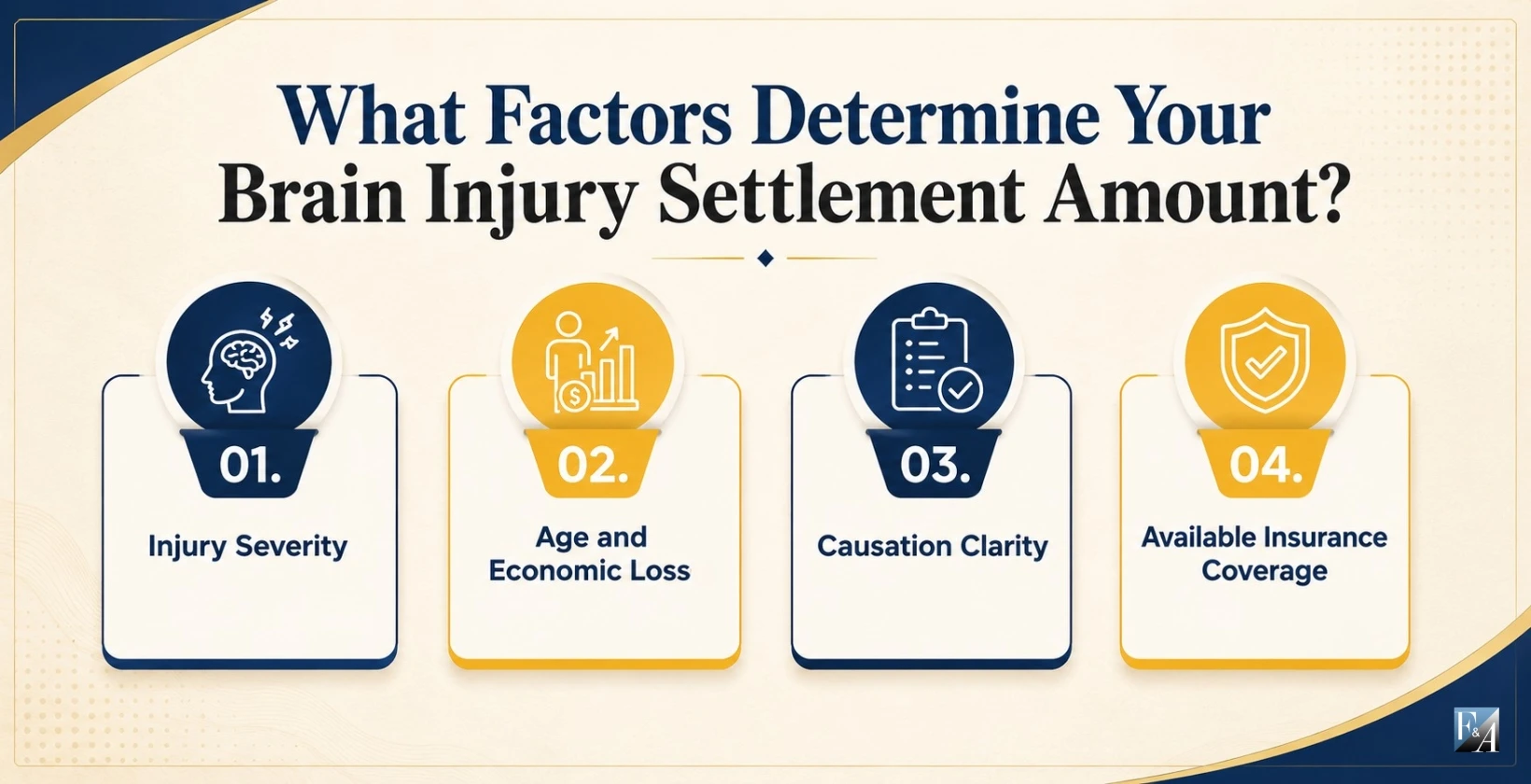
No two TBI cases settle for the same amount. These four factors shape what your claim is actually worth.
- Injury Severity: Mild TBI (Glasgow Coma Scale 13–15, loss of consciousness under 30 minutes) typically resolves within months. Moderate TBI (GCS 9–12) frequently results in permanent cognitive impairment. Severe TBI (GCS 3–8) regularly produces long-term disability or a need for supervised daily care. Diffuse axonal injury and intracranial hemorrhage produce the highest settlements because the structural damage is documentable on MRI and CT.
- Age and Economic Loss: Your age at the time of injury directly shapes your claim’s value. A 30-year-old who can no longer work after a moderate TBI faces decades of lost income and rising care costs. A life care planner and vocational expert calculate those figures and define the economic scope of your claim.
- Causation Clarity: When negligence is unambiguous, insurers settle faster and for higher amounts. When comparative fault is contested, your settlement shrinks in proportion to the percentage attributed to you. Under CPLR § 1411, a jury finding you were 30% at fault reduces your recovery by 30%, not to zero.
- Available Insurance Coverage: A drunk driver with a $25,000 policy caps your recovery at that amount unless you carry uninsured/underinsured motorist (UIM) coverage. Commercial defendants such as trucking companies and construction contractors typically carry far larger policies. Identifying every available coverage source is one of our first tasks when we take your case.

How Much Are Brain Injury Cases Worth in New York?
Your settlement value depends on your injury’s severity, your age, and the evidence your attorney builds. New York doesn’t cap what a jury can award, which means severe TBI cases have produced verdicts in the tens of millions. According to the CDC, there were approximately 214,110 TBI-related hospitalizations nationally in 2020 and 68,663 TBI-related deaths in 2023. For survivors, the financial cost runs just as high.
Our lawyers have secured a $69.5 million recovery in a motor vehicle accident case. Neuroimaging confirmed the damage. Neuropsychological testing quantified the deficits. Life care planning projected decades of costs. The jury couldn’t argue with the numbers.
Who Can Be Held Liable for a Brain Injury?
More than one party can be responsible for your injury. Our attorneys identify every liable defendant before your case is filed.
- Negligent drivers: If a driver’s negligence caused your injury, their insurer is accountable. In truck accidents, the carrier’s insurer is also involved. Car accidents are among the most common causes of moderate-to-severe TBI in working-age adults.
- Property owners: If you slipped on an unmarked wet floor, fell on a broken staircase, or tripped on a crumbling sidewalk, the owner can face premises liability for failing to correct a known hazard.
- Construction contractors: New York Labor Law § 240 imposes absolute liability on general contractors and property owners for elevation-related injuries, such as a fall from a scaffold or a falling object striking a worker. You don’t need to prove you were fault-free to recover. Labor Law § 241(6) works alongside it, imposing a non-delegable safety duty on contractors and owners for a broader range of construction-site hazards.
- Medical providers: If your TBI resulted from a birth injury, a missed intracranial hemorrhage, or a surgical error, you can pursue a medical malpractice claim against the provider responsible.
- Product manufacturers: If a defective helmet, a faulty airbag, or failed equipment contributed to your injury, liability attaches to the manufacturer regardless of whether the direct cause was a crash or a fall.
Not sure who’s responsible for your injury? Call (866) 288-9529 for a free case evaluation.
How Does New York Law Affect What You Recover?
New York law works in your favor in ways most states don’t allow. There’s no cap on what a jury can award you, no fault percentage that cuts off your right to recover, and specific filing rules that protect your claim from the start.
- No-fault insurance and the serious injury threshold: Under Insurance Law § 5102, your PIP coverage pays medical expenses and lost wages up to $50,000 after a car accident, regardless of fault. To sue for pain and suffering, your injury must meet the serious injury threshold, significant limitation of use, permanent consequential limitation, or 90 days of disability within the first 180 days.
- Pure comparative negligence: If you’re found 80% at fault, you still recover 20% of total damages under CPLR § 1411. New Jersey bars your recovery entirely at 51% fault or more. New York does not.
- Statute of limitations: Most TBI claims must be filed within three years under CPLR § 214. Municipal claims require a Notice of Claim within 90 days. Medical malpractice TBI claims carry a 2.5-year window. Missing any of these ends your case permanently.
- Workers’ compensation: Workers’ comp covers your medical bills and partial lost wages, but not pain and suffering. If a third party contributed to your injury, our attorneys can file a separate civil lawsuit alongside your workers’ comp claim to recover what workers’ comp cannot pay.
What Evidence Builds a Strong Brain Injury Compensation Claim?
Your TBI claim fails when the injury can’t be documented. Not because it doesn’t exist, but because the right evidence wasn’t gathered in time.
- Neuroimaging: A standard CT scan identifies acute bleeds and skull fractures but misses diffuse axonal injury and many contusions. Consider a common scenario: you go to the ER after a rear-end collision, your CT comes back negative, and you are discharged. Three weeks later, an MRI with diffusion tensor imaging (DTI) reveals white matter disruption across multiple tracts. That MRI is the difference between a denied claim and a documented injury. If your CT was negative but your symptoms are real, get a neurologist referral for advanced MRI imaging before any settlement is discussed.
- Neuropsychological testing: A licensed neuropsychologist administers standardized tests measuring your memory, attention, processing speed, executive function, and language. The results produce an objective cognitive profile that directly contradicts the insurance argument that you’re fine because the scan looks normal.
- A life care plan: A certified life care planner projects the cost of every medical service, therapy, assistive device, and caregiver hour you’ll need over your lifetime. Without that document in the record, your future care costs have no number an adjuster or jury can act on.
- Witness statements and employment records: Family members, friends, and colleagues who knew you before the injury can testify to the behavioral and cognitive changes they’ve observed. Pay stubs, tax returns, and performance reviews establish the concrete financial gap between your earning capacity before and after the TBI.
- Liability evidence: Police reports, EMT records, Glasgow Coma Scale scores documented at the scene, CCTV footage, and scene photographs establish how the accident happened and who caused it. A documented loss of consciousness at the scene carries particular weight in New York TBI claims.

Should You Accept a Settlement Offer for a Brain Injury?
Not before you know what your injury will cost over a lifetime. Insurance adjusters push for fast settlements because speed favors them, but signing a release closes your claim permanently. Because brain injuries are unpredictable, a mild TBI can turn into years of cognitive fog, while a moderate injury might quietly end your career even if you look fine day to day. If you settle early, your payout reflects how you present today, not how you will function years from now.
Never respond to an offer until your neurological evaluation, neuropsychological testing, and life care plan are in hand. These three documents define your financial floor. Without them, you’re negotiating against an insurer who already knows exactly what your case is worth.
Request a free case evaluation.
Talk to a New York Brain Injury Lawyer Today
Your TBI claim depends on evidence gathered early, the kind outlined above. Without it, a fast settlement locks in a number based on how you look today rather than what your injury will cost over a lifetime. New York law gives you the right to build your case properly. You just have to protect that right before you sign any insurance documents.
At Frekhtman & Associates, we have spent 25+ years representing TBI victims across Brooklyn, Manhattan, Queens, the Bronx, and Staten Island, and we review every case at no cost. You pay no fee unless we recover compensation for you.

Call (866) 288-9529 or request a free case evaluation online.
Frequently Asked Questions
How Long Does a TBI Lawsuit Take in New York?
Most TBI cases settle before trial, typically 12 to 24 months after you reach maximum medical improvement. Cases that go to trial take three to five years from filing to verdict. The TBI lawsuit time depends on the complexity of your injury, the number of defendants, and how aggressively the insurer fights the claim.
Can I Still Recover Compensation If I Was Partly at Fault?
Yes. New York follows pure comparative negligence under CPLR § 1411. There is no fault percentage that cuts off recovery. A plaintiff found 70% at fault still recovers 30% of the total damages. Your compensation is reduced in proportion to your share of fault, never eliminated by it.
What Is a Life Care Plan, and Why Does It Matter?
A life care plan is a document prepared by a certified life care planner projecting the cost of every future medical service, therapy, assistive device, and caregiver hour a TBI victim will need over their lifetime. Without this document in the record, future care costs remain a number that an adjuster can dismiss as speculative. It is one of the most important pieces of evidence in a high-value TBI case.
Does a Normal CT Scan Mean I Don’t Have a Compensable TBI?
No. A standard CT scan detects acute bleeding and fractures but misses diffuse axonal injury, microhemorrhages, and many contusions. MRI with DTI sequences can reveal white matter damage invisible on CT. A normal CT scan in the emergency room is not a medical or legal finding that you’re uninjured. Neuropsychological testing and advanced neuroimaging frequently document significant injury in patients whose initial CT appeared normal.
What Happens to a TBI Compensation Claim If the Victim Dies?
A fatal TBI triggers a wrongful death claim under EPTL § 5-4.1. Your family or estate has two years from the date of death to file. Recoverable damages include lost future earnings, loss of financial support, loss of companionship, and the conscious pain and suffering your loved one experienced before death. A survival action under EPTL § 11-3.2 runs alongside it to recover damages your loved one could have claimed had they survived.
Prior results do not guarantee a similar outcome. Every case is unique, and the value of any claim depends on its specific facts.