
If you are weighing that decision right now, you are not alone, and you deserve a clear picture of what pursuing a traumatic brain injury lawsuit in New York actually involves before you decide anything. Working with an attorney for traumatic brain injuries starts with that clarity.
If you are weighing that decision right now, you are not alone, and you deserve a clear picture of what pursuing a traumatic brain injury lawsuit in New York actually involves before you decide anything. At an NYC brain injury law firm like Frekhtman & Associates, attorney Arkady Frekhtman and our team have spent 25+ years representing brain injury survivors across New York City.
This guide walks you through when to file, how your attorneys prove a TBI case, what compensation can cover, and what the process looks like from the first call to resolution.
Call (866) 629-9529 for a free consultation with our traumatic brain injury lawyers.
When Does a Brain Injury Claim Become a Lawsuit?
Most TBI cases start as insurance claims. Your attorney submits a claim to the at-fault party’s insurer, they investigate, and sometimes a fair resolution follows without any court involvement. This is one of three ways a brain injury lawyer helps your claim move forward. A traumatic brain injury lawsuit becomes necessary when that process breaks down:
- The insurer denies the claim outright, arguing that the policyholder was not at fault
- The offer does not cover existing medical bills, let alone future care and lost income
- The insurer disputes TBI severity by pointing to normal imaging results to minimize your injury
- Policy limits are too low to cover the full damage, requiring additional defendants to be pursued
Filing a lawsuit doesn’t mean going to trial. It formally initiates the civil process, gives your claim legal standing, and puts binding deadlines on the other side. Most cases still resolve through negotiated settlement. The litigation process is what creates the pressure and surfaces the evidence that moves insurers toward a number that actually reflects your losses.
How Fault Is Legally Established in a TBI Lawsuit
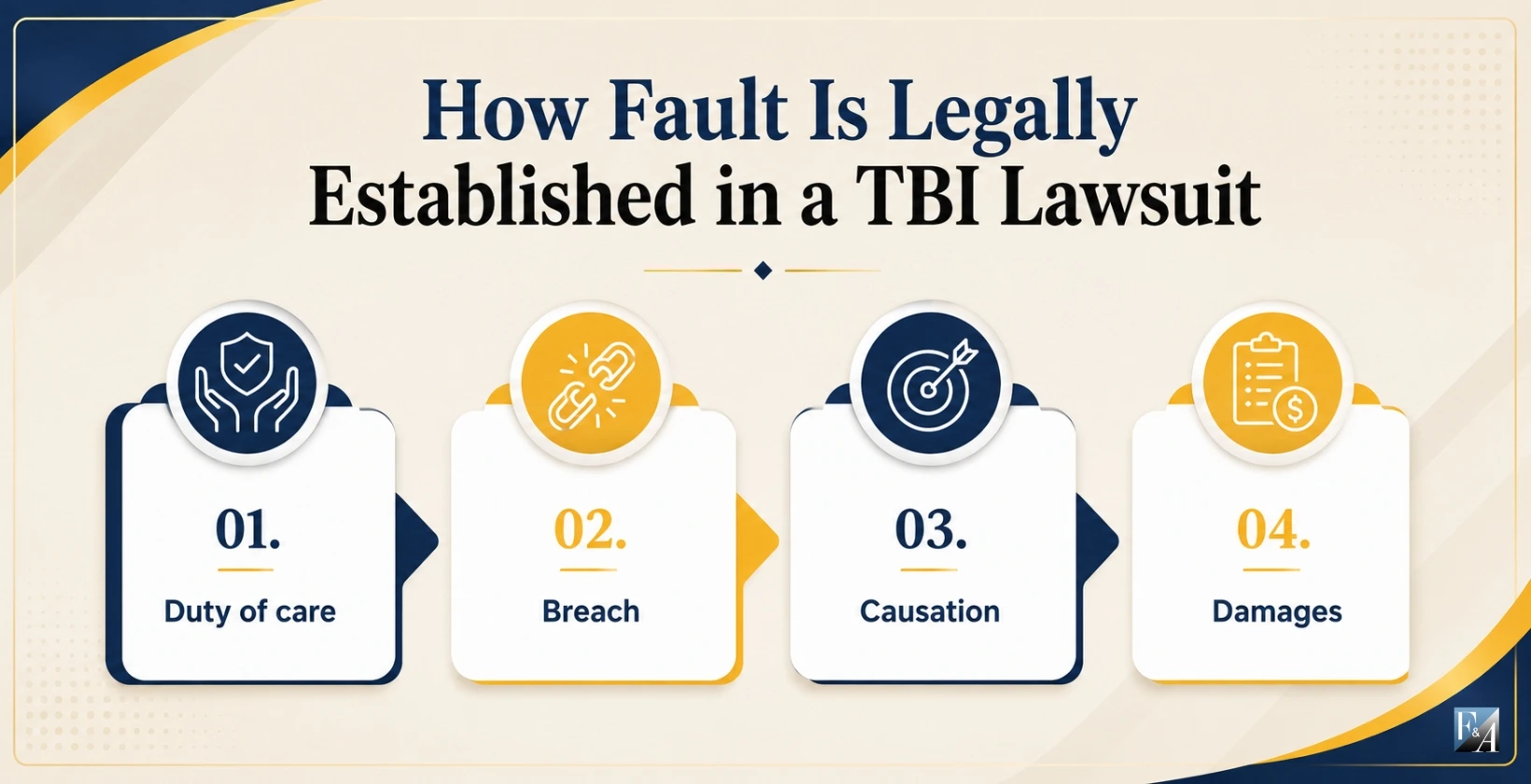
To win a traumatic brain injury lawsuit, you must prove that someone else’s negligence caused your injury. The state laws that shape TBI claims determine exactly what that proof has to look like.
- Duty of care: The defendant had a legal obligation to act safely. Drivers owe that duty to other road users. Property owners owe it to visitors. Employers owe it to workers.
- Breach: The defendant failed to meet that standard. A driver who runs a red light, a property owner who ignores a broken railing, or a trucking company that pushes a driver past legal hours each represents a breach.
- Causation: The breach directly caused your brain injury. Defendants routinely argue that pre-existing conditions or later events caused your symptoms, not their conduct.
- Damages: The injury produced real, quantifiable harm. Medical bills, lost income, and cognitive impairment are the core categories.
A police report placing the defendant at fault supports duty and breach. Emergency medical records connecting the impact to the injury support causation. Neuropsychological test results document damage. When any link is weak, defendants push hard on it.
Common Causes of TBI That Lead to Lawsuits
The cause of your TBI determines which defendants are named, which legal theories apply, and what evidence the case is built around. Reviewing what causes traumatic brain injuries most often in New York is a useful starting point.
Motor Vehicle Accidents
Car and truck crashes are among the most litigated TBI patterns in New York. Rapid deceleration forces the brain forward into the skull, then backward, producing coup-contrecoup injuries across multiple regions. Even low-speed collisions cause serious claims when the head strikes glass, an airbag, or a headrest. A high-profile brain injury case out of Georgia showed how these mechanics play out in litigation. TBI after car accidents follows predictable injury mechanics that attorneys and experts know how to document.
Slip and Fall Accidents
Falls are the leading cause of TBI across all age groups, according to the CDC. When a dangerous property condition caused your fall, the owner can be held liable under premises liability law. Head injuries in falls and car crashes share evidentiary patterns attorneys look for early. Slip and fall TBIs are frequently undervalued in initial offers because the full cognitive picture takes months to emerge.
Construction Accidents
Falls from height, falling objects, and struck-by incidents are among the most serious TBI accident patterns seen on New York job sites. Labor Law §§240 and 241 impose absolute liability on property owners and general contractors for gravity-related injuries, which significantly strengthens these claims. Workers may also pursue third-party lawsuits against equipment manufacturers or subcontractors in addition to a workers’ compensation claim.
Medical Malpractice
Preventable errors in a healthcare setting can directly damage brain tissue or deprive it of oxygen. Common examples include surgical errors, stroke misdiagnosis, anesthesia mistakes, and birth injuries involving oxygen deprivation. Why children’s brain injury cases are different matters most in this category, since damages calculations stretch across a full lifetime. These claims fall under medical malpractice law rather than standard negligence.
Defective Products
A product that malfunctions or fails to provide protection during an impact can produce a TBI with no other party directly at fault. Product liability claims in this category typically involve defective helmets, airbags that fail to deploy, or malfunctioning machinery.
Why TBIs Are Treated Differently Than Other Personal Injuries
Most moderate-to-severe TBIs qualify as catastrophic injuries under New York law. Unlike a broken bone that heals to a defined endpoint, the neurological damage affects memory, processing speed, emotional regulation, and executive function for years or permanently. Why TBI claims need experienced counsel becomes clear once you see how that classification changes how compensation is calculated and what future damages you can claim.
- Long-term or lifetime cognitive rehabilitation
- Psychiatric treatment for depression, anxiety, and PTSD
- Home care or personal assistance costs if daily functioning is affected
- Family counseling for relationship strain caused by cognitive and behavioral changes
Life care planners project these costs over your lifetime. Those projections drive the future-damages component of your claim, which is why TBI awards are larger than most other personal injury cases. If this sounds like your situation, the sooner an attorney reviews your case, the better. Call (866) 629-9529 for a free consultation.
How Attorneys Prove a Brain Injury When the MRI Comes Back Normal
Standard MRI and CT scans detect structural damage: bleeds, fractures, swelling. They are not built to detect diffuse axonal shearing, microscopic fiber tears, and neurochemical disruptions that characterize most mild-to-moderate TBI cases. Knowing where to get TBI treatment in New York City matters here too, since the right specialists catch what a normal scan misses. A normal scan does not mean an uninjured brain. It means the imaging the insurer prefers did not detect the injury pattern your doctors are treating.
Neuropsychological Testing
Standardized cognitive batteries administered by a licensed neuropsychologist measure processing speed, working memory, executive function, attention, and emotional regulation. Results are compared against baseline population norms. Objective scores document the injury regardless of what the MRI shows.
Advanced Imaging
Diffusion tensor imaging (DTI) maps white matter fiber tracts and can detect axonal shearing that conventional MRI misses. Functional MRI measures brain activity patterns rather than structure. Both modalities can support your claim even when standard imaging appears normal.
Medical Records Demonstrating Symptom Trajectory
A continuous record from the emergency room through neurology and rehabilitation documents the full injury picture. Gaps in treatment give defendants ammunition to argue that symptoms resolved or were caused by something else. Consistent documentation by qualified specialists protects your claim.

What Compensation Can Cover in a New York TBI Lawsuit
A TBI costs you money and takes things that money can’t replace. New York law recognizes both. Understanding brain injury compensation in New York means looking at economic damages for the financial losses you can calculate and non-economic damages for the pain, disruption, and loss the injury has caused.
Economic Damages
- Past and future medical expenses: emergency care, hospitalization, neurology, neuropsychology, rehabilitation, physical therapy, occupational therapy, cognitive therapy, psychiatric care, medications, and assistive devices
- Lost wages from missed work during recovery
- Diminished earning capacity when the injury permanently limits your career options going forward
- Home care and personal assistance costs
- Home modification expenses for severe TBI with physical disability
Non-Economic Damages
- Pain and suffering
- Emotional distress (depression, anxiety, and PTSD)
- Loss of enjoyment of life
- Loss of consortium
How New York’s Comparative Fault Law Affects Your Recovery
Under CPLR §1411, New York follows a pure comparative fault doctrine. Your degree of fault reduces your recovery but does not eliminate it. You can be 60% at fault and still recover 40% of your total damages.
When defendants argue shared fault, as they do in TBI cases, New York law doesn’t bar your recovery. A pedestrian who crossed against the light or a worker who was not wearing a hard hat still has a valid claim. Your damages are reduced proportionally, not eliminated. Your rights after a brain injury include the right to contest an inflated fault percentage. Insurers routinely overstate plaintiff fault percentages during negotiations. Contesting those allocations requires evidence: speed data, witness accounts, surveillance footage, and engineering analysis that places fault where the facts support it.
Why Brain Injury Cases Depend on Expert Testimony
A jury cannot evaluate diffuse axonal injury, neuropsychological testing methodology, or lifetime care projections without qualified specialists explaining what the evidence means. An overview of the NFL concussion litigation shows just how much expert testimony can shape the outcome of a high-stakes TBI case.
- Neurologist or Neurosurgeon: Establishes the medical foundation; what happened to your brain, how it happened, and what treatment it requires.
- Neuropsychologist: Administers standardized cognitive batteries and interprets scores against population norms. The results translate your injury into objective, documented numbers a jury can evaluate. In mild TBI cases where imaging looks normal, this testimony is often the most persuasive evidence in the room.
- Life Care Planner: Projects future medical and personal care costs over your lifetime. That projection forms the foundation of your future damages claim and is typically the most scrutinized document at mediation.
- Vocational Rehabilitation Expert: Testifies about which occupations are no longer accessible and what the income difference amounts to over a working lifetime, anchoring the diminished earning capacity figure in your economic damages.

How Long Do You Have to File a Brain Injury Lawsuit in New York
CPLR §214 gives you three years from the date of injury to file a TBI lawsuit in New York. Missing that deadline ends the claim regardless of its merit. Two deadlines are shorter:
- Municipal and city agency claims: A Notice of Claim must be filed within 90 days of the accident under GML §50-e. This applies to injuries involving MTA buses, city parks, and city-owned buildings.
- Wrongful death claims: EPTL §5-4.1 carries a separate two-year deadline running from the date of death, not the accident.
Surveillance footage gets overwritten. Witness memories fade. The longer you wait, the harder the case is to build. The deadlines don’t pause while you decide. If you’re unsure which deadline applies to your situation, don’t wait to find out.
What Actually Happens After You File a Brain Injury Lawsuit
Most TBI cases resolve through negotiated settlement before reaching a jury. The quality of trial preparation is what makes favorable settlements possible. Insurers offer more when they believe your attorney will try the case.
- Investigation and Evidence Preservation: Before filing, your attorney investigates the accident, identifies all potentially liable parties, preserves surveillance footage, sends spoliation notices to prevent destruction of records, and collects medical documentation to quantify your injury.
- Filing the Complaint: The lawsuit begins with a Summons and Complaint filed in New York Supreme Court. The defendant is served and has 20 to 30 days to answer, depending on the method of service. This formally starts the litigation process and stops the statute of limitations from expiring.
- Discovery: Both sides exchange documents, medical records, accident reports, and witness information. You and the defendant each sit for depositions. Expert witnesses are identified, and their reports exchanged. Discovery in TBI cases can run a year or longer, depending on case complexity.
- Mediation and Settlement Negotiations: Most TBI cases in New York go through at least one round of formal mediation with a neutral facilitator. If mediation does not resolve the case, negotiations continue informally as both sides weigh the cost and risk of proceeding to trial.
- Trial: When a settlement is not reached, the case goes to a jury. Both sides present lay witnesses, treating physicians, and expert testimony. The jury decides liability and the damages amount.
Five Questions to Ask Before Hiring a Brain Injury Attorney
Choosing the right attorney shapes what your case is worth. What to know before hiring a brain injury lawyer starts with these five questions, which help you evaluate whether an attorney has the depth your TBI case requires.
- Have you taken TBI cases to trial?
Attorneys who try these cases develop a reputation that affects what insurers offer at mediation. Ask for specific examples, not general assurances. - Do you work with neuropsychologists and life care planners?
The right experts are the difference between a documented claim and an underdeveloped one. An attorney who cannot name the experts they typically use has not built these cases in depth. - What is your experience with mild TBI cases specifically?
Winning a mild TBI case when imaging looks normal requires a higher level of evidentiary work than moderate or severe cases. That distinction matters when your scan came back clean. - Do you handle cases on contingency?
Personal injury attorneys typically take TBI cases on contingency, meaning no fees unless they recover compensation for you. Confirm this before engaging. - What is your honest assessment of my case?
An attorney who quotes a large number at the first meeting without reviewing your records is not giving you an assessment. A reliable attorney reviews the facts first and gives you a measured, evidence-based answer.
Common Questions About Filing a TBI Lawsuit
1. Can I File a TBI Lawsuit if My Injury Was Diagnosed as Mild?
Yes. The medical classification of “mild” describes the immediate post-injury presentation, not the long-term outcome. Why a mild TBI is not a minor injury is a distinction insurers exploit and courts recognize. A mild diagnosis does not limit your legal claim if the injury has produced documented, lasting effects on your life.
2. What If I Did Not Go to the Hospital Right After the Accident?
Delayed treatment creates a gap that defendants use to argue the injury was not caused by the accident. Expert testimony can address that gap, but seeing a doctor as soon as possible protects your claim. Do not wait.
3. How Long Does a TBI Lawsuit Take in New York?
Timeline varies by case complexity and whether the matter goes to trial. Your attorney can give you a realistic estimate once the facts of your case are reviewed.
4. Does Wearing a Seatbelt or Helmet Affect My Claim?
Not wearing one may be raised as comparative fault. Under CPLR §1411, that reduces your damages proportionally but does not bar your claim.
5. Should I Accept the Insurance Company’s First Offer?
First offers do not reflect the full value of a TBI claim. The insurer’s initial calculation is based on limited evidence. Consulting an attorney before accepting any settlement preserves your options. Once you sign a release, the claim is closed permanently.
Speak With a New York Brain Injury Attorney
A traumatic brain injury lawsuit involves medical evidence, expert witnesses, and legal deadlines that move quickly. The first step is a consultation with a brain injury attorney who handles these cases at trial.
Frekhtman & Associates has recovered over $900 million for injured New Yorkers across 25+ years of practice. Our team represents TBI survivors from car accidents, construction incidents, falls, and assaults across Brooklyn, Queens, the Bronx, Manhattan, and Staten Island.
Frekhtman & Associates has recovered over $900 million for injured New Yorkers across 25+ years of practice. Our team represents TBI survivors from car accidents, construction incidents, falls, and assaults across Brooklyn, Queens, the Bronx, Manhattan, and Staten Island, including brain injury claims in Queens that come through our borough offices.
Call (866) 629-9529 or use the contact form for a free, confidential consultation.
Prior results do not guarantee a similar outcome.