
After a car crash, an adrenaline surge masks pain and suppresses early symptoms. Some of the most serious brain damage from a car accident, including slow arterial bleeding and tearing of nerve fibers across the brain, produces no obvious signs at the scene. By the time symptoms appear, secondary damage is already underway.
Our NYC brain injury attorneys at Frekhtman and Associates have seen this pattern in cases across New York City: victims who felt fine at the scene and were critically injured hours later.
Gaps in medical treatment give insurance adjusters grounds to argue a separate event caused your injury or that it was less severe than claimed. Either argument can reduce or eliminate compensation for what may become millions of dollars in long-term care costs. This guide covers what those hidden injuries are, how to recognize delayed warning signs, and what New York law requires to pursue your claim.
If you have questions now, call us at (866) 288-9529 for a free case evaluation.
Can a Car Accident Cause Brain Damage Without Hitting Your Head?
Yes. You do not need to strike the steering wheel, dashboard, or window for your brain to sustain serious injury. In a collision, rapid deceleration stops the skull while the brain continues moving, slamming into the inner surface, bouncing back, and rotating. That rotation shears axons, the nerve fibers that carry signals between brain regions.
Whiplash compounds the risk. The sharp forward-and-back snap of the neck transmits force through the cervical spine directly to the brainstem. A study published in the American Journal of Neuroradiology (2020) found measurable changes in brain network connectivity in people with whiplash-associated disorders, even when standard imaging appeared normal.
Types of Brain Injuries Caused by Car Accidents
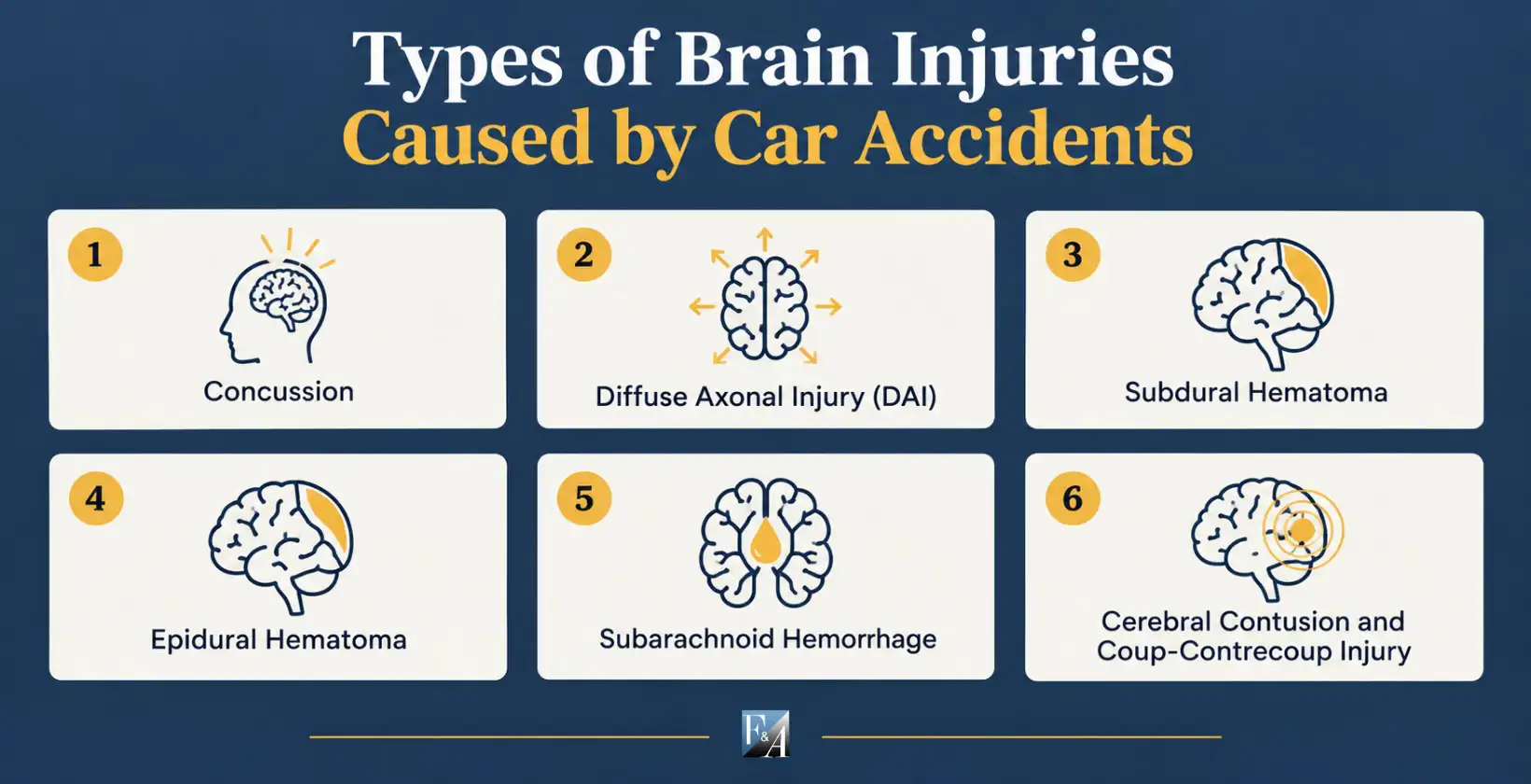
These are the diagnoses that appear most frequently after motor vehicle crashes, and they track closely with typical head injuries after a serious accident more broadly, whether the cause was a fall or a collision.
- Concussion: A mild traumatic brain injury caused by the brain losing normal electrical function after rapid movement or impact. No structural damage appears on a standard CT scan. Symptoms include headache, mental fog, light and sound sensitivity, slowed reaction time, sleep disruption, and mood changes. Post-concussion syndrome, where symptoms persist beyond the acute phase, develops in a subset of cases. “Mild” describes the initial clinical presentation, not the long-term impact on daily life.
- Diffuse Axonal Injury (DAI): Rotational forces tear axons across both brain hemispheres. CT scans show nothing. MRI is required for detection. Severe DAI causes coma and leaves permanent deficits in memory, attention, processing speed, and personality.
- Subdural Hematoma: Blood collects between the brain and the dura mater after bridging veins rupture. Because venous pressure is low, this builds slowly over hours. Older adults face higher risk because age-related brain atrophy creates more space for blood to accumulate before pressure rises.
- Epidural Hematoma: Arterial blood from the middle meningeal artery collects between the skull and the dura, expanding rapidly under arterial pressure, a neurosurgical emergency.
- Subarachnoid Hemorrhage: Blood enters the space between the brain surface and the arachnoid membrane, raising intracranial pressure and triggering vasospasm, a narrowing of cerebral arteries that can cause stroke days after the original injury. The warning sign is a sudden severe headache unlike any you have experienced before.
- Cerebral Contusion and Coup-Contrecoup Injury: A contusion is a bruise on brain tissue itself. Coup-contrecoup injury produces a mirror contusion on the opposite side of the brain as it rebounds off the skull. The frontal and temporal lobes, governing judgment, impulse control, and memory, sustain the most damage. These injuries are frequently misread as psychiatric conditions, which delays the correct neurological diagnosis.
Brain Injury Warning Signs and Why Symptoms Are Delayed
The phrase “Talk and die” means you remain alert after the crash, sometimes for hours, then lose consciousness from a bleed that was expanding the entire time. This happens because brain injury occurs in two stages: primary damage at impact, then secondary injury as swelling builds, intracranial pressure rises, and oxygen delivery to neurons drops in the hours that follow.
An epidural hematoma expands from arterial pressure while the brain still has reserve space. You appear lucid, then deteriorate suddenly once that space runs out. A subdural hematoma builds more slowly. You may be discharged with a normal CT result and worsen overnight.
Not all symptoms appear at the scene. Return to the ER immediately if any of the following develop after discharge.
Mild TBI:
- Persistent or worsening headache
- Mental fog or confusion
- Nausea
- Light and sound sensitivity
- Slowed thinking or difficulty concentrating
- Irritability or mood changes
- Disrupted sleep
- Memory gaps around the accident
Moderate to Severe TBI:
- Loss of consciousness lasting more than a few minutes
- Post-traumatic amnesia beyond 24 hours
- Repeated vomiting
- Seizures
- Clear fluid from the nose or ears
- One-sided weakness or numbness
- Slurred speech or inability to form words
- Unequal or dilated pupils
- Inability to be woken
In children, watch for:
- Persistent inconsolable crying
- Refusal to eat
- Loss of a recently learned skill
- Unsteady walking
- Unusual irritability after any collision
If you’re more concerned about the brain injuries in children and teens, read our dedicated guide on How To Recognize Traumatic Brain Injuries in Young Children and Teens.
Long-Term Effects of Brain Damage From a Car Accident
The CDC documents moderate and severe TBI as producing lasting physical, cognitive, behavioral, and emotional changes that affect every area of daily life, including the ability to return to work. These consequences are central to calculating the value of your legal claim.
Physical and Cognitive Effects
- Weakness or partial paralysis
- Balance problems
- Tremors and spasticity
- Swallowing difficulties
- Persistent fatigue
Behavioral and Psychiatric Effects
- Disinhibition, impulsivity, and aggression
- Personality changes
- Depression and post-traumatic epilepsy are documented consequences of severe TBI
A life care plan projects your medical, rehabilitative, and custodial care costs over your expected lifetime. In major TBI cases in New York City, those projections routinely reach $5 million or more. See our NYC TBI verdicts and settlements.
Compensation Available for a Brain Injury Claim in New York
New York law allows you to pursue three categories of damages. Our full breakdown of brain injury compensation in New York covers each in detail, but the value of your claim depends on the severity of your injury, the strength of your medical documentation, and whether the at-fault driver’s conduct rises above ordinary negligence.
Economic Damages
- Medical expenses: past and future, including surgery, rehabilitation, and long-term neurological care
- Lost wages and lost earning capacity
- In-home care and daily living assistance
- Life care plan costs over your expected lifetime
Non-Economic Damages
- Pain and suffering
- Loss of enjoyment of life
- Loss of consortium for spouses and dependents
Punitive Damages
Available when the at-fault driver’s conduct was reckless or intentional. Drunk driving and street racing are the most common grounds in New York TBI cases, as seen in a case involving brain injury caused by an alleged drunk driver on Long Island. A separate showing beyond negligence is required under New York law.

Your Legal Rights After a Car Accident Brain Injury
New York’s no-fault system pays your first $50,000 in medical bills and lost wages under NY Insurance Law § 5102. It does not cover pain and suffering or non-economic losses. To pursue those, your injury must meet the serious injury threshold under § 5102(d).
A TBI meets that threshold under two categories:
- Significant limitation of use of a body function or system
- A medically determined injury that prevents you from performing substantially all usual daily activities for at least 90 of the 180 days following the accident
Deadlines that bar your claim if missed:
- Personal injury lawsuit: 3 years from the accident date under CPLR § 214
- If a government vehicle or defective road caused the crash: Notice of Claim within 90 days under NY General Municipal Law § 50-e
If your crash also caused a spinal cord injury, both can be pursued in the same claim. If the crash was fatal, your family has a separate wrongful death claim under NY EPTL § 5-4.1. Our broader guide to the legal consequences of a crash-related brain injury covers these overlapping claims in more depth.
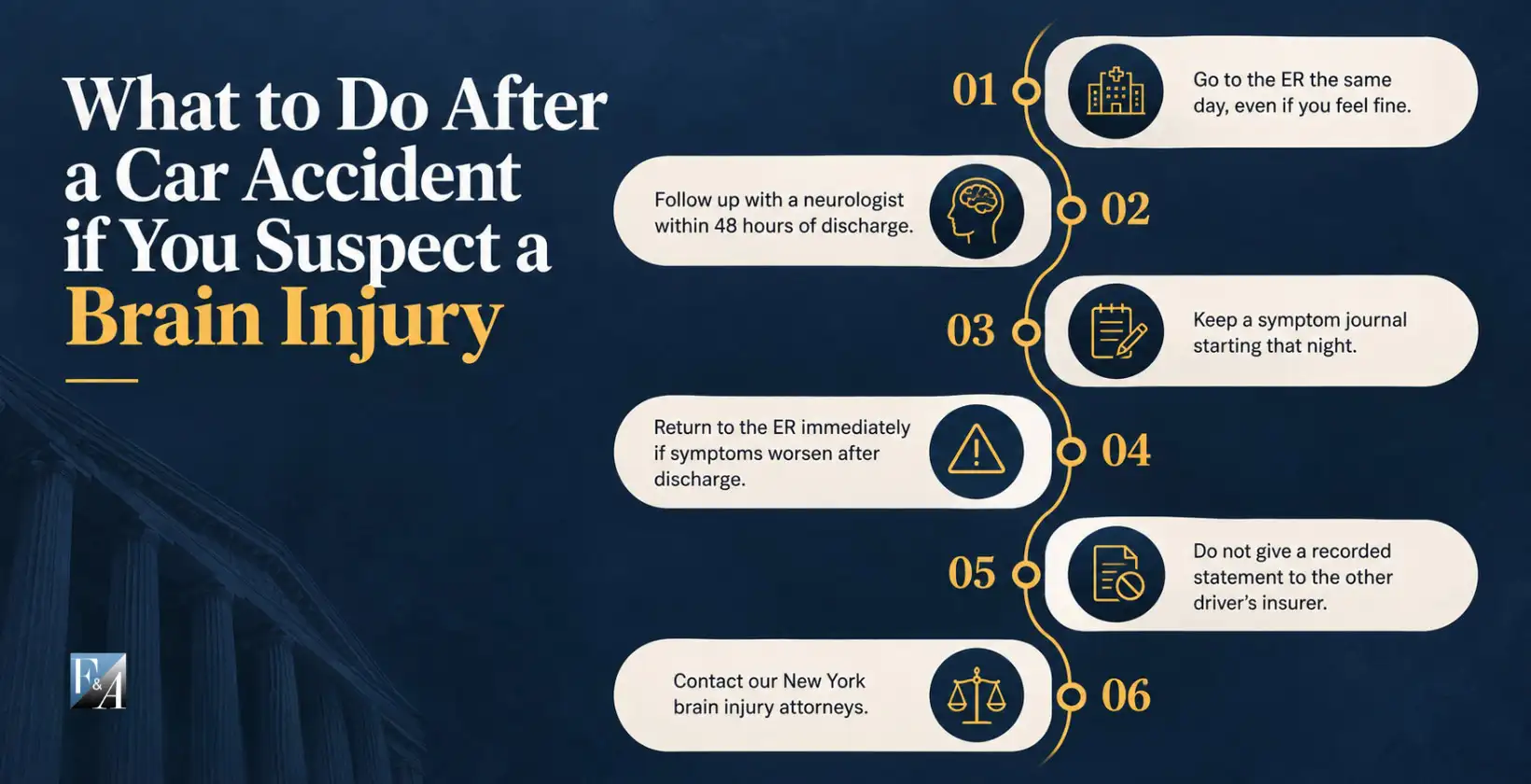
What to Do After a Car Accident if You Suspect a Brain Injury
The steps you take in the first 72 hours affect both your medical outcome and your legal claim.
- Go to the ER the same day, even if you feel fine. Adrenaline suppresses pain and early TBI symptoms are subtle. Request a CT scan and make sure the visit is documented. Do not wait for symptoms to develop.
- Follow up with a neurologist within 48 hours of discharge. Emergency physicians rule out life-threatening conditions. They do not document the full clinical picture of a TBI. A neurologist does, and that record supports your claim.
- Keep a symptom journal starting that night. Write down every headache, cognitive difficulty, mood change, and sleep disruption with the date and time. Contemporaneous records carry more weight than a recalled account months later.
- Return to the ER immediately if symptoms worsen after discharge. A progressively worsening headache, new confusion, one-sided weakness, or difficulty staying awake can indicate a developing hematoma.
- Do not give a recorded statement to the other driver’s insurer. Adjusters are trained to use statements made in the hours after a crash, when you may minimize symptoms, against your claim.
- Contact our New York brain injury attorneys. Dash cam footage, black box data, and physical evidence disappear quickly. A preservation letter requests that evidence be retained before it is lost.
Our NYC car accident lawyers handle cases across all five boroughs.
Why Choose Frekhtman & Associates for Your Brain Injury Case
Choosing the right attorney after a brain injury changes the outcome. Insurance companies close TBI claims quickly and cheaply. Our founding attorney, Arkady Frekhtman, has spent over 25 years building TBI cases in New York City courts, and our team at Frekhtman & Associates was built to counter exactly that.
- Proven Record: We have recovered over $900 million for injured clients across documented cases; our largest single motor vehicle recovery is $69.25 million.
- Trial-Ready Preparation: Our lawyers work with neurologists, neuropsychologists, and certified life care planners to build the medical documentation your case requires; that means objective imaging reports, neuropsychological test scores, and a life care plan that quantifies your long-term costs before any settlement discussion begins.
- New York Courtroom Experience: Our attorneys have taken complex TBI cases to verdict when insurers refused to offer fair value; we hold a 9.8 Avvo rating and National Top 100 Trial Lawyers recognition.
- Bilingual Support: We serve our clients in English and Russian.
- Contingency Fee Basis: You pay nothing unless we recover for you; there are no upfront costs at any stage of your case.
If you were injured in a car accident and suspect a brain injury, call (866) 288-9529 for a free case evaluation.
Frequently Asked Questions
Can You Get Brain Damage From a Minor Car Accident?
Yes. Low-speed collisions can produce concussion and, in some cases, diffuse axonal injury without any head contact. The brain’s vulnerability comes from inertial forces transmitted through rapid deceleration and neck whiplash, not only from direct impact. A crash that does not deploy airbags or cause visible vehicle damage can still injure the brain.
Why Did My Brain Injury Symptoms Appear Days After the Crash?
Because secondary brain injury develops over hours and days, not at the moment of impact. A subdural hematoma can take 12 to 72 hours to become symptomatic. Any new or worsening symptom after discharge warrants an immediate return to the ER.
How Much Is a Brain Injury Claim Worth in New York?
It depends on injury severity, your age and occupation, and how thoroughly the long-term effects are documented. Cases involving post-concussion syndrome have settled between $100,000 and $500,000. Moderate-to-severe TBI cases with permanent cognitive or functional deficits have reached $2 million to $25 million in New York City courts.
What if I Was Partly at Fault for the Accident?
You can still recover damages. New York follows pure comparative negligence under CPLR § 1411. Your award is reduced by your percentage of fault, not eliminated. If you were 50 percent at fault, you recover 50 percent of your damages.
How Long Does Brain Damage From a Car Accident Last?
It depends on injury severity. A concussion with no complications resolves within one to four weeks. Post-concussion syndrome can persist for months or longer in a subset of cases. Moderate TBI recovery is measured in months, often requiring inpatient rehabilitation followed by outpatient therapy. Severe TBI, particularly diffuse axonal injury, can produce permanent deficits.
Talk to a New York Brain Injury Attorney
Brain injury cases turn on documentation: medical records, black box data, dash cam footage, and accident reconstruction. Black box data is overwritten within 30 days. Dash cam footage rarely survives 72 hours. We act quickly to preserve evidence before it disappears.
At Frekhtman and Associates, our lawyers handle TBI cases on a contingency fee basis across Brooklyn, Manhattan, Queens, the Bronx, and Staten Island. You pay nothing unless we recover for you.
Call us at (866) 288-9529 or contact our lawyers for a free case evaluation.
Prior results do not guarantee a similar outcome.