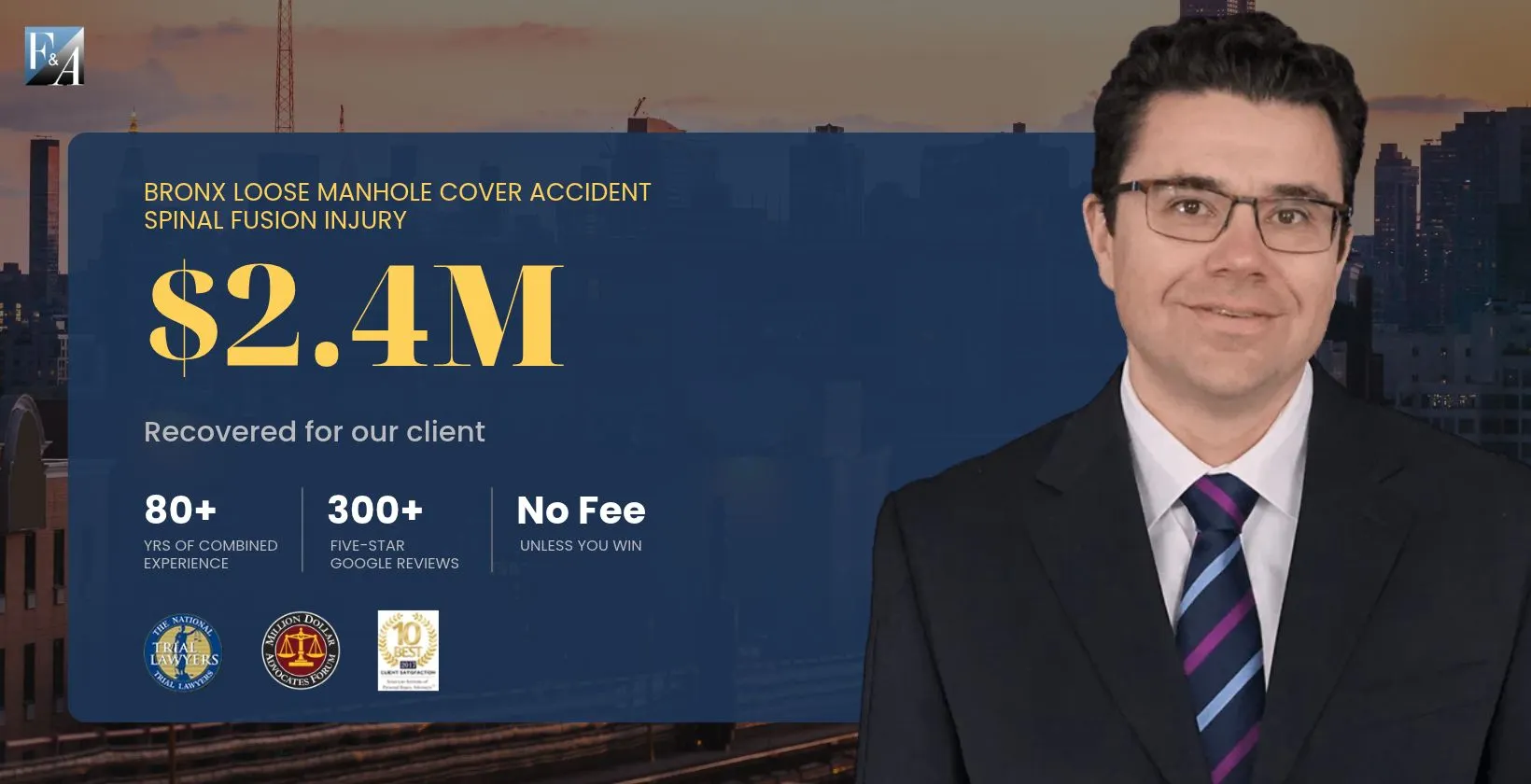
A Bronx father and grandfather suffered serious lower back injuries after his vehicle struck a loose utility manhole cover, causing a violent impact that threw him upward against the roof of his car. The utility company responsible for the cover had reportedly received notice of the dangerous condition eight days before the accident but failed to repair it. The case ultimately settled for $2,400,000 during trial.
A Loose Manhole Cover Causes a Violent Crash on a Bronx Roadway
On a July evening, a Bronx father and grandfather was driving along Broadway in the northwest Bronx.
As his vehicle passed near the entrance to a gas station, it traveled over a loose utility manhole cover embedded in the roadway.
The cover tipped upward beneath the vehicle.
The resulting impact was severe.
The force threw the driver upward out of his seat, causing his head to strike the roof of the car before his body slammed back down into the driver’s seat.
The violent movement placed substantial force on his spine.
Although the accident involved a roadway hazard rather than a collision with another vehicle, its consequences were devastating.
The driver sustained lower back injuries that would eventually require major spinal surgery and permanently affect his ability to work, exercise, and participate in family activities.
What made the case particularly significant was that the utility company had reportedly been warned about the dangerous manhole cover more than a week before the crash.
The Utility Company Had Been Warned Eight Days Before the Accident
The manhole cover belonged to a major utility company responsible for maintaining the structure.
Eight days before the driver’s accident, a member of the public had reported the hazardous cover.
That complaint was forwarded to the utility company.
Despite receiving notice of the condition, the company did not send personnel to repair the cover during the following eight days.
According to the plaintiff’s case, the dangerous condition remained unaddressed until the night of the accident.
A company troubleshooter finally arrived at the location after the crash had already occurred.
The prior complaint became a central piece of evidence in the litigation.
Rather than requiring the plaintiff to establish that the company should have discovered an unknown roadway defect, the case focused on evidence that the utility company had already received notice of the specific hazard.
The plaintiff argued that the company had sufficient time to investigate and repair the loose cover before it caused an injury.
Serious Lumbar Disc Injuries Requiring a Two Level Spinal Fusion
The violent impact caused serious injuries to the driver’s lower back.
Following the accident, medical evaluations identified lumbar disc herniations.
His condition ultimately required a two level lumbar spinal fusion.
Spinal fusion is a major surgical procedure intended to stabilize affected segments of the spine.
For the plaintiff, the surgery represented a significant medical intervention following an accident that had abruptly changed his physical capabilities.
The injuries also created an important medical causation dispute.
Because the driver’s head struck the roof of his vehicle, the defense questioned how that movement could have caused injuries to his lumbar spine.
The plaintiff’s case focused on the complete sequence of the accident, including the force that threw his body upward and then caused it to slam back down into the seat.
His legal team prepared a medical animation to illustrate this mechanism of injury.
The animation demonstrated how the impact could transmit substantial force through the body and into the lower spine.
The plaintiff’s spinal surgeon was prepared to testify that the accident caused his lumbar disc injuries and the need for fusion surgery.
The case therefore required not only documenting the spinal damage but also explaining how the unusual roadway impact produced the injuries.
From an Active Film Industry Worker to a Life of Physical Limitations
Before the accident, the plaintiff worked on film sets and music video productions.
His responsibilities involved physically demanding tasks, including carrying equipment trunks, lighting fixtures, cameras, and other heavy production materials.
He was also pursuing his own creative ambitions.
He had been shooting, lighting, and editing an independent film project.
Following the accident, he was unable to complete that project.
Outside of work, he maintained an active lifestyle.
He lifted weights several times a week and regularly played basketball and handball with his twin brother.
The brothers shared a close relationship built partly around sports, exercise, and spending time together.
He was also the person his family relied upon for physical tasks.
Whether carrying groceries, moving heavy objects, or helping with household responsibilities, he had always been the one who could handle the work.
He enjoyed taking his family to parks, lakes, and beaches.
At amusement parks, he particularly loved riding the most intense attractions.
Following the accident and spinal surgery, many of these activities were no longer possible.
His injuries affected not only his employment and hobbies but also the role he had always played within his family.
How the Accident Changed His Family’s Everyday Life
The consequences of the accident became apparent in the simplest daily routines.
Before the crash, the plaintiff could climb the four flights of stairs to his apartment in approximately one minute.
Afterward, the same trip took five to seven minutes.
He had to stop and rest on every floor.
Tasks he once performed without thinking became physically difficult.
His wife took over carrying bags and other items.
His teenage daughters assumed more responsibility for cleaning, grocery shopping, and carrying groceries upstairs.
The change was especially difficult for a man who had always taken pride in supporting his family.
He described feeling like a burden to the people who previously depended on him.
His relationship with his grandchildren was also affected.
He could no longer pick them up.
During family trips to the pool, he remained seated at the side while watching everyone else participate.
His ability to spend time with his twin brother changed as well.
They no longer played basketball, exercised together, or went out as they had before the accident.
The injuries took away not just physical strength but many of the activities and relationships that had defined his everyday life.
The plaintiff’s case emphasized that the harm extended far beyond medical expenses and spinal surgery.
It included the loss of independence, creative opportunities, recreational activities, and meaningful time with his family.
Establishing the Utility Company’s Responsibility for the Dangerous Manhole Cover
The plaintiff pursued a negligence claim against the utility company that owned and maintained the manhole cover.
A central issue was whether the company knew about the dangerous condition and failed to take reasonable steps to correct it.
The plaintiff’s case focused on several important circumstances.
The utility company owned and maintained the manhole cover.
The company was responsible for the structure involved in the accident.
The dangerous condition had been reported before the crash.
A member of the public complained about the loose cover eight days earlier, and the complaint was forwarded to the utility company.
The company did not repair the cover during those eight days.
According to the plaintiff, no maintenance personnel were dispatched to correct the condition before the accident.
The manhole cover tipped upward beneath the plaintiff’s vehicle.
The plaintiff maintained that the defective cover caused the violent impact that threw him against the vehicle’s roof.
The plaintiff relied on roadway maintenance requirements.
His case emphasized applicable New York City rules concerning the maintenance, condition, and repair of utility manhole covers.
The utility company’s own testimony became an important component of the litigation.
A company troubleshooter acknowledged that manhole covers sit on metal rims without bolts or screws securing them in place.
He also explained that the supporting rims can wear down over time as vehicles repeatedly travel across them.
When questioned about the company’s procedures for loose manhole covers, he testified that there was “really no procedure.”
He further stated that the company did not inspect the structure beneath a cover when it had flipped and that his responsibility was to refer the problem to another department.
When asked about the particular repair assignment, the troubleshooter repeatedly testified that he did not remember it.
The plaintiff argued that this testimony, combined with the prior complaint, demonstrated serious deficiencies in the company’s response to a known roadway hazard.
Overcoming the Defense’s Arguments About Driver Responsibility and Preexisting Conditions
The utility company disputed responsibility for the accident.
One defense argument concerned the plaintiff’s position on the roadway.
The company pointed to the fact that he had been driving in a lane near a gas station entrance marked by a solid white line.
It suggested that he should not have been traveling in that lane and that his own driving contributed to the accident.
The defense also challenged whether the company had acted unreasonably in maintaining the manhole cover.
It emphasized that manhole covers are heavy and do not ordinarily become loose easily.
The utility company argued that it could not be expected to monitor every manhole cover at every moment.
The plaintiff responded by emphasizing the distinction between continuous monitoring and responding to a specific reported danger.
His position was that the company had already received notice of this particular loose cover eight days before the accident.
The defense also disputed the medical cause of his lower back injuries.
It questioned how an impact involving his head striking the roof could produce lumbar disc herniations requiring fusion surgery.
Additionally, the defense pointed to his history of heavy weightlifting as a potential alternative explanation for his spinal condition.
The plaintiff addressed these arguments through medical evidence and the proposed testimony of his spine surgeon.
His legal team also developed a medical animation illustrating the movement of his body during the impact and the force transmitted through his lower spine.
An economist was prepared to testify concerning the plaintiff’s economic losses.
The litigation therefore involved significant disputes over the utility company’s maintenance obligations, the driver’s conduct, and the relationship between the unusual crash mechanism and the resulting spinal injuries.
$2,400,000 Settlement Reached During Trial
After litigation involving the defective manhole cover, the utility company’s prior notice, and the extent and cause of the driver’s spinal injuries, the parties reached a $2,400,000 settlement during trial.
The resolution provided substantial compensation in a case involving lumbar disc herniations, major spinal fusion surgery, physical limitations, and significant disruption to the plaintiff’s work and family life.
The settlement followed disputes concerning whether the utility company had failed to respond to a known roadway hazard and whether the accident caused the plaintiff’s lower back condition.
The case illustrates how a dangerous roadway defect can cause serious injuries even without a collision involving another vehicle.
It also demonstrates the importance of identifying prior complaints, investigating maintenance procedures, and developing medical evidence to explain unusual mechanisms of injury.
Why This Case Matters for New York Roadway Accident Victims
This case highlights several important considerations in serious accidents involving defective roadway infrastructure.
Utility companies may face responsibility for dangerous manhole covers.
Companies that own or maintain roadway structures may have legal obligations concerning their inspection, maintenance, and repair.
Prior complaints can become critical evidence of notice.
In this case, the plaintiff relied on a complaint made eight days before the accident to argue that the utility company knew about the specific dangerous condition.
A vehicle does not have to collide with another car to cause serious injuries.
Roadway defects, displaced manhole covers, and other hazards can produce violent movements inside a vehicle and result in significant physical trauma.
Medical evidence can help explain unusual accident injuries.
When the relationship between an impact and a spinal injury is disputed, physician testimony, diagnostic records, and medical illustrations may help explain how the injuries occurred.
The consequences of serious spinal injuries can extend into every aspect of daily life.
For physically active individuals, chronic back problems and major spinal surgery can affect employment, independence, family responsibilities, and activities that once brought enjoyment.
For this Bronx father and grandfather, striking a loose manhole cover resulted in major spinal surgery and lasting changes to his personal and professional life.
The case ultimately resolved for $2.4 million during trial.
Injured in a Roadway Accident in New York?
Dangerous manhole covers, defective utility structures, and poorly maintained roadways can cause serious injuries to drivers, passengers, cyclists, and pedestrians.
The attorneys at Frekhtman & Associates represent individuals and families throughout New York City in serious motor vehicle accident cases, roadway defect claims, and catastrophic spinal injury litigation.
If you or a loved one suffered injuries because of a dangerous roadway condition, contact our firm for a No Obligation Case Review.
No fee unless we win.
Attorney Advertising. Prior results do not guarantee a similar outcome. Each case depends on its own facts and circumstances. The settlement represents a negotiated resolution, not a judicial finding of liability.