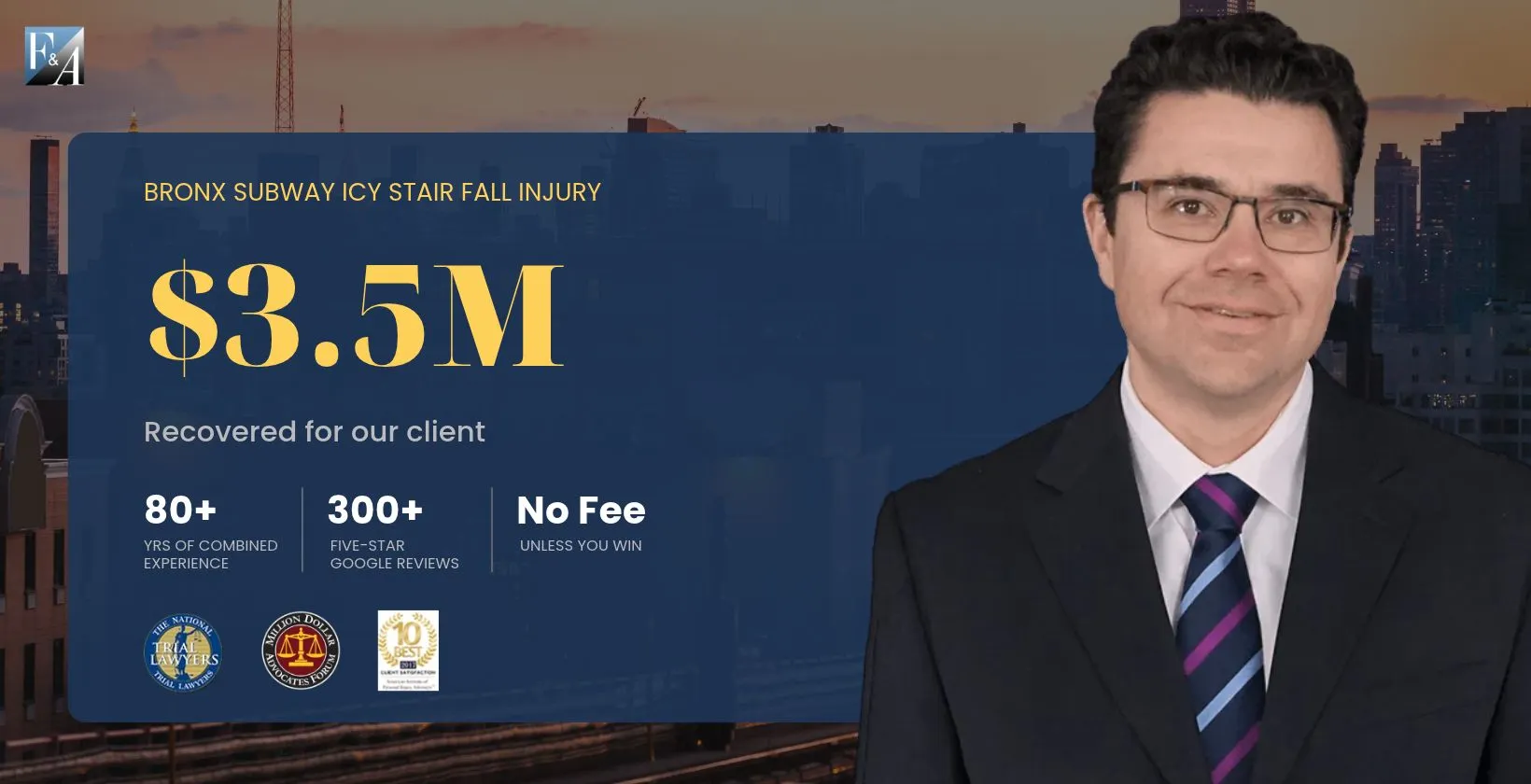
A 33 year old Bronx subway passenger suffered devastating spinal and neurological injuries after slipping on snow and ice covering an elevated subway station staircase. Despite the transit agency’s own winter maintenance rules requiring crews to clear stairways, the assigned cleaning team was removed after just ten minutes without completing the work. The passenger ultimately underwent extensive spinal surgeries, leaving six levels of his cervical spine fused. Frekhtman & Associates secured a $3,500,000 settlement during trial.
Snow and Ice Accumulate on an Elevated Bronx Subway Station Staircase
On a Sunday in early March, snow fell across New York City.
The snowfall ended at approximately 9:50 p.m.
At an elevated subway station in the Bronx, the outdoor staircases remained exposed to the winter conditions.
Ice accumulated on the steps, with snow covering the slippery surface.
For subway passengers using the station, the staircases provided the only way to reach the street.
The transit agency responsible for the property maintained a winter operations manual outlining how employees were expected to respond to snow and ice.
According to the agency’s own rules, snow removal was supposed to take priority over other maintenance duties once snowfall began.
Crews were instructed to clear every stairway and landing before moving to another station.
They were also expected to continue working until the station was reported to be in satisfactory condition.
Despite these requirements, the staircases were not cleared before passengers began using the station the following morning.
The circumstances surrounding the agency’s response would become a central issue in the litigation.
A Snow Removal Crew Leaves After Just Ten Minutes
Shortly after midnight, the transit agency assigned a snow removal crew to the Bronx station.
The team arrived and signed in at approximately 1:40 a.m.
However, at 1:50 a.m., just ten minutes later, a field office instructed the crew to report to another station.
The crew left without clearing the snow and ice from the staircases.
No replacement team was sent.
The original crew never returned.
Station records documented the absence of further cleaning activity.
According to the sign in logs, no cleaning crew reported to the station that morning.
The records also showed that a supervisor did not sign in until approximately 4:45 p.m.
As a result, all four staircases were left untreated during the morning hours.
More than twelve hours had passed since the snowfall ended.
The plaintiff’s case emphasized that the transit agency had recognized the need for snow removal by assigning a crew in the first place.
However, the agency then reassigned those workers before they performed the necessary work.
This failure allegedly left passengers exposed to dangerous conditions.
A Subway Passenger Falls Down an Entire Flight of Icy Stairs
At approximately 10:00 a.m. on Monday, a 33 year old man arrived at the elevated Bronx subway station.
He was traveling to a doctor’s appointment.
After exiting his train, he approached the staircase leading down to the street.
The steps were visibly covered with snow.
Beneath the snow was a layer of ice.
The plaintiff was wearing snow boots.
Recognizing the dangerous conditions, he warned other passengers behind him to be careful.
He then grasped the handrail with his left hand and attempted to descend.
As he took his first step, his foot slipped.
He lost his balance and fell down the entire flight of stairs.
Two strangers witnessed the incident.
Both confirmed that the staircase was covered with snow and ice.
One witness photographed the dangerous condition and called for an ambulance.
These independent witnesses and the photographs became important evidence documenting the condition of the staircase immediately after the accident.
The plaintiff sustained serious injuries that would require multiple surgical procedures and permanently alter his life.
A Previously Active Man Suffers Devastating Cervical Spine Injuries
The plaintiff had a significant medical history involving his cervical spine.
Years before the subway accident, he had undergone neck surgery following a motor vehicle collision.
However, he maintained that he had successfully recovered from that earlier injury.
Following his recovery, he returned to an active lifestyle.
He worked in construction.
He also worked as a nightclub bouncer.
He trained as a boxer, lifted weights, and regularly participated in dancing.
He was an accomplished salsa dancer who had even been invited to perform at a salsa congress.
His level of physical activity became important evidence in the litigation because the defense later attempted to attribute his injuries to the prior accident.
Following the subway staircase fall, MRI imaging showed that the previously repaired levels of his cervical spine remained intact.
The plaintiff maintained that the fall had damaged previously healthy levels below the earlier surgical site.
His subsequent medical treatment became extensive.
Multiple Cervical Spine Surgeries Leave Six Levels Fused
The plaintiff underwent a cervical fusion procedure involving the lower levels of his neck.
The surgery was intended to stabilize the injured spinal segments.
Unfortunately, the bone graft failed to heal properly.
This complication required another, much more extensive operation.
The second surgery involved revision of the cervical fusion through both the front and back of his neck.
The procedure required substantial surgical intervention and spinal instrumentation.
Following the operation, the plaintiff was admitted to the intensive care unit.
Ultimately, six levels of his cervical spine were fused.
Plates, rods, and screws were used to stabilize the affected areas.
The extensive fusion significantly restricted the movement of his neck.
His treating spine surgeon also warned that additional surgery might become necessary.
The physician raised the possibility of extending the fusion farther down his back.
The plaintiff therefore faced both permanent limitations from the completed procedures and the possibility of further major spinal surgery.
Permanent Left Hand Dysfunction and Additional Orthopedic Injuries
The fall also caused significant neurological and orthopedic injuries beyond the cervical spine.
According to the plaintiff’s medical evidence, the accident damaged a nerve affecting his left hand.
He lost the ability to straighten his fingers normally.
The impairment also affected his grip.
Surgeons attempted to improve his hand function through a tendon transfer procedure.
However, the surgery did not restore his normal gripping ability.
The plaintiff continued experiencing substantial limitations involving his left hand.
He also sustained a torn rotator cuff in his left shoulder.
That injury required arthroscopic surgery.
Additional injuries included a torn meniscus in his left knee and herniated discs in his lumbar spine.
The combination of spinal injuries, hand dysfunction, shoulder damage, and knee problems significantly affected his mobility and physical independence.
His medical condition involved multiple body regions and extensive treatment.
The plaintiff maintained that these injuries resulted from the fall down the icy subway staircase.
A Construction Worker, Boxer, and Dancer Loses His Independence
Before the accident, the plaintiff’s life revolved around physical activity.
He worked in construction and hoped to eventually establish his own construction company.
He trained as a boxer and lifted weights.
He was also passionate about salsa dancing.
His abilities had earned him an invitation to perform at a salsa congress.
Following the accident and extensive spinal surgeries, those activities were no longer possible.
His cervical fusion significantly limited his mobility.
His left hand impairment made ordinary tasks difficult.
He could no longer work in construction.
He could no longer box or dance.
Swimming also became impossible because his left hand could not perform the necessary stroke.
Even basic household activities were affected.
The plaintiff could not fold his clothes normally.
Instead, he kept his clothes hanging where he could reach them.
He could not cook or clean his home independently.
He drove using only his right hand and obtained a disability parking permit.
The plaintiff had hoped to marry, have children, and build his own construction business.
The accident profoundly disrupted those plans.
His case emphasized that the injuries did not simply interrupt his employment.
They affected his identity, independence, recreational activities, and expectations for the future.
Establishing the Transit Agency’s Responsibility for the Icy Staircase
Frekhtman & Associates pursued a premises liability claim against the public transit agency responsible for operating and maintaining the subway station.
The plaintiff argued that the agency failed to provide a reasonably safe route for passengers leaving the station.
Several important circumstances supported the claim.
The staircase was the only available route to the street.
Passengers exiting the elevated station had no alternative but to use the outdoor stairs.
The steps were covered with snow and ice.
Independent witnesses confirmed the dangerous condition, and photographs documented the staircase following the accident.
The agency had established winter maintenance procedures.
Its operations manual directed crews to prioritize snow removal and clear station stairways and landings.
A snow removal crew was assigned to the station.
The agency sent workers to address the winter conditions shortly after midnight.
The crew left without performing the required work.
The workers were reassigned approximately ten minutes after signing in.
No replacement cleaning team arrived that morning.
Station logs showed no additional cleaning personnel before the accident.
The plaintiff maintained that the agency had sufficient notice of the hazardous condition and failed to take reasonable action to correct it.
The case focused on whether the agency’s failure to follow its own snow removal procedures exposed passengers to an unreasonable risk of injury.
The Transit Agency’s Own Employees Confirmed the Snow Removal Procedures
The plaintiff relied on testimony from transit agency personnel to establish how the station should have been maintained.
One cleaner testified that snow removal took priority over other maintenance duties.
The employee also explained that crews were expected to monitor conditions for refreezing ice.
The supervisor responsible for the crew assigned to the station acknowledged that her team had not performed snow removal before leaving.
Her testimony also addressed the absence of replacement personnel.
The plaintiff argued that the testimony, combined with the station logs and winter operations manual, demonstrated that the hazardous conditions were not simply overlooked.
Instead, the agency had dispatched workers and then redirected them before the dangerous staircases were cleared.
The timing became particularly important.
Snowfall had ended the previous evening.
The plaintiff fell at approximately 10:00 a.m. the following morning.
During that interval, the station’s outdoor stairs remained untreated.
The plaintiff maintained that the agency had a reasonable opportunity to address the condition before the accident occurred.
A Defense That Blamed Earlier Neck Surgery and Degeneration
The transit agency disputed the cause and extent of the plaintiff’s injuries.
A major component of its defense involved his earlier cervical spine surgery.
The agency argued that his current condition was attributable to the prior accident and degenerative spinal changes rather than the subway fall.
The plaintiff challenged that position.
He maintained that he had recovered from the earlier surgery and returned to a highly active lifestyle.
His history included physically demanding construction work, nightclub security work, boxing, weightlifting, swimming, and salsa dancing.
The plaintiff also relied on postaccident MRI findings showing that the previously operated cervical levels remained intact.
His position was that the subway fall injured other spinal levels, ultimately requiring extensive surgical treatment.
The plaintiff further argued that a defendant may be responsible for aggravating an existing medical condition.
Even if his earlier neck injury made him more vulnerable, he maintained that the agency’s negligence caused additional harm.
The litigation therefore involved disputes concerning prior medical history, the cause of the new spinal injuries, and the extent of the plaintiff’s permanent disability.
The Defense Also Argued That the Snow Was Visible
The transit agency challenged liability by pointing out that the plaintiff had observed the snow before attempting to descend the stairs.
He had even warned other passengers about the dangerous conditions.
The defense argued that his awareness of the hazard was relevant to whether he had exercised reasonable care.
The plaintiff responded that he had no alternative means of leaving the station.
The stairs were the only available route to the street.
He had also taken precautions.
He was wearing snow boots, warned others about the conditions, and held the handrail before stepping down.
Despite these efforts, his foot slipped on the ice and snow.
The agency additionally argued that a relatively small station did not necessarily require a full cleaning crew.
It maintained that its policies did not require a supervisor to remain physically present at every station throughout the day.
The plaintiff emphasized that the central issue was not whether a supervisor had to be present continuously.
Instead, it was whether the agency had taken reasonable steps to clear the dangerous stairways before passengers used them.
The case therefore involved competing arguments concerning the agency’s maintenance obligations and the plaintiff’s own conduct.
$3,500,000 Settlement Reached During Trial
After extensive litigation involving the transit agency’s maintenance procedures, the plaintiff’s prior medical history, and the severity of his injuries, Frekhtman & Associates secured a $3,500,000 settlement during trial.
The resolution provided substantial compensation to a man who underwent multiple major cervical spine operations and was left with six fused levels of his neck.
His injuries also involved permanent left hand dysfunction, shoulder surgery, knee damage, and lumbar spine problems.
The accident ended his ability to continue working in construction and participating in many of the physical activities that had defined his life.
The settlement followed disputes concerning whether the transit agency had adequately maintained the staircases and whether the plaintiff’s injuries were caused by the fall or his earlier medical conditions.
The case illustrates the importance of documenting hazardous conditions, obtaining maintenance records, and examining a property owner’s own operating procedures when pursuing a serious slip and fall claim.
Why This Case Matters for New York Subway Slip and Fall Victims
This case highlights several important considerations in serious subway station and snow and ice accident claims.
Transit agencies must take reasonable steps to maintain safe station entrances and exits.
Snow and ice accumulation on stairways can create serious hazards for passengers, particularly when an outdoor staircase provides the only route to the street.
Maintenance records can provide important evidence of notice and response.
In this case, crew assignments, station logs, and winter operations procedures helped establish what the agency knew and what work had or had not been performed.
Witness photographs can preserve evidence of dangerous conditions.
Independent witnesses photographed the icy staircase and corroborated the plaintiff’s account of the accident.
Prior spinal surgery does not automatically eliminate a claim for new injuries.
Medical imaging, treatment history, and evidence of a person’s activities before an accident may help distinguish earlier conditions from newly sustained injuries.
Severe spinal injuries can permanently alter a person’s ability to work and live independently.
Extensive cervical fusion, neurological impairment, and other orthopedic injuries may affect employment, mobility, household activities, and quality of life.
For this Bronx subway passenger, a fall on untreated station stairs resulted in multiple spinal surgeries, permanent hand dysfunction, and the loss of an active lifestyle and career ambitions.
The case ultimately resolved for $3.5 million during trial.
Injured in a Subway Station Slip and Fall Accident in New York?
Snow covered staircases, icy station entrances, poorly maintained platforms, and other dangerous transit property conditions can cause serious injuries to subway passengers.

The attorneys at Frekhtman & Associates represent individuals and families throughout New York City in subway station accidents, snow and ice slip and fall claims, premises liability cases, and catastrophic spinal injury litigation.
If you or a loved one suffered injuries because of unsafe conditions at a subway station or another public property, contact our firm for a No Obligation Case Review.
No fee unless we win.
Attorney Advertising. Prior results do not guarantee a similar outcome. Each case depends on its own facts and circumstances. The settlement represents a negotiated resolution, not a judicial finding of liability.