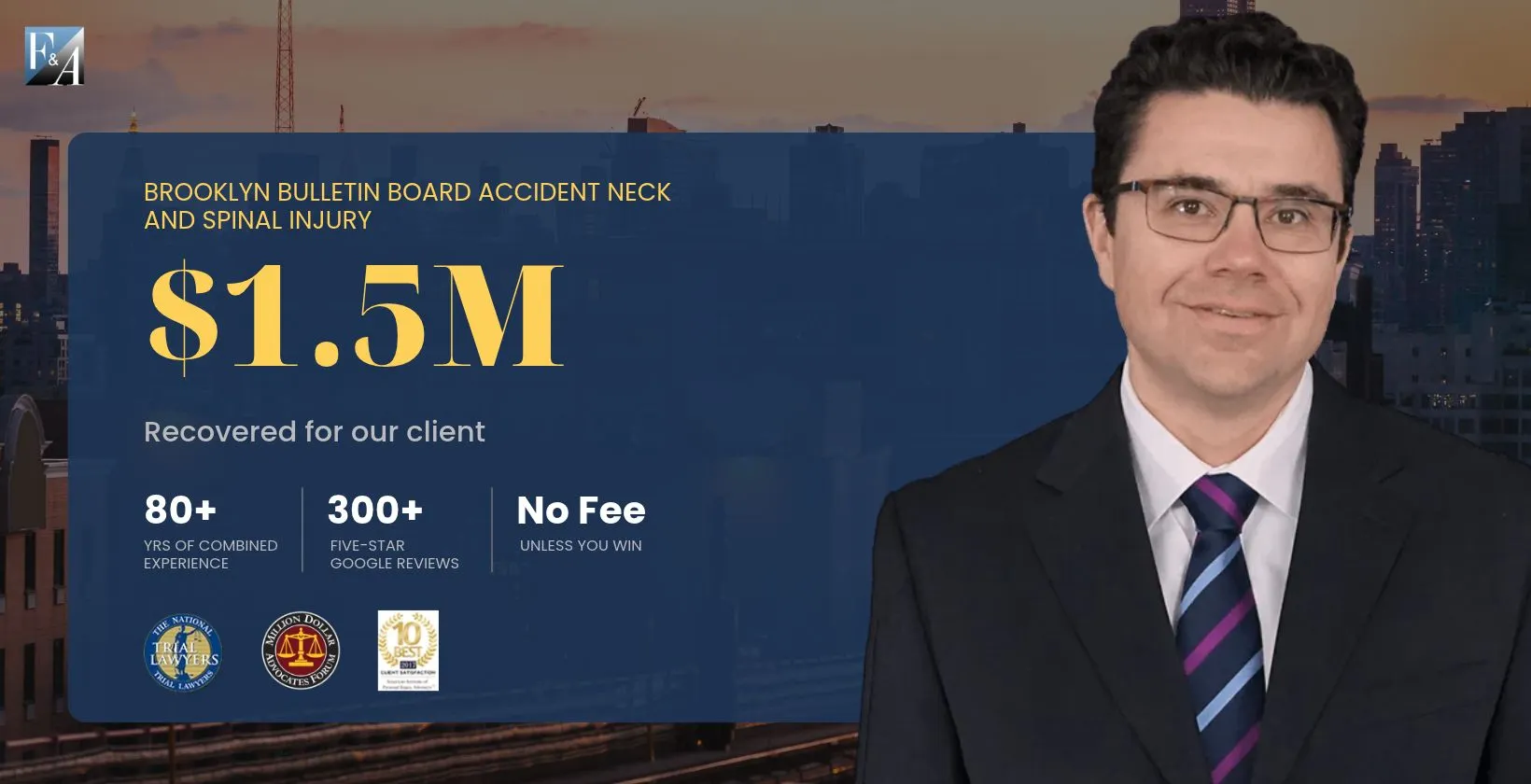
A 45 year old Brooklyn woman suffered serious cervical spine injuries after a large, metal framed bulletin board fell from the wall of a government benefits office and struck her head and neck. Despite disputes over the board’s installation, missing physical evidence, and the cause of her injuries, Frekhtman & Associates secured a $1,500,000 settlement following years of litigation.
A Routine Government Benefits Appointment Ends in a Serious Accident
On an October afternoon in 2019, a 45 year old Brooklyn woman visited a municipal public benefits office for a scheduled appointment.
At the time, she was working as an office manager for a nonprofit organization and raising her family.
She was seated in the first floor waiting room when a large bulletin board suddenly detached from the wall.
The board measured approximately four feet wide and three feet tall.
It was enclosed in a metal frame and contained a thin pane of glass, making it a substantial fixture hanging above an area where members of the public regularly gathered.
Without warning, the board fell and struck the woman in the back of her head and neck.
She was not the only person injured.
The building’s own security report documented that the falling bulletin board also struck two other individuals seated in the waiting area.
Emergency medical personnel responded, and the injured woman was transported by ambulance to a Brooklyn hospital.
After the scene was cleared, building management issued a work order concerning the bulletin board.
A security officer later testified that a bulletin board had been reinstalled on the wall within approximately one day.
What began as an ordinary appointment would lead to years of medical treatment, cervical spine surgery, permanent physical limitations, and significant disruption to the woman’s working and family life.
Serious Cervical Spine Injuries That Initial Emergency Imaging Did Not Fully Reveal
Following the accident, the plaintiff underwent emergency medical evaluation.
Initial CT imaging did not identify a fracture.
She was diagnosed with a head injury and postconcussion syndrome.
However, her symptoms persisted well beyond the initial hospital visit.
She continued experiencing neck pain, weakness, and numbness extending into her arm.
Further diagnostic testing revealed more substantial cervical spine injuries.
MRI imaging identified disc herniations at three levels of her neck.
One of the most significant findings involved the C4 C5 level, where a herniated disc deformed the spinal cord and narrowed the spinal canal.
Additional electrodiagnostic testing confirmed left C6 radiculopathy, a condition involving irritation or compression of a cervical nerve root that can produce pain, weakness, and sensory symptoms extending into the arm.
The plaintiff’s symptoms and diagnostic findings became central to her claim that the falling board had caused serious and lasting spinal damage.
She also received diagnoses of chronic posttraumatic stress disorder, postconcussional syndrome, and chronic pain associated with trauma.
The combination of physical and psychological symptoms affected her ability to work, sleep, drive, and participate in ordinary daily activities.
Conservative Treatment Fails to Relieve Her Neck Pain and Neurological Symptoms
Before undergoing surgery, the plaintiff attempted several forms of conservative medical treatment.
Her care included activity modification, physical therapy, antiinflammatory medication, muscle relaxants, and prescription pain medication.
Despite these efforts, her symptoms did not meaningfully improve.
She continued experiencing significant cervical pain and neurological complaints.
The C4 C5 disc herniation and associated spinal cord compression became particularly concerning.
Her treating physician ultimately recommended surgical intervention.
In August 2020, approximately ten months after the accident, she underwent an anterior cervical discectomy and fusion at C4 C5.
The procedure involved removing the damaged cervical disc and stabilizing the affected spinal segment.
Her operation also included a plastic surgery closure and tissue rearrangement involving an area of the neck measuring approximately 6 by 5.2 centimeters.
The surgery represented a major intervention intended to address her continuing symptoms and cervical spine damage.
However, the plaintiff continued experiencing significant physical limitations after the operation.
Her treating surgeon ultimately determined that she had reached maximum medical improvement and assigned a guarded prognosis.
Permanent Neck Limitations and the Possibility of Future Spinal Surgeries
Years after her cervical fusion, the plaintiff continued struggling with pain and restricted neck movement.
Medical examinations documented substantial limitations in cervical flexion, extension, and rotation.
These movements remained well below normal ranges.
The plaintiff also continued reporting chronic discomfort and difficulty performing activities requiring sustained neck positioning or movement.
More than five years after the accident, her treating surgeon observed that she remained visibly uncomfortable.
The examination also documented muscle spasms on both sides of her neck.
Her surgeon concluded that the injuries had left her with permanent physical limitations.
The long term implications were especially significant because of the possibility of additional spinal surgery.
Her treating surgeon anticipated that she might require future surgery involving adjacent cervical spine levels at intervals of approximately 10 to 12 years over the remainder of her life.
These anticipated procedures became an important part of the plaintiff’s future medical care claim.
An economist calculated her projected future health care costs at $3,103,829.
The projection reflected the potentially substantial financial consequences of ongoing treatment, permanent cervical limitations, and additional medical procedures.
From Working Full Time to Struggling With Everyday Activities
Before the accident, the plaintiff worked full time as an office manager for a nonprofit organization.
She was also raising her family and managing the responsibilities of everyday life.
According to her medical history, she reported no prior injuries, and her treating surgeon identified no records documenting earlier neck symptoms or treatment.
After the accident, her physical capabilities changed significantly.
She could no longer sit comfortably for extended periods without experiencing neck and back pain.
Driving became difficult, and she limited herself to short distances.
Her son eventually took over most of the family’s driving responsibilities.
Chronic neck pain frequently interrupted her sleep.
The limitations also affected her employment.
She reported that she was unable to maintain a full time position and needed a specially adapted chair when working.
Ordinary activities that had once been manageable became sources of pain and discomfort.
The plaintiff’s case emphasized that the consequences of the falling bulletin board extended far beyond the initial head injury and spinal surgery.
They affected her earning capacity, independence, sleep, family responsibilities, and overall quality of life.
Establishing the Government Building Owner’s Responsibility for the Falling Bulletin Board
The plaintiff pursued a premises liability claim against the municipal entity responsible for the building.
A central question was whether the bulletin board had been improperly installed, maintained, or secured above a public waiting area.
The plaintiff’s case focused on several important circumstances.
The bulletin board was a large fixture mounted above a public seating area.
The board measured approximately four feet by three feet and featured a metal frame and glass panel.
The board detached from the wall and injured multiple people.
The building’s own security report documented injuries to three individuals seated in the waiting room.
The incident prompted maintenance activity.
Building management issued a work order after the accident, and a security officer testified that a bulletin board was back on the wall within approximately one day.
A forensic engineering expert identified problems with the mounting system.
The plaintiff’s expert concluded that the methods used to support the bulletin board were inadequate and improper.
The expert attributed the failure to deficient support and maintenance.
The engineering analysis concluded that the board’s structural support was insufficient and that the fixture had not been maintained in accordance with applicable building safety requirements.
The plaintiff argued that a heavy fixture installed above a crowded waiting room should have been properly secured and maintained to prevent it from falling onto members of the public.
The forensic engineering evidence became important in explaining why the board detached from the wall and whether the incident could have been prevented through proper installation and maintenance.
A Missing Bulletin Board Creates an Evidence Dispute
One unusual challenge in the litigation involved the physical evidence.
The bulletin board that struck the plaintiff was not produced for inspection.
Its absence prevented the plaintiff’s experts from directly examining the original fixture and its mounting components.
The plaintiff’s legal team sought an adverse inference instruction concerning the loss or destruction of the board.
Such an instruction can permit a jury, under appropriate circumstances, to draw an unfavorable inference from a party’s failure to preserve relevant evidence.
The defense disputed that the board had been improperly destroyed.
It maintained that the fixture had been disposed of pursuant to agency procedures after the agency vacated the leased property at the end of 2020.
The defense argued that the loss was neither intentional nor negligent.
The court later determined that the defendant had submitted a sufficient affidavit describing its efforts to locate the missing bulletin board.
The dispute nevertheless became a significant issue because the original fixture could no longer be directly examined.
The plaintiff continued relying on the incident documentation, witness testimony, expert engineering analysis, and other available evidence to support her claim.
The case illustrates how the preservation and availability of physical evidence can become critical in premises liability litigation involving defective building fixtures.
Overcoming a Defense That Disputed the Need for Spinal Fusion
The municipal defendant also challenged the nature and severity of the plaintiff’s injuries.
An orthopedic surgeon retained by the defense examined the plaintiff and questioned whether the cervical fusion was medically necessary because of the accident.
The defense physician pointed to arthritic changes visible on imaging obtained before her surgery.
He also characterized her as relatively functional in everyday activities and reported that she had no restrictions.
The defense emphasized that she was not actively receiving treatment at the time of his examination.
Additional imaging identified mild degenerative changes at spinal levels below the fusion.
The defendant relied on these findings to question whether her continuing symptoms and need for surgery were attributable to the falling bulletin board.
The plaintiff disputed those conclusions.
Her treating surgeon maintained that she had been asymptomatic before the accident and that the falling board was the cause of the cervical injuries requiring treatment.
The plaintiff’s medical evidence included MRI findings showing significant disc herniation and spinal cord compression, electrodiagnostic confirmation of cervical radiculopathy, and the surgical treatment required to address her symptoms.
Her treating surgeon also documented persistent physical limitations and concluded that she remained permanently disabled.
The litigation therefore involved substantial disputes over medical causation, preexisting degeneration, surgical necessity, and future health care needs.
$1,500,000 Settlement Following Years of Litigation
After years of litigation and with trial approaching, Frekhtman & Associates successfully resolved the case for $1,500,000 following a settlement conference with the court.
The resolution provided substantial compensation in a case involving cervical spine injuries, fusion surgery, chronic pain, permanent limitations, and anticipated future medical treatment.
The settlement followed disputes over the cause of the bulletin board’s failure, the missing physical evidence, and the medical necessity of the plaintiff’s surgical treatment.
The case also involved a substantial projection of future health care costs based on the possibility of additional cervical procedures over the plaintiff’s lifetime.
The result demonstrates the importance of investigating how fixtures are installed and maintained in public spaces, obtaining qualified engineering analysis, and documenting the long term consequences of serious spinal injuries.
Why This Case Matters for New York Premises Liability Victims
This case highlights several important considerations in serious accidents involving falling objects and unsafe conditions inside public buildings.
Property owners may face liability for improperly secured fixtures.
Heavy bulletin boards, signs, displays, and other wall mounted objects can pose serious hazards when their mounting systems are inadequate or improperly maintained.
Government buildings are not automatically exempt from premises liability claims.
Injuries occurring in municipal offices and other government facilities may give rise to legal claims, although special procedural requirements and deadlines can apply.
Engineering experts can help establish why an object fell.
In this case, forensic engineering analysis addressed the adequacy of the bulletin board’s mounting system and the circumstances surrounding its structural failure.
Missing physical evidence can complicate litigation.
When an important object is unavailable for examination, witness testimony, photographs, incident reports, and expert analysis may become particularly significant.
Serious cervical spine injuries can create lifelong medical needs.
Disc herniations, nerve compression, spinal fusion, and permanent loss of motion may require continuing treatment and, in some circumstances, future surgery.
For this Brooklyn woman, an ordinary appointment at a public benefits office resulted in serious cervical spine injuries, major surgery, and permanent limitations affecting her work and family life.
The case ultimately resolved for $1.5 million.
Injured by a Falling Object or Unsafe Property Condition in New York?
Dangerous conditions involving falling fixtures, improperly secured displays, defective building components, and inadequate property maintenance can cause serious injuries.
The attorneys at Frekhtman & Associates represent individuals and families throughout New York City in premises liability cases, falling object accidents, government property injury claims, and catastrophic spinal injury litigation.
If you or a loved one suffered injuries because of unsafe conditions in a public building or another property, contact our firm for a No Obligation Case Review.
No fee unless we win.
Attorney Advertising. Prior results do not guarantee a similar outcome. Each case depends on its own facts and circumstances. The settlement represents a negotiated resolution, not a judicial finding of liability.