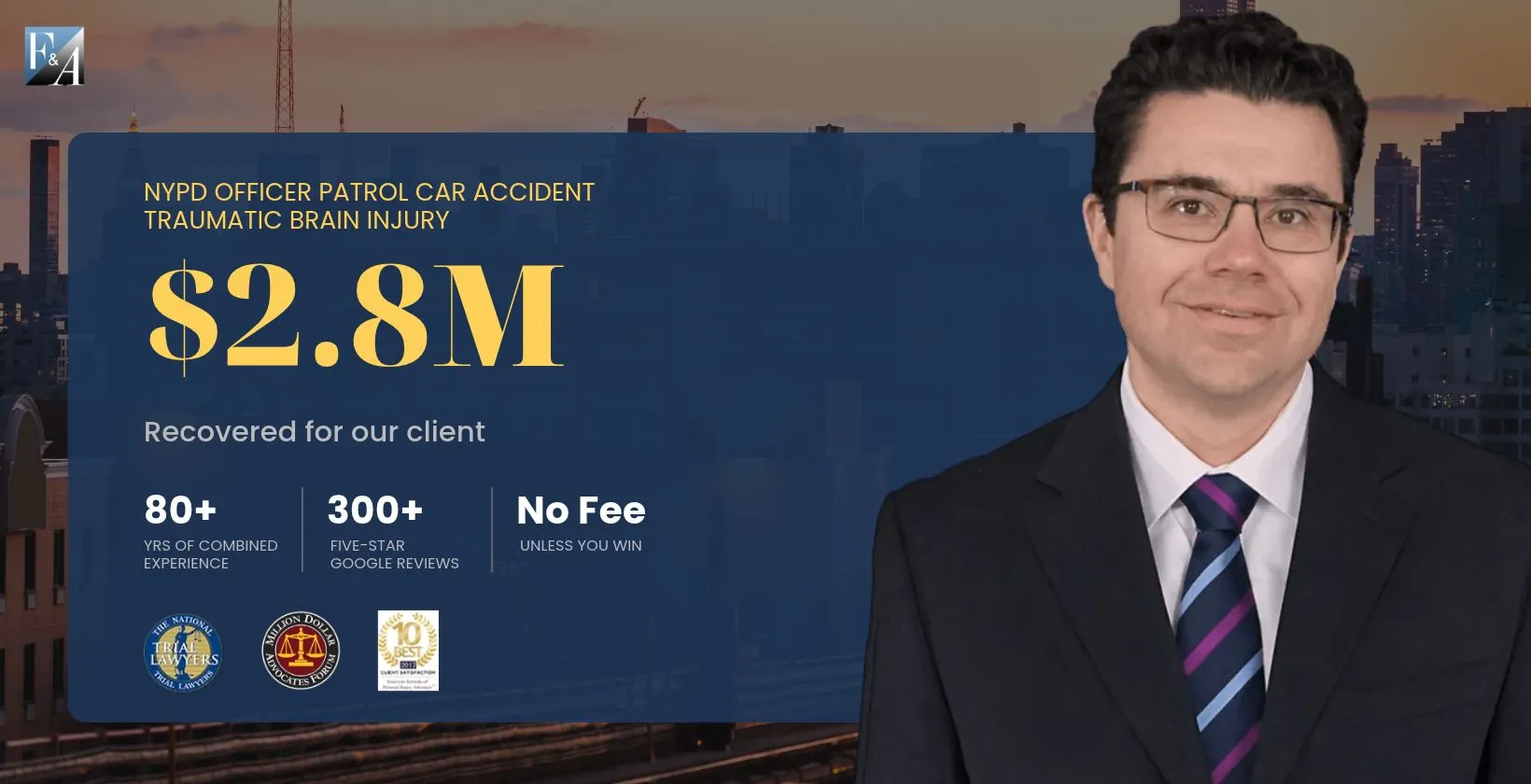
A New York City police officer suffered a traumatic brain injury after the patrol car he was riding in entered a busy Bronx intersection against a red light and was struck by another vehicle. Despite repeated warnings from the passenger officer, the driver failed to brake before the collision. The injuries ultimately ended the officer’s police career, and the case settled for $2,800,000 during trial.
A Police Emergency Response Ends in a Devastating Bronx Intersection Crash
In September, a young New York City police officer was assigned to ride as the passenger, also known as the recorder, in a patrol car with a different partner than usual.
The officers were responding to an emergency call with the patrol vehicle’s emergency lights activated.
As the patrol car traveled south toward a wide Bronx parkway, it approached an intersection requiring the driver to cross eight lanes of traffic and two grassy medians against a red traffic signal.
Police academy training instructs officers to stop before proceeding through a red light and to ensure that the intersection is clear.
According to the plaintiff’s case, the driver failed to stop before entering the intersection.
As another vehicle approached with a green light, the passenger officer recognized the danger.
He repeatedly shouted warnings to the driver.
“Stop it.”
“He ain’t stopping.”
“Hit the brake.”
“Hit the brake.”
Despite four warnings in a matter of seconds, the driver did not brake.
Instead, the patrol car continued into the intersection, where it was struck broadside by the approaching vehicle.
Data recovered from the patrol car’s crash recorder showed that its speed increased from approximately 16 to 23 miles per hour in the moments before impact.
The injured officer was transported by ambulance to the hospital with complaints of head pain and an ankle injury.
At the hospital, the patrol car driver reportedly apologized to the injured officer’s parents and explained that he had frozen up during the emergency.
What began as a routine emergency response would ultimately result in permanent neurological injuries and the loss of a young officer’s law enforcement career.
A Traumatic Brain Injury That Initial Medical Scans Failed to Reveal
One of the central challenges in the litigation was establishing the extent of the officer’s brain injury despite early imaging that appeared largely normal.
His initial CT scan was interpreted as normal.
A brain MRI performed approximately one year later was also read as mostly normal.
However, the officer continued experiencing neurological symptoms that interfered with his ability to function.
Over the following years, his treating physicians diagnosed traumatic brain injury and postconcussion syndrome.
More advanced imaging revealed findings that became significant components of his medical evidence.
These included atrophy involving the left temporal lobe, abnormalities affecting 12 of 31 white matter tracts on diffusion tensor imaging, and statistically significant brain volume loss identified through NeuroQuant analysis.
The plaintiff relied on these findings, together with his clinical symptoms and medical evaluations, to support his claim that the collision caused lasting neurological damage.
Neuropsychological testing also documented memory impairment and slowed cognitive processing.
Although the defense continued disputing the severity of his injuries, his treating physicians concluded that the neurological consequences extended well beyond the initial emergency room evaluation.
Severe Vision Problems, Migraines, and Vestibular Damage
The officer’s brain injury was associated with extensive neurological complications affecting his vision, balance, memory, and daily functioning.
Eye specialists diagnosed severe convergence insufficiency, a condition affecting the ability of the eyes to work together when focusing on nearby objects.
He experienced double vision, blurred vision during movement, difficulty reading, and problems remembering what he had read.
His specialists advised that he was unlikely to regain full visual function.
He also developed vestibular dysfunction, which caused dizziness and balance problems.
Persistent tinnitus resulted in constant ringing in his ears.
Chronic migraine headaches became another major part of his condition.
The migraines required Botox injections approximately every three months to help manage his symptoms.
In addition to the neurological injuries, the officer suffered neck and lower back conditions involving nerve pain.
His treatment included epidural steroid injections to address persistent symptoms.
The combined effects of his injuries made everyday tasks increasingly difficult.
Reading, concentrating, maintaining balance, and performing activities requiring reliable visual coordination all became challenging.
His neurologist ultimately determined that he was unable to work and advised against driving at night.
A Police Career Cut Short by Permanent Neurological Injuries
Before the accident, the plaintiff had been serving as a New York City police officer.
His profession required physical readiness, sound judgment, quick reactions, and the ability to process information accurately under pressure.
Following the collision, his ongoing neurological impairments prevented him from safely performing the duties of a police officer.
He was ultimately forced to retire from the department.
The consequences extended far beyond the loss of his current position.
His retirement also affected the wages, pension benefits, and future earning opportunities he had expected to receive throughout his law enforcement career.
An economist retained on the plaintiff’s behalf calculated his combined lost wages, pension benefits, and future earning capacity at $7,403,487.
This projection helped document the substantial economic impact of ending a police career prematurely.
The plaintiff’s case also emphasized the personal consequences of losing a profession that had been central to his future.
Beyond the financial losses, he continued experiencing chronic migraines, vision impairment, cognitive difficulties, dizziness, and other limitations that affected his independence and quality of life.
Establishing Responsibility for the Patrol Car Collision
The plaintiff brought claims against the City of New York and the police officer who had been driving the patrol vehicle.
A central issue was whether the driver’s conduct exceeded the legal protections available to emergency vehicle operators.
New York Vehicle and Traffic Law Section 1104 permits drivers of authorized emergency vehicles to take certain actions during qualifying emergency operations, including proceeding through a red traffic signal after slowing down as necessary for safe operation.
However, the law does not provide unlimited protection.
Under the applicable emergency vehicle standard, liability for covered driving conduct generally requires proof of reckless disregard for the safety of others.
The plaintiff argued that the driver’s actions met that standard.
The case focused on several important circumstances.
The patrol car entered an intersection against a red light.
The driver attempted to cross eight lanes of traffic and two grassy medians while responding to an emergency call.
The driver failed to stop before entering the intersection.
According to the plaintiff, the officer did not follow the training he had received concerning safe entry into intersections against traffic signals.
The passenger officer repeatedly warned of an approaching vehicle.
The injured officer shouted four warnings, including two commands to apply the brakes.
The patrol car accelerated before the collision.
Data recovered from the vehicle showed its speed increased from approximately 16 to 23 miles per hour immediately before impact.
The plaintiff argued that the driver failed to adequately check approaching traffic.
He maintained that the driver’s view to the right was obstructed and that the driver proceeded without independently confirming that the intersection was safe.
The patrol car’s sirens were not operating continuously.
The police department’s incident report documented that the sirens were not running continuously, a fact the plaintiff argued helped explain why the approaching motorist did not hear the emergency vehicle.
The plaintiff also anticipated testimony from fellow police officers concerning the driver’s prior accidents and allegedly slow reactions behind the wheel.
Taken together, the plaintiff argued that these circumstances demonstrated more than ordinary negligence.
His position was that the driver consciously disregarded a substantial risk by continuing into the intersection despite repeated warnings and the obvious danger of approaching traffic.
Overcoming the City’s Emergency Vehicle Defense
The City of New York disputed liability and relied on the heightened reckless disregard standard applicable to certain emergency vehicle operations.
The defense maintained that the patrol car driver was responding to an emergency and was entitled to the protections provided by Vehicle and Traffic Law Section 1104.
The driver testified that his emergency lights and sirens were activated.
He also claimed that he entered the intersection traveling approximately 5 miles per hour.
According to his testimony, he looked to the left while relying on his partner to observe traffic approaching from the right.
The plaintiff challenged this account.
In particular, the patrol car’s crash data recorder documented speeds substantially higher than the driver’s estimate in the moments before the collision.
The plaintiff also emphasized that he had repeatedly warned the driver to stop and that the vehicle continued accelerating rather than braking.
The defense further argued that the other motorist contributed to the collision.
The approaching driver acknowledged seeing the flashing emergency lights and initially received a traffic citation for failing to yield.
However, that citation was later dismissed.
The plaintiff’s case emphasized that the other driver’s actions did not necessarily eliminate responsibility for the patrol car driver’s own conduct.
The central question remained whether the officer operating the emergency vehicle had acted with reckless disregard for safety.
A Defense That Disputed the Existence of Serious Brain Injuries
The City also challenged the severity of the plaintiff’s injuries.
A defense neurologist examined the injured officer on one occasion and testified that his injuries were not serious.
The defense relied in part on the initial CT scan and subsequent conventional MRI, which had been interpreted as normal or largely normal.
The plaintiff disputed the conclusion that the absence of significant findings on those studies meant he had not sustained a serious brain injury.
His treating physicians documented persistent neurological symptoms over several years.
Advanced imaging identified brain abnormalities, while neuropsychological testing documented memory loss and slowed thinking.
The plaintiff also relied on specialist evaluations addressing his convergence insufficiency, vestibular dysfunction, chronic migraines, and other neurological complications.
His case emphasized that traumatic brain injuries can involve persistent cognitive, visual, and neurological impairments even when initial conventional imaging does not reveal obvious abnormalities.
The medical dispute was particularly significant because his injuries had forced him to retire from law enforcement.
The plaintiff maintained that his inability to continue working, together with the documented neurological impairments and projected economic losses, demonstrated the seriousness of the collision’s consequences.
$2,800,000 Settlement Reached During Trial
After years of litigation involving emergency vehicle liability, disputed medical evidence, and the financial consequences of a career ending injury, the parties reached a $2,800,000 settlement during trial.
The resolution provided substantial compensation to a police officer who suffered persistent neurological impairments and was unable to return to his profession.
The case involved significant legal challenges because New York law applies a heightened liability standard to certain conduct by drivers of emergency vehicles.
It also involved complex medical questions concerning traumatic brain injury, advanced neurological imaging, and the long term impact of cognitive and visual impairments.
The settlement resolved those disputes without a final judicial determination of liability.
The result illustrates the importance of examining emergency vehicle crash data, investigating officer training and conduct, and developing detailed medical evidence when a brain injury is disputed.
Why This Case Matters for New York Emergency Vehicle Accident Victims
This case highlights several important considerations in collisions involving police vehicles and other emergency responders.
Emergency vehicle operators are not exempt from all traffic safety responsibilities.
New York law provides certain privileges to qualifying emergency vehicle drivers, but those privileges are subject to statutory conditions and do not protect reckless disregard for the safety of others.
Crash data can provide critical evidence.
Information recovered from a vehicle’s electronic crash recorder may help establish speed and other circumstances immediately before a collision.
Warnings from passengers and other witnesses can become important.
In this case, the injured officer’s repeated warnings were central to the plaintiff’s argument that the driver proceeded despite recognizing or being alerted to a serious danger.
A normal initial brain scan does not necessarily rule out traumatic brain injury.
Persistent symptoms, clinical evaluations, neuropsychological testing, and additional diagnostic evidence may become important when determining the nature and extent of neurological injuries.
A serious brain injury can permanently end a career.
Cognitive impairment, visual dysfunction, balance problems, and chronic migraines can prevent individuals from returning to occupations requiring physical readiness and reliable decision making.
For this Bronx police officer, an emergency response collision resulted in years of medical treatment, permanent neurological limitations, and the loss of his law enforcement career.
The case ultimately resolved for $2.8 million during trial.
Injured in a Police Vehicle or Serious Car Accident in New York?
Collisions involving police vehicles, ambulances, fire trucks, and other emergency vehicles can cause devastating injuries and present complex liability questions under New York law.
The attorneys at Frekhtman & Associates represent individuals and families throughout New York City in serious motor vehicle accident cases, traumatic brain injury claims, and catastrophic personal injury litigation.
If you or a loved one suffered serious injuries in a collision involving an emergency vehicle or another negligent driver, contact our firm for a No Obligation Case Review.
No fee unless we win.
Attorney Advertising. Prior results do not guarantee a similar outcome. Each case depends on its own facts and circumstances. The settlement represents a negotiated resolution, not a judicial finding of liability.