
Personal injury laws in New York mainly decide two things: the statute of limitations for filing a claim and how comparative fault reduces your financial recovery. Get either wrong, and a valid case is dismissed before reaching a courtroom.
These rules apply differently to injury cases involving car accidents, slip-and-falls, dog bites, and medical malpractice, with each subject to its own filing deadlines and standards of proof. The state’s pure comparative negligence rule lets you recover even at 99% fault, except in car accident lawsuits filed since May 26, 2026. No-fault insurance covers medical expenses and lost wages after a crash, regardless of liability.
At Frekhtman & Associates, NYC personal injury lawyer Arkady Frekhtman has represented injured New Yorkers since 1999, securing the firm’s largest published verdict: $69.25 million in a motor vehicle case. This guide breaks down the legal statutes that determine whether and how much you can recover.
Key Takeaways
- New York personal injury laws protect accident victims and allow them to seek compensation for medical bills, lost wages, and pain and suffering.
- The statute of limitations for most personal injury claims in New York is three years, but medical malpractice claims must be filed within 2 years and 6 months (CPLR § 214-a), and wrongful death claims within 2 years of death (EPTL § 5-4.1).
- New York follows a pure comparative negligence rule, letting plaintiffs recover even at 99% fault, except in motor vehicle injury lawsuits filed on or after May 26, 2026.
- The state uses a no-fault insurance system for car accidents, covering up to $50,000 in medical costs and lost wages regardless of who caused the crash.
- Owners of dogs found to be dangerous are strictly liable for bite victims’ medical costs, and owners who knew of a dog’s aggression or acted negligently may owe all damages.
Statute of Limitations for Personal Injury Claims
In New York, procedural deadlines to file a personal injury lawsuit depend strictly on the type of claim and the defendant involved:
- General Personal Injury (CPLR § 214): Standard negligence claims must be filed within 3 years of the accident date under this statute of limitations.
- Medical Malpractice (CPLR § 214-a): Claims must be filed within 2 years and 6 months of the malpractice or last continuous treatment; missed cancer and foreign-object claims run from discovery.
- Wrongful Death (EPTL § 5-4.1): Claims must be filed within 2 years of the date of death. Families recover pecuniary losses plus medical and funeral costs (EPTL § 5-4.3), not grief.
- Municipal & Government Claims (General Municipal Law §§ 50-e, 50-i): Accidents involving public entities (e.g., MTA, NYC Transit, city buses, public property) require a formal Notice of Claim within 90 days, then a lawsuit within one year and 90 days of the incident.
Missing these statutory deadlines results in a permanent bar to financial compensation. Limited exceptions exist for minors or individuals with severe mental incapacity at the time of injury, which may toll the filing clock.
Comparative Negligence Rule
Most personal injury claims in New York follow the pure comparative negligence rule (CPLR § 1411): you can recover damages even if you’re up to 99% at fault. Your award is reduced by your percentage of fault. A $100,000 verdict with 20% fault results in an $80,000 recovery.
Important 2026 Change: Car accidents follow a different rule as of the May 2026 tort reform. Under new CPLR § 1411(b), for lawsuits filed on or after May 26, 2026, a claimant more at fault than the defendant (or all defendants combined) recovers no damages, though no-fault benefits still apply. Otherwise, damages are still reduced proportionally. This change applies only to motor vehicle injury claims. Property damage claims, slip and falls, premises liability, dog bites, and other injury types still follow the pure comparative negligence rule.
Learn how shared fault affects your recovery in our guide, Comparative Negligence for Car Accidents in New York.
No-Fault Insurance for Car Accidents
New York’s no-fault insurance system provides Personal Injury Protection (PIP) benefits up to $50,000 per person for basic economic loss (medical bills, lost wages, and essential expenses) regardless of who caused the crash (NY Insurance Law Article 51 / 11 NYCRR § 65). Claimants must file a written PIP claim with the insurer within 30 days of the accident.
To sue an at-fault driver for pain and suffering (non-economic damages), your injuries must satisfy the statutory “serious injury” threshold under Insurance Law § 5102(d), such as a fracture, permanent limitation, or significant disfigurement. Separately, if your economic losses exceed $50,000, you may sue for the excess amount alone.
Strict Liability for Dog Bites
New York holds owners of dogs found to be dangerous strictly liable for bite victims’ medical costs, without proof of carelessness (Agriculture and Markets Law § 123(10)). If the owner knew or should have known the dog was prone to bite, the owner may pay all damages, including pain and suffering.
Since the Court of Appeals decided Flanders v. Goodfellow in April 2025, victims can also sue for ordinary negligence, even without a known history. Learn more about your legal options from our New York dog bite lawyers.
Dog bite victims should act fast to protect their rights. They need to report the bite to local authorities and get medical help right away. Documenting the dog’s behavior and the owner’s care of it helps build a strong case under either legal theory.
Premises Liability Laws
New York premises liability laws hold property owners and property managers responsible for keeping their spaces safe. Under New York law, owners owe a legal duty of care to maintain their property in a reasonably safe condition. These laws cover many types of accidents caused by unsafe or hazardous conditions, like slips and falls, falling objects, inadequate security, and unsafe stairs.
Proving a premises liability claim requires strong evidence. Injured parties need to show how the owner’s failure to maintain safety caused their harm. Photos of the accident scene and witness statements only prove a case if paired with the property owner’s actual or constructive notice, the standard that decides most premises liability claims.
If your injury happened on someone’s property, our New York premises liability lawyers can help establish notice and guide your case.
Your Injury Questions Answered — Real Legal Advice
Additional Guidelines and Insights
The rules above decide whether you can sue. The sections below cover what you can recover, what to do after an injury, and which missteps weaken a claim.
Types of Damages in Personal Injury Cases
Personal injury cases in New York can result in various types of damages. These damages aim to compensate victims for their losses and hold negligent parties accountable.
- Economic Damages: These cover financial losses from the injury.
- Medical expenses: Costs for doctor visits, hospital stays, prescriptions, therapy, and treatments
- Lost wages: Money lost due to time off work
- Reduced earning capacity: Future income lost to long-term effects
- Future medical care: Ongoing treatment and therapy costs
- Property damage: Repair or replacement of damaged items
- Non-Economic Damages: These address non-monetary losses.
- Pain and suffering: Physical discomfort and emotional distress
- Loss of enjoyment: Reduced quality of life due to injury
- Emotional trauma: Mental anguish caused by the incident
- Loss of consortium: Impact on relationships with family members
- Punitive Damages: Rarely awarded in New York. Courts require proof of gross negligence or reckless indifference, a higher bar than ordinary negligence.
- Damage Caps: New York has no general cap. Since May 26, 2026, at-fault drivers who were uninsured or convicted of impaired driving or a felony while driving face a $100,000 pain-and-suffering cap.
- Medical Expense Coverage: Includes a wide range of health-related costs.
- Doctor appointments and hospital stays
- Prescription medications and medical devices
- Physical therapy and rehabilitation services
- Mental health counseling and psychological treatment
- Lost Income Compensation: Covers past and future earnings.
- Wages lost during recovery period
- Reduced earning capacity due to long-term effects
- Benefits and bonuses missed due to injury
Steps to Take After a Personal Injury Accident
Personal injury accidents can be stressful and confusing. Taking the right steps after an accident is crucial for your health and potential legal claims.
- Seek medical attention: Your health comes first. Get checked by a doctor, even if you feel fine. Some injuries may not show symptoms right away.
- Report the accident: Notify police or the property owner. In case of a motor vehicle accident involving injuries, death, or $1,000+ in property damage, file a DMV MV-104 within 10 days.
- Document the scene: Take photos of the accident area, your injuries, and any property damage. These images can serve as key evidence later.
- Gather witness information: If anyone saw the accident, get their names and contact details. Their accounts may support your claim.
- Keep all receipts: Save bills for medical care, medications, and other expenses related to your injury. These prove your financial losses.
- Start a pain journal: Write down how you feel each day. Note any pain, discomfort, or limitations caused by your injury.
- Avoid public discussions: Don’t post about your accident on social media or talk about it with others. Your words could be used against you.
- Consult an attorney: Speak with a personal injury lawyer about your case. They can guide you through the legal process and protect your rights.
- Collect evidence: Gather any items that might prove useful, such as torn clothing or broken personal belongings from the accident.
- Follow medical advice: Stick to your doctor’s treatment plan. This shows you’re taking your recovery seriously.
Common Mistakes in Personal Injury Claims
After taking the right steps following a personal injury accident, it’s crucial to avoid common pitfalls. Many people make mistakes that can hurt their chances of getting fair compensation. Here are some key errors to watch out for in personal injury claims:
- Delaying medical care: Putting off doctor visits can harm your health and weaken your case. Quick medical attention proves the link between the accident and your injuries.
- Talking to insurance companies too soon: Chatting with insurers before speaking to a lawyer may lead to lower settlements. Insurance firms often try to pay out as little as possible.
- Missing the no-fault deadline: After a car crash, a written no-fault (PIP) claim is due within 30 days. A late claim can be denied, leaving medical bills unpaid.
- Accepting early settlement offers: Quick deals may seem tempting but often don’t cover all your costs. It’s wise to wait until you know the full extent of your injuries.
- Not hiring a lawyer: Going it alone can result in mistakes and missed opportunities. Legal experts know how to navigate the complex world of personal injury law.
- Posting on social media: Sharing details about your accident or injuries online can hurt your case. Insurance companies may use your posts against you.
- Ignoring doctor’s orders: Not following medical advice can make it seem like you’re not truly hurt. This can lead to lower compensation or even a denied claim.
- Waiting too long to file: New York has time limits for personal injury claims. Missing these deadlines can bar you from seeking compensation.
- Downplaying injuries: Being tough and minimizing your pain can backfire. It’s important to be honest about how the injury affects your life.
- Not keeping records: Failing to track medical bills, lost wages, and other costs related to your injury can result in incomplete compensation.
How to File a Personal Injury Lawsuit in New York
Filing a personal injury lawsuit in New York requires careful planning and knowledge of the legal system. The process follows a set order, and each step has its own court rules.
- Choose the right court: Select the appropriate court based on your claim amount. Options include Town/Village Justice Court (up to $3,000), City Court outside NYC (up to $15,000), NYC Civil Court (up to $50,000), County Court (up to $25,000), or Supreme Court for claims exceeding these limits.
- Prepare legal documents: Draft a complaint outlining your case, including details of the injury, parties involved, and damages sought.
- File the lawsuit: Submit your complaint and pay the required filing fee to the court clerk.
- Serve the defendant: Have the defendant formally served with the summons and complaint as the CPLR requires.
- Engage in discovery: Exchange information with the opposing party to build your case. This includes gathering evidence, witness statements, and expert opinions.
- Participate in settlement talks: Attempt to resolve the case through negotiations before trial. Settlement can happen at any stage, including during discovery.
- Attend court hearings: If settlement fails, prepare for trial by following court procedures and presenting your case before a judge or jury.
- Small claims court: NYC Small Claims Court handles disputes up to $10,000; outside NYC, town and village courts cap small claims at $3,000–$5,000. It’s rarely the right venue for a personal injury claim of any real value, but it’s worth knowing the ceiling.
Many claims resolve before a jury ever hears them, in the discovery and settlement-talk stages above, which is where an experienced negotiator’s value shows up most in the final number.
FAQs About New York Personal Injury Laws
Do I Need a Lawyer for My Personal Injury Case?
While not required, consulting an experienced personal injury lawyer is important for maximizing your claim potential and handling complex cases. They can help you understand your rights and options.
How Long Does a Personal Injury Lawsuit Typically Take?
Timing depends mostly on treatment, since claims are valued once your condition stabilizes. Trials take longer than settlements, and the lawsuit must be filed on time, usually within three years.
How Much Does It Cost to Hire a Personal Injury Lawyer?
Hiring an injury attorney at Frekhtman & Associates costs nothing upfront. We work on a 100% contingency fee. Clients pay no legal fees unless the firm recovers money. The initial consultation is free, available 24/7 by phone, with hospital, office, and home visits for serious injuries.
Hurt in New York? Talk to Our NY Injury Lawyers
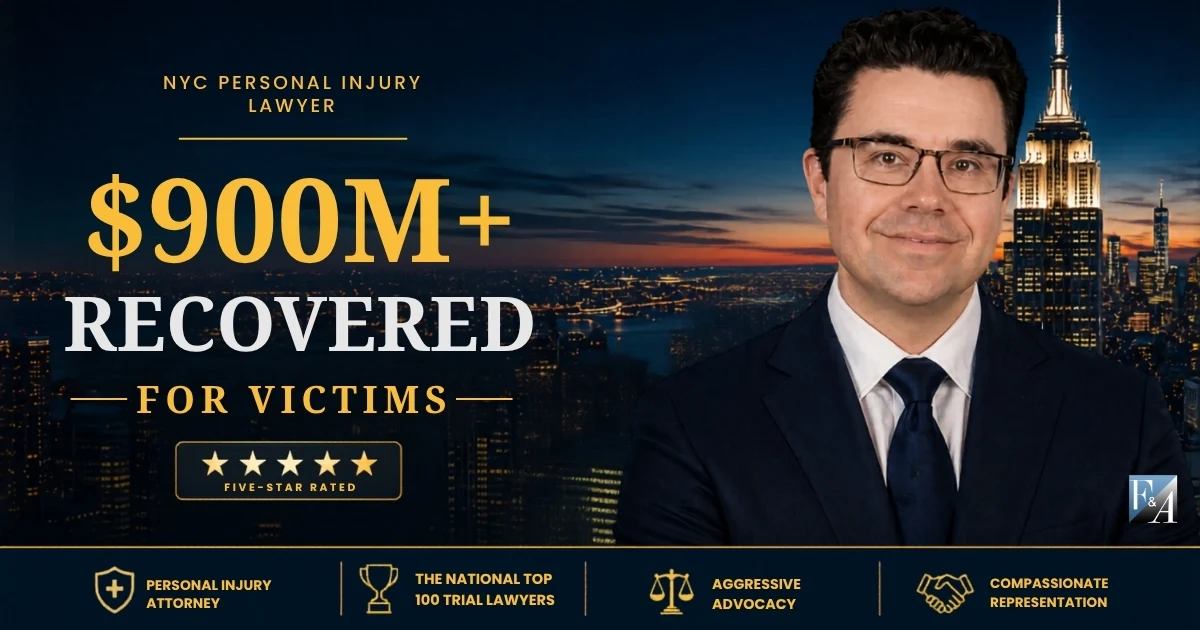
Filing deadlines vary by claim type, and insurers negotiate differently once a trial attorney is involved. Arkady Frekhtman, founding partner of Frekhtman & Associates, has practiced in New York since being admitted to the bar in 1999 (NY Reg. #2931723). We have recovered more than $900 million for injured clients across New York. See our full verdicts and settlements page or learn more about our firm.
Seeking legal help early can meaningfully change what you recover. Contact Frekhtman & Associates for a free consultation. Call 24/7 at (866) 288-9529 or reach out online via our contact form. No fee unless we win.
Our Fight is Your Fight.