

A slip and fall head injury happens when a fall forces your skull or brain to absorb impact, whether you strike the floor directly, clip a shelf on the way down, or land on concrete outside. The injury spectrum runs from a concussion that resolves in weeks to a subdural hematoma requiring emergency neurosurgery. As New York brain injury lawyers, we see this delayed pattern often: the most serious consequences, internal bleeding and axonal tearing, can develop hours or days after a fall that seemed minor at the time. That delay is what makes these injuries dangerous.
At Frekhtman & Associates, we handle slip and fall head injury cases throughout Manhattan, Brooklyn, the Bronx, Queens, and Staten Island. This article covers what actually happens to the brain in a fall, the specific injury types and their symptoms, what to do after hitting your head, and what New York premises liability law says about who bears responsibility when a dangerous condition causes the fall.
Call us at (866) 288-9529 or fill out our online form for a free case review, no fee unless we recover.
How a Slip and Fall Injures the Brain
When your head strikes a hard surface, the force of impact transmits directly to the brain. The skull absorbs some of it, but when impact exceeds what bone can cushion, the energy transfers inward, bruising brain tissue, tearing blood vessels, or shearing the axonal fibers that carry signals between neurons.
The brain floats in cerebrospinal fluid rather than sitting rigidly inside the skull. That creates a second hazard. After the initial impact, the brain can rebound and strike the opposite interior wall, a pattern called a coup-contrecoup injury. Damage occurs at both the impact point and the opposite side. That’s why a fall where you hit the back of your head can produce frontal lobe symptoms. Doctors don’t assume the injury is confined to where contact was made.
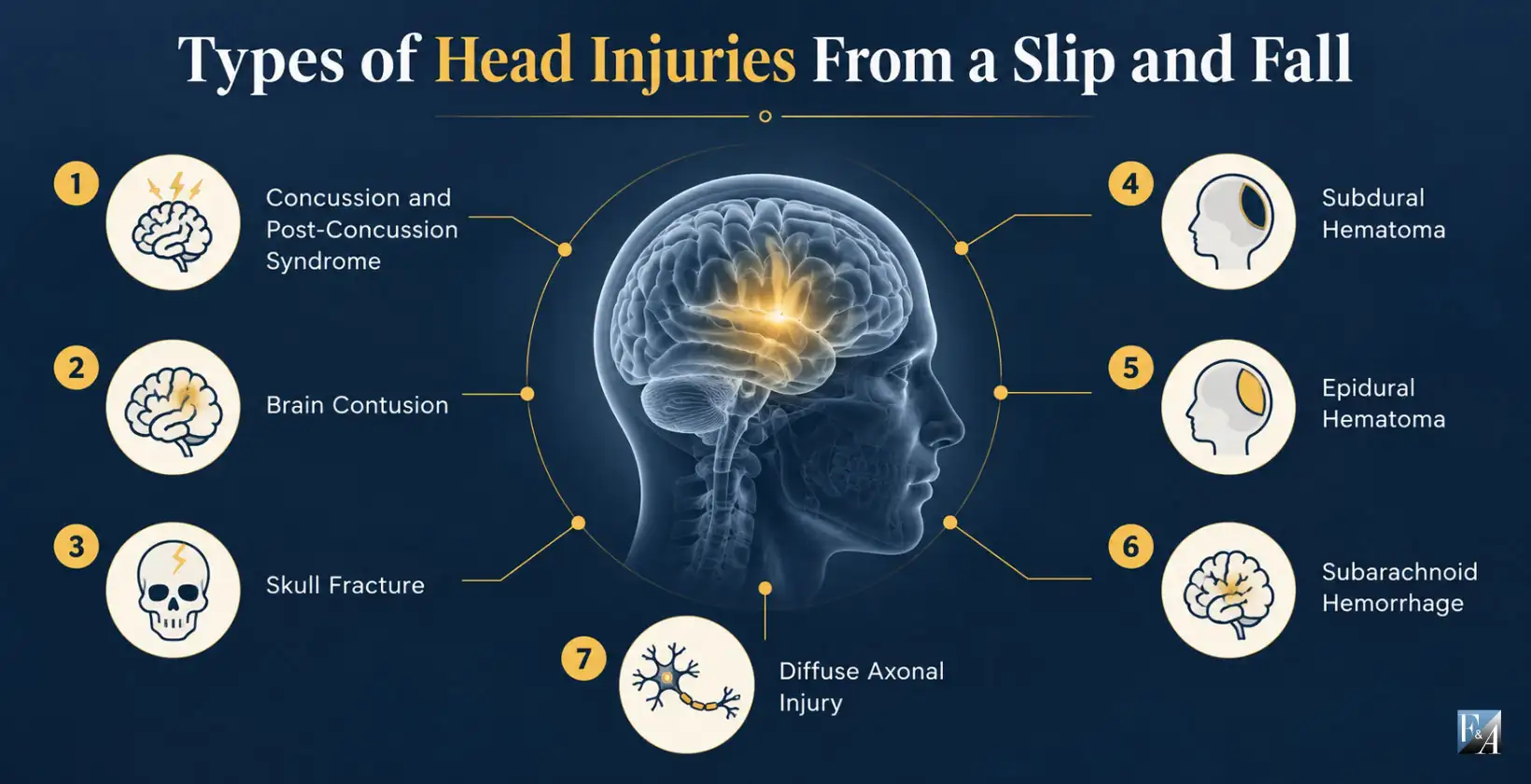
Types of Head Injuries From a Slip and Fall
Severity depends on the mechanism, the impact surface, and the patient’s age and health history. Head injuries in falls and car crashes share the same underlying mechanics, even though the fact patterns of the two accident types look very different. The following are ordered from least to most severe.
Concussion and Post-Concussion Syndrome
A concussion is a mild traumatic brain injury caused by the brain accelerating and decelerating rapidly within the skull. “Mild” refers to its classification on the Glasgow Coma Scale. Symptoms include headache, dizziness, nausea, confusion, memory gaps, light and noise sensitivity, and disrupted sleep. Most resolve within a few weeks with rest. Some develop post-concussion syndrome, where symptoms persist for months or longer and affect the ability to work, concentrate, and maintain relationships.
Brain Contusion
A contusion is a bruise on the brain itself. Direct trauma causes focal bleeding and swelling within brain tissue. Mild contusions resolve without surgery. Larger ones raise intracranial pressure, compressing surrounding brain structures and requiring neurosurgical intervention. CT imaging identifies most contusions, though MRI with diffusion-weighted sequences catches smaller or deeper lesions that a standard CT misses.
Skull Fracture
A skull fracture occurs when the bones surrounding the brain break on impact. Linear fractures are clean breaks along the bone, the most common type, and often heal without surgery. Depressed fractures, where a fragment is driven inward toward the brain, carry a higher risk of bleeding, infection, and underlying brain damage, and may require craniotomy to relieve pressure and remove bone fragments.
Subdural Hematoma
A subdural hematoma is blood pooling between the brain’s surface and the outer protective membrane. As it accumulates, it compresses the brain. Acute subdural hematomas are neurosurgical emergencies. Chronic subdural hematomas develop slowly, sometimes over days or weeks after what appeared to be a minor fall, producing a gradual headache, cognitive dulling, and personality change.
Epidural Hematoma
An epidural hematoma forms between the skull and the dura, typically from a ruptured meningeal artery. It often follows a lucid interval: the person feels relatively normal right after the fall, then deteriorates sharply as the hematoma expands. This is why emergency physicians take any reported loss of consciousness after a fall seriously, even when the patient currently seems fine.
Subarachnoid Hemorrhage
A subarachnoid hemorrhage is bleeding into the space between the brain’s surface and its innermost membrane. It produces a sudden, severe headache and carries the risk of vasospasm, secondary stroke, and lasting cognitive damage.
Diffuse Axonal Injury
Diffuse axonal injury (DAI) results from rapid rotational forces tearing axons throughout the brain. It frequently does not appear on standard CT imaging, and MRI with susceptibility-weighted sequences, while more sensitive, still misses some cases. The injury can produce cognitive, behavioral, and physical deficits despite near-normal imaging. In a premises liability claim, DAI requires neuropsychological testing to document functional deficits.
Symptoms to Watch For, Including Delayed Warning Signs
Not all brain injury symptoms appear at the scene. People dismiss falls because they feel fine immediately afterward, then develop symptoms hours or days later without connecting them to the fall. That gap is where serious injuries go undiagnosed.
Emergency Symptoms: Go to the ER Immediately
Call 911 or go to the emergency department without delay if any of the following are present:
- Loss of consciousness, even briefly
- Seizure or convulsions
- Unequal pupil size
- Clear or bloody fluid from the nose or ears
- Inability to recognize people or surroundings
- Repeated vomiting
- Severe or progressively worsening headache
- Slurred speech or sudden weakness on one side of the body
These signs point to intracranial hemorrhage or elevated intracranial pressure. Both are emergencies. Minutes matter.
Delayed Symptoms That Appear Hours or Days Later
In the days after a slip and fall, watch for new or worsening versions of any of the following:
- Persistent headaches that begin mild and intensify over several days
- Memory problems or difficulty concentrating
- Irritability, depression, or emotional changes not present before the fall
- Sleep disruption, including difficulty falling asleep, frequent waking, or sleeping far more than normal
- Sensitivity to light or noise
- Dizziness or a sense that the room is moving
- Cognitive fog or difficulty following conversations
Post-concussion syndrome and chronic subdural hematoma both follow this delayed pattern. Any new neurological symptom after a head impact warrants same-day physician evaluation, regardless of how minor the fall seemed.
Who Is Responsible for Your Slip and Fall Head Injury?
The answer depends on where you fell. Our NYC slip and fall accident lawyer has handled cases against nearly every type of property owner, since in New York City, responsibility for a slip and fall head injury can fall on several different parties depending on the property type.
- Commercial property owners: Grocery stores, restaurants, retail shops, and office buildings are responsible for maintaining safe conditions. A wet floor with no warning sign, broken flooring, or poor lighting that causes a fall puts liability on the business owner or the building owner.
- Landlords and building managers: Apartment building owners and property managers are responsible for common areas including lobbies, stairwells, hallways, and entranceways. A broken handrail, defective lighting, or an uneven lobby floor is their responsibility to maintain.
- Adjacent property owners: Under NYC Administrative Code Section 7-210, the private owner of the building next to a public sidewalk is responsible for maintaining that sidewalk in most cases. If you slipped on a broken or icy sidewalk in New York City, the building owner beside it is likely the liable party, not the City.
- Municipal entities: Falls in public parks, NYC Housing Authority buildings, government offices, or on city-maintained property involve a municipal defendant. These claims carry different rules, including the 90-day Notice of Claim requirement under General Municipal Law Section 50-e.
- Nursing homes and assisted living facilities: These facilities carry specific fall prevention obligations under New York State Department of Health regulations. A failure to meet those standards can support a negligence claim independent of general premises liability.
Read More: When Will a Defendant Be Held Liable in a Slip and Fall Case? Identifying the right defendant is only half the equation. Understanding the legal standard that makes them liable is the other half.
What Compensation Is Available After a Slip and Fall Head Injury
Our broader guide to brain injury compensation in New York covers these categories in more depth, but here’s what typically applies to a slip and fall head injury claim.
Economic damages
- Emergency department treatment, hospitalization, and neurosurgery costs
- Ongoing neurological, psychiatric, and cognitive rehabilitation
- Occupational therapy and speech therapy
- Future medical expenses projected through a life-care plan in serious TBI cases
- Lost wages during recovery
- Loss of earning capacity if the TBI permanently affects professional function
In serious TBI cases, future damages routinely exceed past medical costs. Quantifying them accurately requires a neuropsychologist’s functional assessment and a life-care planner’s cost projections.
Non-economic damages
- Pain and suffering from the injury and recovery
- Emotional distress, including anxiety, depression, and irritability, from neurological changes
- Activities and relationships the injury has limited or ended
- Permanent neurological deficits that result in lasting disability
- Loss of consortium for the impact on a spouse or partner
Understanding how TBI settlement values are calculated in New York can help you gauge what your case may be worth.
What New York Law Says About Slip and Fall Liability
Under New York premises liability law, a property owner who fails to address a dangerous condition may be held liable for resulting injuries. Three legal standards determine whether that liability holds up in court.
- Actual Notice: The owner knew about the hazard before you fell. A maintenance log showing a reported leak, an employee who saw the spill and walked past it, a prior complaint about the same broken step. Each establishes direct knowledge and inaction.
- Constructive Notice: The owner didn’t know, but should have. If a dangerous condition sat unaddressed long enough that a reasonable inspection would have caught it, the law treats that the same as actual knowledge. A puddle that formed three minutes before your fall is a harder argument than one that was there all morning.
- Comparative Negligence: Even if you were partly at fault, you can still recover. New York follows pure comparative negligence under CPLR Article 14-A. Found 30% responsible? You recover 70% of total damages. Partial fault reduces what you get. It does not take it away entirely.
- Statute of Limitations: You have three years from the date of injury to file a claim for most private property, which falls under CPLR Section 214. For falls on municipal property, a Notice of Claim must go out within 90 days. Miss that window and your claim is typically gone.
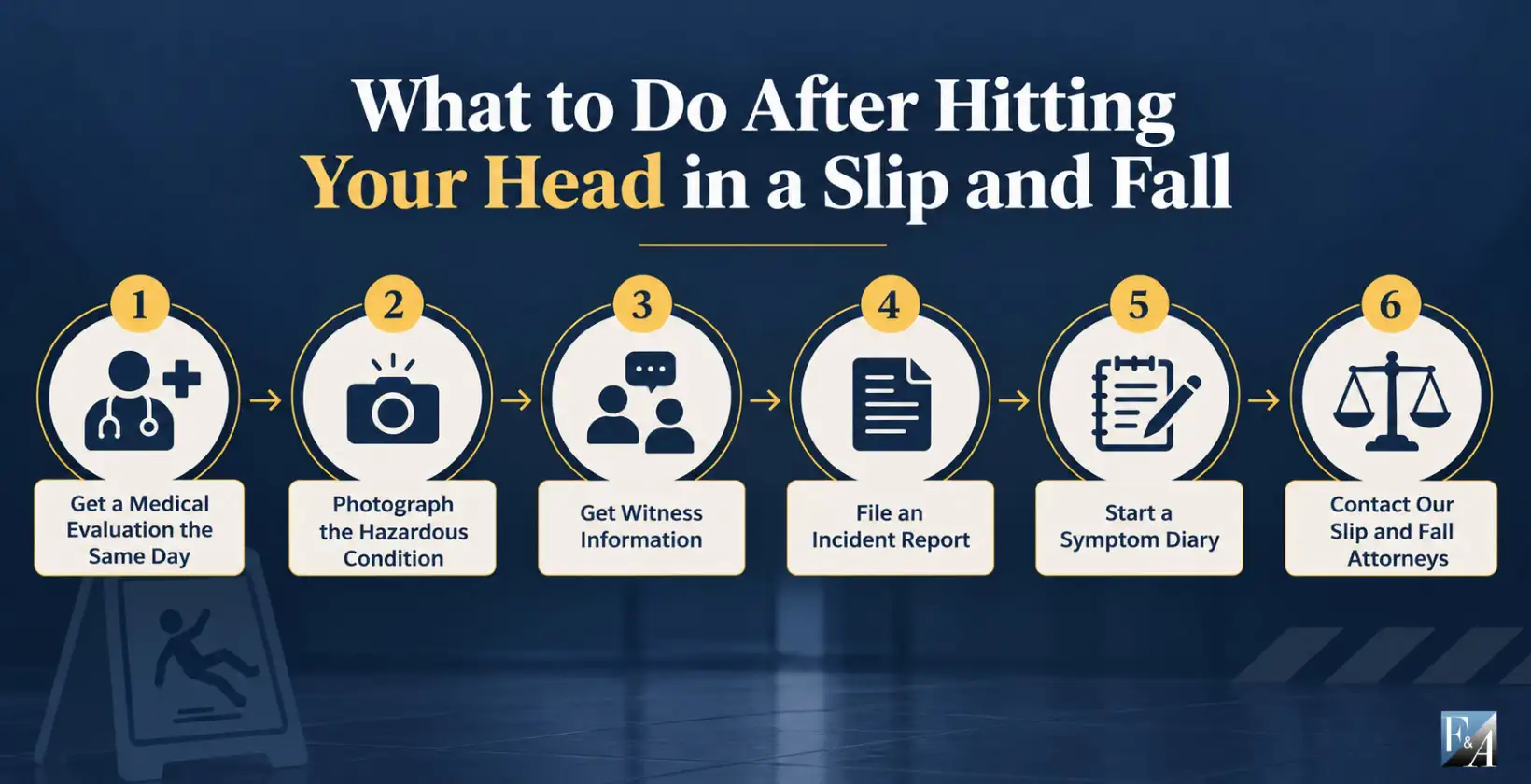
What to Do After Hitting Your Head in a Slip and Fall
Not all head injuries declare themselves at the scene. The steps you take in the hours and days after a fall matter just as much as what happens at the scene.
Step 1: Get a Medical Evaluation the Same Day
See a physician or visit an emergency department even if you feel fine. Tell the treating physician you fell and struck your head, describe every symptom, and ask about neuroimaging. That clinical record connects your injury to the fall date.
Step 2: Photograph the Hazardous Condition
Before you leave, photograph whatever caused the fall, whether a wet floor, broken pavement, missing handrail, or absent warning sign. Time-stamp everything.
Step 3: Get Witness Information
Get the names and contact information of anyone who saw the fall or was nearby. Note the exact date, time, and location. Witnesses become harder to locate the longer you wait.
Step 4: File an Incident Report
Report the fall to the property owner, store manager, or building superintendent before leaving and get a written copy. Do not give a recorded statement to an insurance adjuster without speaking to an attorney first.
Step 5: Start a Symptom Diary
Starting the day after the fall, write down every symptom, when it started, and how it changed. A symptom diary documents the gap between how you functioned before the fall and how you function now, in a way medical records alone cannot.
Step 6: Contact Our Slip and Fall Attorneys
Our team can send a preservation demand for surveillance footage before it is overwritten, identify all liable parties, and advise you on the deadlines that apply to your specific claim. In New York City, some deadlines are as short as 90 days.
Why Choose Frekhtman & Associates for Slip and Fall Head Injury Victims
At Frekhtman & Associates, we know insurers routinely dispute cognitive and emotional deficits that don’t show up on a standard CT scan, whether the cause was a fall or gas inhalation and lasting brain damage from a workplace incident. We understand both the medicine and the litigation strategy it takes to win these cases.
- Proven Results: We have recovered over $900 million for injured New Yorkers across premises liability and traumatic brain injury cases.
- Trial-Ready Preparation: Our lawyers prepare every case as if it is going to trial. That reputation affects every offer we receive on your behalf.
- TBI-Specific Experience: Our team has handled traumatic brain injury cases across all five NYC boroughs for over 27 years. We know which experts move the needle and how to document deficits that standard imaging cannot capture.
- Neuropsychological Expert Network: We work with neuropsychologists and life-care planners who translate cognitive impairment into a damages record that holds up at trial.
- Bilingual Support: Our team serves clients in English and Spanish. You will never navigate a brain injury claim without fully understanding every step.
- No Upfront Costs: You pay nothing unless we recover compensation. No consultation fees, no retainer, no out-of-pocket costs.
Contact us for a free case review.
Frequently Asked Questions
Do I Need to See a Doctor If I Feel Fine After Hitting My Head?
Yes. See a doctor the same day, even if you feel fine. Epidural hematoma produces a lucid interval before deterioration. Chronic subdural hematoma can develop over days or weeks. Post-concussion syndrome often does not peak until well after the fall. A same-day evaluation creates a medical record connecting your symptoms to the fall date. Without it, your treatment path and any legal claim become harder to support.
How Long Do Slip and Fall Head Injury Symptoms Last?
It depends on the injury type. A typical concussion resolves within two to four weeks with rest. Post-concussion syndrome can persist for three to twelve months or longer. Contusions, hematomas, and fractures requiring surgery often mean six months to a year or more. Diffuse axonal injury can result in permanent neurological changes.
Can I Have a Brain Injury Without Losing Consciousness?
Yes, loss of consciousness is not required for a traumatic brain injury diagnosis. Many concussions occur without it, producing only a brief feeling of being dazed. Diffuse axonal injuries, contusions, and subdural hematomas can all develop without unconsciousness. If you struck your head and experience any neurological symptoms afterward, get evaluated regardless of whether you blacked out.
What Evidence Do I Need for a Slip and Fall Head Injury Claim?
Photographs, an incident report, witness information, surveillance footage, medical records, a symptom diary, and employment records. In serious TBI cases, neuropsychological testing results and a life-care plan become the most important exhibits. Preserve everything as early as possible.
What Tests Will the Doctor Run After a Slip and Fall Head Injury?
A CT scan first, followed by an MRI if symptoms persist. CT identifies most acute bleeds, fractures, and contusions quickly enough to guide emergency treatment. MRI with susceptibility-weighted sequences is more sensitive for diffuse axonal injury and small contusions. Physicians also assess neurological function using the Glasgow Coma Scale on arrival.
Who Pays My Medical Bills After a Slip and Fall Head Injury?
Your health insurance covers treatment while the claim is pending. A premises liability claim seeks reimbursement of those costs as economic damages, along with future medical expenses. In workplace fall cases, workers’ compensation covers medical treatment regardless of fault. Our team can identify all available coverage sources and structure the claim accordingly.
Suffered a Head Injury in a New York Slip and Fall?
The window to build a strong claim closes faster than most people expect. Evidence gets overwritten, witnesses forget details, and New York’s 90-day municipal deadline catches more people off guard than any other rule in premises liability law. At Frekhtman & Associates, founding attorney Arkady Frekhtman has handled slip and fall head injury cases across New York City for over 27 years. New York law gives you the right to pursue compensation for medical costs, lost wages, and the lasting impact on your life.
Call (866) 288-9529 for a free same-day case evaluation across Manhattan, Brooklyn, the Bronx, Queens, and Staten Island.
No fee unless compensation is recovered.
Prior results do not guarantee a similar outcome.