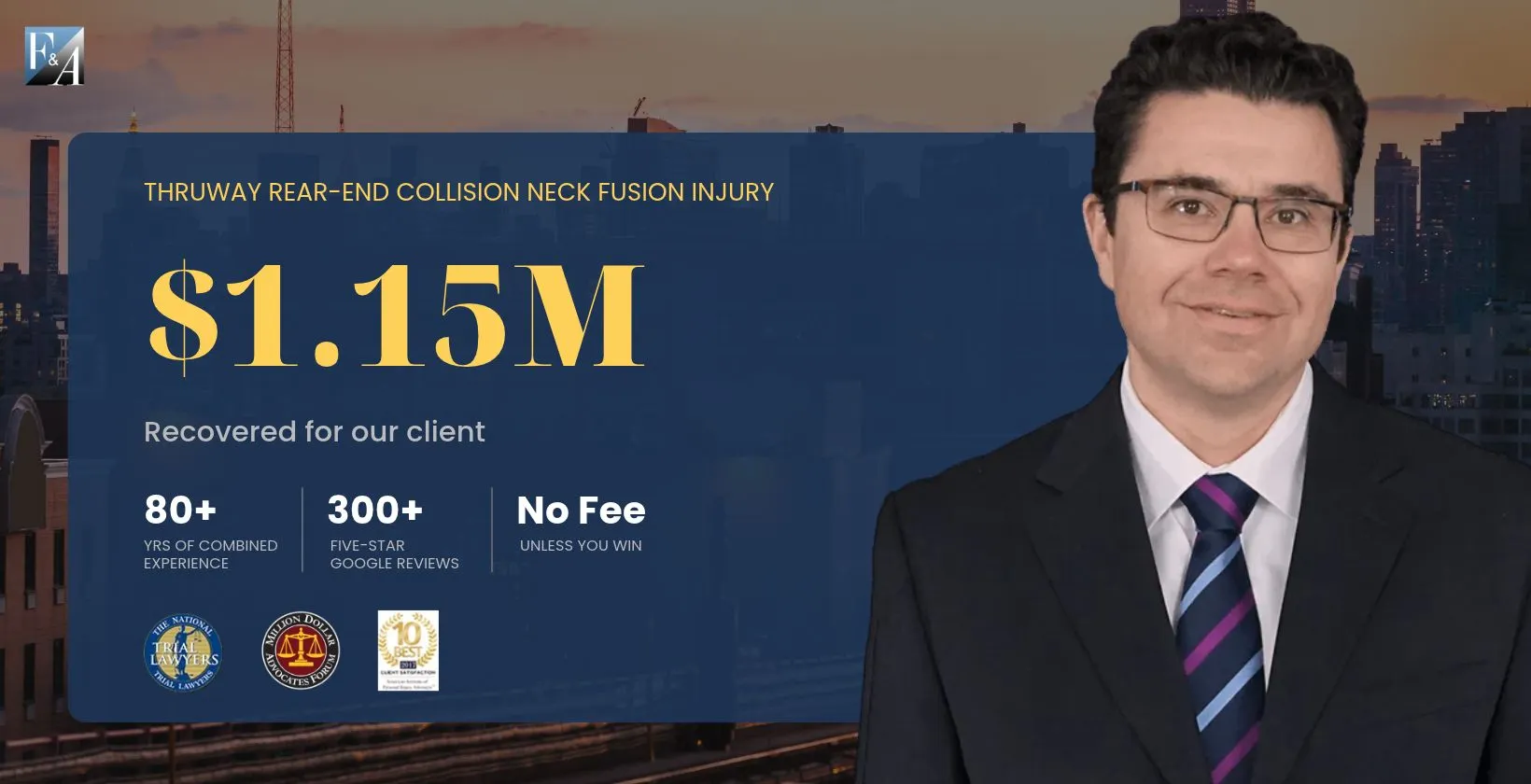
A 50 year old Rockland County woman suffered serious neck, shoulder, and nerve injuries when a distracted driver swerved into her lane and struck her SUV from behind on the New York State Thruway. Despite the driver’s admission that he was looking for a falling water bottle instead of watching the road, the defense challenged the severity and cause of her injuries. Following cervical fusion surgery, shoulder surgery, and significant disruption to her cleaning business, Frekhtman & Associates secured a $1,150,000 settlement.
A Distracted Driver Causes a Serious Highway Collision on Interstate 87
On a clear, dry afternoon in October 2023, a 50 year old woman was driving northbound on Interstate 87, also known as the New York State Thruway, in Rockland County.
She was traveling in the right lane in light traffic and had maintained her lane for several minutes.
Behind her, another driver was traveling in the center lane in a passenger sedan.
According to his own testimony, the driver reached into his vehicle’s console to retrieve a water bottle.
During this movement, he apparently struck the gear shift.
As the water bottle fell, he attempted to catch it.
While reaching for the bottle, he pulled his steering wheel to the right.
His vehicle swerved into the plaintiff’s lane and struck the rear of her SUV.
The impact was severe.
Vehicle data indicated that the plaintiff was traveling approximately 53 miles per hour while the other vehicle struck her at approximately 72 miles per hour.
The defendant admitted that he had been looking at the falling water bottle rather than the roadway.
He testified that he first saw the plaintiff’s vehicle at the moment of impact.
He also acknowledged that his foot was on the accelerator in the seconds leading up to the collision.
Both vehicles were totaled.
What began as an ordinary drive on the Thruway resulted in serious spinal and shoulder injuries, two major surgeries, and lasting consequences for the plaintiff’s livelihood.
Serious Cervical Spine, Shoulder, and Nerve Injuries
Following the collision, the plaintiff was transported by ambulance to an emergency department.
She complained of pain involving her neck, back, and shoulder.
After receiving initial treatment, she was discharged home.
However, her symptoms continued.
Over the following months, diagnostic imaging and nerve testing identified significant injuries involving her cervical spine, right shoulder, and lower back.
Her cervical MRI revealed disc protrusions at C4 C5 and C6 C7.
Imaging also identified a disc osteophyte complex at C5 C6, accompanied by spinal canal stenosis and foraminal narrowing.
Electrodiagnostic testing was interpreted by her pain management physician as demonstrating bilateral C5 C6 radiculopathy.
These findings were associated with nerve related symptoms affecting her upper extremities.
Her right shoulder imaging revealed partial thickness tears involving the subscapularis tendon and biceps tendon.
Additional lumbar imaging identified disc bulges at L3 L4 and L5 S1, along with a disc protrusion at L4 L5.
The combination of spinal injuries, nerve symptoms, and shoulder damage significantly affected her ability to perform physically demanding activities.
Her symptoms persisted despite an extended course of conservative treatment.
Conservative Treatment Fails, Leading to Cervical Spinal Fusion
Following the accident, the plaintiff attempted several forms of nonsurgical treatment.
Her care included physical therapy, medication, and a cervical epidural steroid injection.
These treatments failed to provide meaningful or lasting relief.
Her symptoms continued interfering with daily activities and her ability to work.
Before surgery, her treating spine surgeon determined that she was temporarily totally disabled and unable to perform her job.
In April 2024, approximately six months after the collision, she underwent an anterior cervical discectomy and fusion at C5 C6.
The procedure involved removing the damaged cervical disc and stabilizing the affected spinal segment.
During surgery, her physician identified a herniated disc fragment pressing against a nerve root.
The surgeon also observed adhesions tethering the nerve roots.
These operative findings became important evidence in the litigation because the defense disputed whether she had sustained a significant traumatic cervical injury.
Despite the surgery, the plaintiff continued experiencing pain and physical limitations.
Her treatment was not finished.
She would require another major procedure involving her right shoulder less than two months later.
Right Shoulder Surgery and Continuing Arm Pain
Following her cervical fusion, the plaintiff continued experiencing significant right shoulder symptoms.
Her shoulder injuries included tendon damage and restricted movement.
She eventually underwent arthroscopic shoulder surgery.
The procedure involved debridement of labral and rotator cuff tears, release of a frozen shoulder capsule, removal of a loose body, and surgical decompression.
The operation addressed multiple sources of pain and dysfunction within the shoulder.
However, her symptoms did not immediately resolve.
Months after the procedures, she continued reporting neck and shoulder pain radiating down her right arm and into her fingers.
She also experienced ongoing weakness and difficulty using her arm for ordinary activities.
The combined effects of her cervical and shoulder injuries created substantial limitations, particularly because her work required repetitive physical movement and upper body strength.
From Cleaning Five or Six Homes Daily to Struggling to Maintain Her Business
Before the collision, the plaintiff owned and operated a residential cleaning business.
She had spent years building relationships with customers, including clients who had relied on her services for more than a decade.
Her work was physically demanding.
On a typical day, she cleaned approximately five or six homes.
The job required lifting, bending, reaching, scrubbing, and repetitive use of her arms and shoulders.
Following the accident, her physical limitations prevented her from maintaining the same workload.
She could manage only one to three homes per day.
Her injuries also affected basic personal care.
She testified that she could no longer comfortably wash her hair, brush her teeth, or lift heavy objects with her right arm.
Tasks she had previously performed without difficulty became painful and exhausting.
The reduction in her ability to work also created financial problems.
When her no fault insurance benefits were exhausted, she reported that she could no longer afford the follow up care and physical therapy recommended by her doctors.
The ongoing pain and loss of independence affected her emotionally as well.
During an examination performed by a defense medical expert, she became emotional while describing her daily struggles.
She explained that she lived with constant pain and that the collision had fundamentally changed her life.
The plaintiff’s case emphasized that the consequences extended beyond the surgeries.
They included reduced earning capacity, financial strain, interrupted medical care, chronic pain, and significant changes to her ability to manage her business and everyday responsibilities.
Establishing the Distracted Driver’s Responsibility for the Collision
Frekhtman & Associates pursued a negligence claim against the driver who struck the plaintiff’s SUV.
The central liability issue concerned the defendant’s failure to maintain attention to the roadway and control of his vehicle.
Several important pieces of evidence supported the plaintiff’s position.
The defendant admitted he was distracted.
He testified that he had reached for a water bottle and was watching it fall rather than observing the traffic ahead.
The driver swerved into the plaintiff’s lane.
According to the defendant’s account, he inadvertently pulled the steering wheel to the right while attempting to retrieve the bottle.
The defendant did not see the plaintiff’s SUV until impact.
He acknowledged that he first observed her vehicle when the collision occurred.
Vehicle data documented the speed of the collision.
The plaintiff’s SUV was traveling approximately 53 miles per hour, while the defendant’s vehicle was traveling approximately 72 miles per hour.
Dash camera footage captured the collision.
Video evidence showed the defendant’s sedan swerving into the right lane and striking the rear of the plaintiff’s vehicle.
The plaintiff’s legal team moved for summary judgment on liability.
The motion sought a ruling that the defendant was legally responsible for causing the accident without requiring a jury to resolve that issue at trial.
The plaintiff maintained that the defendant failed to keep a proper lookout, failed to maintain control of his vehicle, and caused the collision through inattentive driving.
His own testimony and the available video and vehicle data became central components of the liability case.
Overcoming a Defense That Blamed the Plaintiff for the Crash
The defendant initially contested liability.
The defense alleged that the plaintiff had stopped suddenly and without warning.
It also asserted that she failed to use her seat belt and that her own conduct contributed to the accident.
These allegations were disputed by the plaintiff.
She maintained that she had been traveling steadily in the right lane for several minutes before the defendant swerved into her vehicle.
The defendant’s own testimony described his distraction immediately before the collision.
Dash camera footage also documented the sedan moving into her lane and striking the rear of her SUV.
The plaintiff relied on this evidence to support her position that the defendant’s inattentiveness caused the collision.
The defense further argued that she had not sustained a qualifying serious injury under New York’s no fault insurance law.
This created an additional dispute concerning the nature and extent of her injuries.
A Defense That Disputed the Medical Necessity of Her Neck Fusion
The defense challenged whether the accident caused injuries serious enough to require cervical spinal fusion.
An examining neurosurgeon retained by the defense reviewed her condition and concluded that the C5 C6 findings were mild and degenerative.
He argued that the abnormalities predated the crash and that the imaging did not demonstrate nerve compression sufficient to justify surgery.
The defense expert also questioned the significance of the electrodiagnostic testing.
He maintained that the nerve findings were more consistent with peripheral nerve compression than a cervical injury caused by the collision.
The defense physician concluded that the plaintiff may have sustained only sprains involving her neck and upper back.
The plaintiff’s treating spine surgeon strongly disagreed.
He maintained that the collision caused the injuries responsible for her symptoms and disability.
The findings observed during the April 2024 surgery became particularly significant.
The surgeon documented a herniated disc fragment impinging on a nerve root and adhesions affecting the nerve roots.
The plaintiff relied on these operative findings, her diagnostic studies, treatment history, and continuing limitations to support her damages claim.
She also maintained that she did not have a relevant preexisting condition that had been aggravated by the crash.
The medical dispute became a major issue because the defense sought to minimize the nature and severity of her cervical spine injuries despite her surgery and ongoing symptoms.
$1,150,000 Settlement Despite Disputed Medical Evidence
Despite challenges concerning liability, medical causation, and the severity of her injuries, Frekhtman & Associates successfully resolved the case for $1,150,000.
The settlement provided substantial compensation to a working mother and business owner who underwent cervical spinal fusion, right shoulder surgery, and extensive medical treatment following the collision.
Her injuries reduced her ability to operate her cleaning business and left her dealing with chronic pain, weakness, and physical limitations.
The case involved important evidence concerning the defendant’s distraction, including his own admissions, dash camera footage, and vehicle speed data.
It also required addressing competing medical opinions concerning spinal degeneration, nerve compression, and the necessity of surgical treatment.
The result illustrates how a few seconds of distraction can cause serious injuries and lasting financial consequences.
It also demonstrates the importance of preserving objective accident evidence and obtaining thorough medical documentation when the defense disputes the extent or cause of an injury.
Why This Case Matters for New York Car Accident Victims
This case highlights several important considerations in serious motor vehicle accident claims involving distracted driving.
Distracted driving can cause devastating highway collisions.
Even brief actions such as reaching for an object inside a vehicle can divert a driver’s attention and result in a serious crash.
Dash camera footage and vehicle data can become critical evidence.
In this case, video footage, recorded speed information, and the defendant’s testimony helped establish the circumstances surrounding the collision.
Rear end collisions can cause injuries requiring major surgery.
Cervical disc damage, nerve compression, and shoulder injuries may require extensive treatment, including spinal fusion and arthroscopic surgery.
Preexisting degeneration does not automatically eliminate a driver’s responsibility.
Medical evidence can help establish whether a collision caused new injuries or aggravated an existing condition.
Serious injuries can threaten the livelihood of business owners.
For people whose work depends on physical labor, lasting neck, shoulder, and arm limitations may significantly reduce their ability to earn income and operate their businesses.
For this Rockland County woman, a distracted driver’s actions resulted in two major surgeries, chronic pain, and lasting disruption to the cleaning business she had spent years building.
The case ultimately resolved for $1.15 million.
Injured in a Rear End Collision or Distracted Driving Accident in New York?
Distracted driving, unsafe lane changes, and failure to maintain proper attention on the roadway can cause serious injuries to drivers and passengers.
The attorneys at Frekhtman & Associates represent individuals and families throughout New York in serious motor vehicle accident cases, rear end collisions, distracted driving crashes, and catastrophic spinal injury claims.
If you or a loved one suffered injuries in a collision caused by another driver’s negligence, contact our firm for a No Obligation Case Review.
No fee unless we win.
Attorney Advertising. Prior results do not guarantee a similar outcome. Each case depends on its own facts and circumstances. The settlement represents a negotiated resolution, not a judicial finding of liability.